Solid-state batteries were never really stuck on range or safety — they were stuck on how fast they wore out. BYD just filed a patent that goes straight at that one number, and if the claim holds, it could hand US drivers a battery that outlasts the car it’s bolted into.
For a decade, “solid-state” has been the battery world’s version of a promise that never arrives. Every year it’s five years away. On July 28, 2026, China’s National Intellectual Property Administration published a new BYD patent that doesn’t promise a future car — it targets the single, unglamorous problem that has kept solid-state locked in the lab: cycle life. Here’s what that means, why it broke solid-state, and how BYD’s claim measures up against the batteries in the driveway today.

What “cycle life” actually means — and why it’s the number that matters
A charge cycle is one full discharge and recharge of a battery’s capacity. Cycle life is how many of those a pack can take before its capacity fades to 80% of new — the industry’s standard “end of useful life” mark. At that point the car still drives; it just doesn’t go as far on a charge.
Range grabs the headlines, but cycle life is the quiet metric that decides whether a battery outlives your car or dies in your driveway. Multiply cycles by miles-per-charge and it gets real fast: a 250-mile pack rated for 2,000 cycles is roughly 500,000 miles of throughput before it hits that 80% line — far beyond how long most Americans keep a car.
Cycle life = the barrier
hardest solid-state problem
Why solid-state batteries kept failing the cycle-life test
In a normal lithium-ion cell, a liquid electrolyte flows around and touches everything, so contact is never the issue. Make everything solid and the physics turns hostile. Solid particles press against solid particles, and every time the battery charges and discharges, those materials expand and contract. Tiny gaps open up, contact is lost, internal resistance climbs, and the cell degrades — cycle after cycle. That’s the whole industry’s headache, not just BYD’s.
“Solid–solid interface stability is one of the main obstacles to industrializing this technology” — the tech is still in a “tackling stage,” says BYD Group Chief Scientist Lian Yubo.
In other words, the reason we’re not already driving solid-state EVs isn’t energy density or fire risk — it’s that the batteries fell apart too soon. Fix the interface, and you fix cycle life.
BYD’s fix: two electrolytes, one cathode
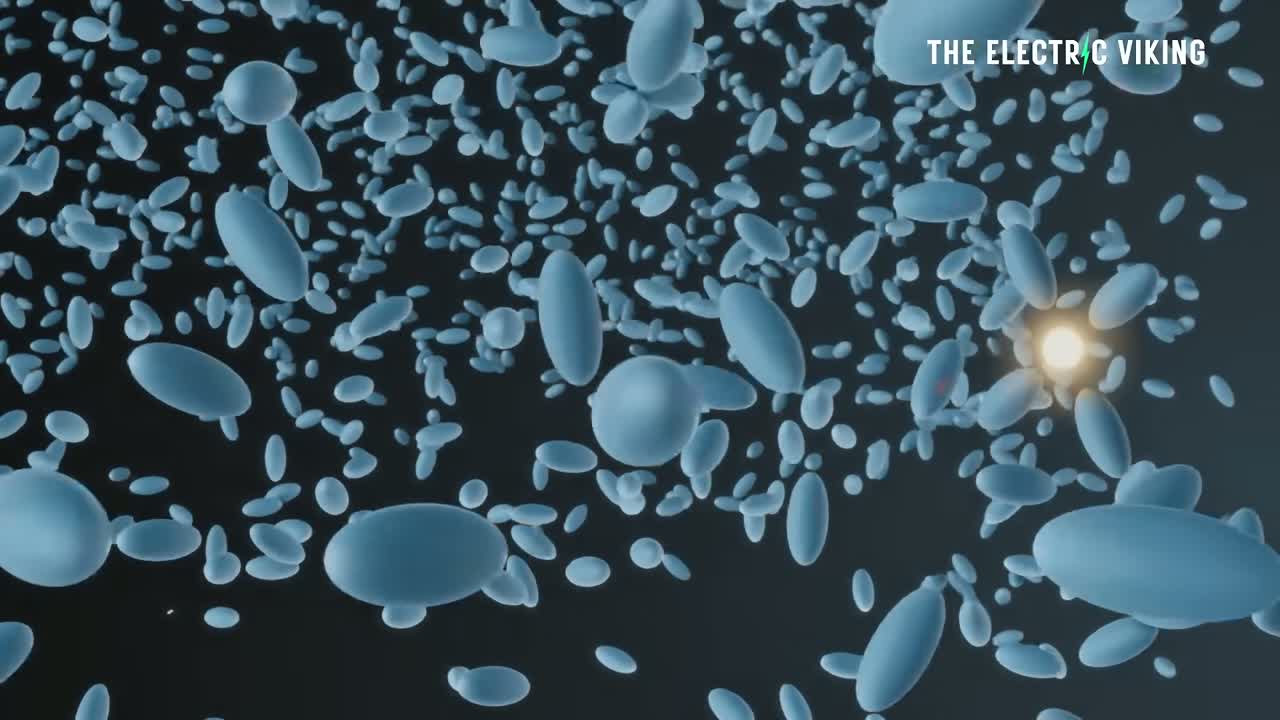
BYD’s patent (application CN202510126712.6, publication CN122474592A) describes what it calls a dual-electrolyte cathode. Instead of one solid electrolyte, it packs smaller halide-electrolyte particles into the gaps between larger sulfide-electrolyte particles, all mixed with the cathode active material. Think of pouring sand into a jar of pebbles: more contact points, fewer gaps, steadier performance over thousands of cycles.
There’s real lab science behind the idea. Research led by Wu Fan at the Institute of Physics, Chinese Academy of Sciences, found that smaller sulfide-electrolyte particles improved capacity retention by nearly 18 percentage points versus larger particles under equivalent conditions. That’s not a rounding error — it’s the difference between a pack that fades and one that lasts. BYD’s Lithium Battery CTO, Sun Huajun, has said the cathode active material proportion in its all-solid-state architecture already exceeds 85%, a sign the company is grinding through every layer of the problem, not just this one.
And this patent doesn’t stand alone. In May 2026 BYD filed for a composite solid-electrolyte membrane that weaves inorganic particles into a polymer fiber network, on top of earlier cathode-composite and dual-layer coating filings. As of early 2026, BYD’s solid-state patent applications had reportedly passed 1,200 — a portfolio, not a one-off.
Capacity retention gain (smaller sulfide particles, lab)
+18 pts
How BYD’s claim stacks up against today’s batteries
Here’s the headline number: BYD is targeting a solid-state cell rated for up to 10,000 cycles, roughly double its own second-generation Blade battery, which is rated around 4,500 cycles. Pair that with 400 Wh/kg energy density (today’s best liquid cells sit near 250–300 Wh/kg) and a 10-to-80% charge in about 10 minutes, and you can see why it’s getting attention. The catch: these are target specs tied to a technology roadmap, not measured results from a shipping product.
| Battery chemistry | Typical cycle life (to 80%) | Energy density | Status |
|---|
| NMC (nickel-manganese-cobalt) | 1,000–2,000 cycles | ~250–300 Wh/kg | Mainstream US/EU EVs |
| NCA (nickel-cobalt-aluminum) | 1,000–1,500 cycles | ~260–300 Wh/kg | Some premium long-range EVs |
| LFP (lithium iron phosphate) | 2,000–5,000 cycles | ~160–200 Wh/kg | Standard-range EVs, storage |
| BYD Blade v2 (LFP) | ~4,500 cycles (rated) | ~150–180 Wh/kg | Shipping today |
| BYD solid-state (claim) | Up to 10,000 cycles | ~400 Wh/kg | Patent / roadmap |
Read the table and the story is clear: even the best liquid NMC packs tap out around 1,000–2,000 cycles to 80%. BYD’s own LFP Blade already crushes that at ~4,500. A credible 10,000-cycle solid-state cell wouldn’t just win on range and charging — it would roughly double the lifespan floor of the most durable chemistry BYD ships today.
The rest of the field: Toyota, QuantumScape, Samsung SDI
BYD isn’t alone, and the cross-company picture is the best sanity check on its numbers. Toyota broke ground with Idemitsu Kosan on a sulfide-electrolyte pilot plant in early 2026, quoting a projected 1,200 km (~750 mi) range and a sub-10-minute charge, with limited EVs targeted for 2027–2028. Samsung SDI’s engineering sample points to a 600-mile range, a 9-minute charge, roughly 500 Wh/kg, and a claimed 20-year life, with mass production aimed at the second half of 2027.
Most telling for the cycle-life question: QuantumScape reported in April 2026 that its multi-layer cells completed 1,000 full cycles with over 95% energy retention — a genuinely strong result for the exact failure mode that has broken solid-state before. Different labs, different chemistries, same message: cycle life is finally the metric everyone is chasing, and everyone is starting to move the needle.
| Program | Cycle / retention claim | Energy density | Consumer timeline |
|---|
| BYD (sulfide + halide) | Up to 10,000 cycles (target) | ~400 Wh/kg | ~1,000 demo cars 2027; ~40,000 by 2030 |
| Toyota (sulfide) | ~2,000 cycles reported | ~500 Wh/kg | Limited EVs 2027–2028 |
| Samsung SDI (sulfide) | ~20-year life claim | ~500 Wh/kg | Mass production H2 2027 |
| QuantumScape (oxide separator) | 1,000 cycles, >95% retention | ~400 Wh/kg | Small batch ~2027; volume 2029–2030 |
What it means for US EV buyers — and when
Here’s BYD’s own roadmap, grounded to what’s been disclosed. Demonstration vehicles arrive in 2027 — roughly 1,000 high-end cars, likely under the YangWang supercar brand, with a claimed range over 1,200 km WLTP (about 750 miles). The plan then scales to around 40,000 vehicles by 2030 at a target cost of $70/kWh, the point at which BYD says solid-state could reach cost parity with today’s NMC packs.
For an American shopper, translate that plainly: nothing you can buy in a US showroom in 2026 or 2027 will have this battery. The realistic window for solid-state in mainstream, US-available EVs is early-2030s, and even that assumes the manufacturing yields hold. It also lands in a tougher market — the $7,500 federal EV tax credit expired on 2025-09-30, so the value case will rest on range, charging on NACS/Superchargers, and longevity rather than a checkout discount.
How close is showroom-ready solid-state?
early-2030s
Keep the skeptic’s hat on, because BYD did. A patent is not a production line; the filing includes no vehicle testing data. CATL Chairman Robin Zeng has said mass-market solid-state is still years away, pegging the tech’s maturity at roughly level 4 of 9. He may be right, he may be wrong — but this is how it actually happens: not with one miracle announcement, but patent by patent, problem by problem. And when BYD finally solves a problem, it doesn’t put it in a museum — it puts it in an affordable car. That’s what should worry the competition.
Will a 10,000-cycle battery outlast my car?
Almost certainly. At roughly 200–250 miles per full cycle, 10,000 cycles pencils out to well over 2 million miles of energy throughput before hitting the 80% capacity mark — many times the life of the vehicle around it. In practice, calendar aging (years, not cycles) and the rest of the car would give out first. The bigger unknown isn’t whether 10,000 cycles is useful; it’s whether BYD hits that number in a mass-produced cell rather than a lab sample.
So here’s the question worth chewing on: if your next EV came with a battery engineered to outlast two of today’s cars, would you keep it longer — or does a decade-plus of ownership change nothing about how you’d shop? Tell us where you land.
Related reading on EVCUBE
Sources