Most of the times you grab the wheel from Full Self-Driving, the car was not about to crash. It was about to take the wrong road. Tesla’s Summer 2026 update is the first release that goes after that specific problem — and it exposes how badly the industry’s favorite safety number has been misread.
Two completely different things wear the same label
Every autonomy debate eventually collapses into one number: miles between disengagements. It gets quoted like a physics constant. It is not. It is a bucket that holds two events which have almost nothing to do with each other.
The first is a safety takeover — the car misread a shadow, hesitated at a merge, drifted toward a curb, and you intervened. That is the event regulators care about, and it is the event behind the federal investigation currently sitting on Tesla’s desk.
The second is a preference takeover. The car was going to do something legal, safe, and entirely competent, and you overrode it because you did not want to go that way. An unprotected left across four lanes that FSD can absolutely execute — but that makes your passenger grip the door handle. A shortcut through a construction zone you have been avoiding for six months because of the debris. A route that is 90 seconds faster on paper and 10 minutes worse in practice.

Both events increment the same counter. Only one of them is a software failure. And for a mature supervised system, the second category is almost certainly the larger one — which is why Tesla’s Summer 2026 release, announced July 21 and rolling out in batches since, is more interesting than its feature list suggests.
A disengagement counter cannot tell the difference between “you were about to hit that” and “I don’t like that left turn.”
What Tesla actually shipped
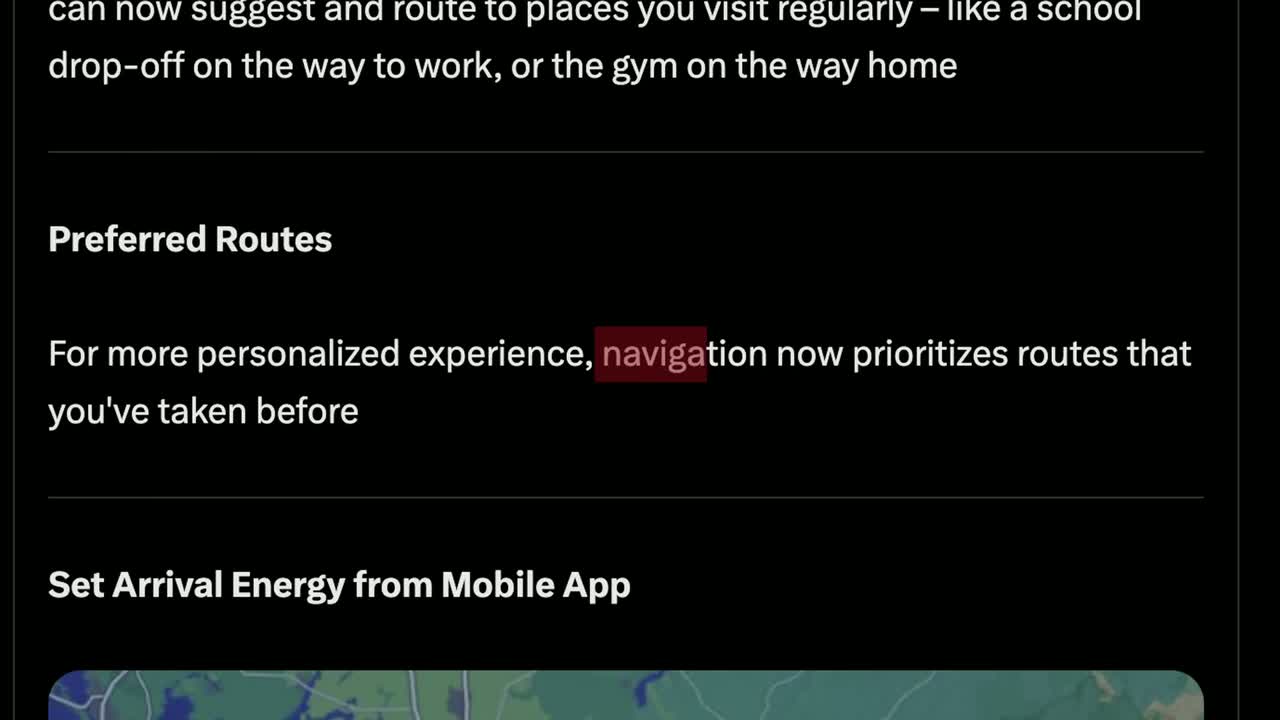
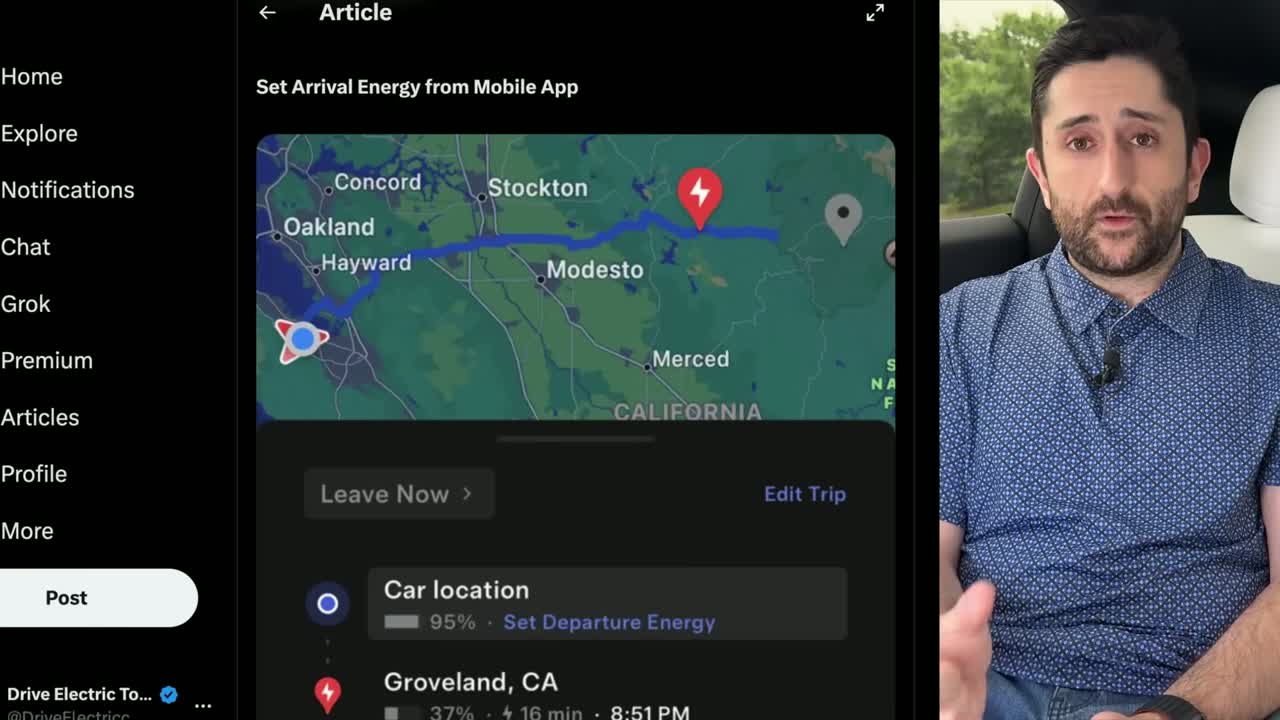
The headline feature is Preferred Routes. Tesla’s own wording: navigation “now prioritizes routes that you’ve taken before.” Because FSD reads its turns, lane choices and exits directly off the navigation line, changing what navigation picks changes what the car drives.
Sitting next to it is an expanded Automatic Navigation. Before this release, destination prediction was limited to Home, Work, and calendar entries with a valid address. That covers a commute and almost nothing else. The update adds frequently visited places — the school drop-off before work, the gym on the way home, the same coffee stop every weekday morning.
The rest of the release circles the same target from different angles.
| Summer 2026 feature | Which kind of takeover it targets | Why it matters for FSD |
|---|
| Preferred Routes | Preference | Removes the single biggest reason drivers override a working system |
| Automatic Navigation (routines) | Preference | Fewer manual destination entries means fewer mid-drive corrections |
| Self-Driving visualization zoom | Confidence | Lets the driver read intent earlier, reducing precautionary grabs |
| Expanded Grok commands (calls, music, climate, glovebox) | Attention | Keeps hands off the touchscreen while supervising |
| Self-Driving Stats in the mobile app | Measurement | First owner-facing dataset on how much FSD is actually used |
| Camera preview out of Park | Diagnostics | Spot a dirty or blocked camera before it degrades performance |
Read the table top to bottom and a pattern shows up. Only one row is about the driving stack. Everything else is about the layer between the driver and the driving stack — routing, visibility, attention, feedback. Tesla spent a release cycle on the human half of the loop.

The numbers, compared across brands and across time
Tesla’s FSD (Supervised) Vehicle Safety Report is the company’s own scoreboard, and the scale is genuinely hard to argue with: roughly 12.9 billion cumulative miles on FSD-capable vehicles, of which about 4.97 billion were driven with FSD engaged. Tesla claims 7x fewer major collisions, 7x fewer minor collisions and 5x fewer off-highway collisions versus the estimated US average, and frames that as an 80%+ reduction in collision likelihood.
Now put that next to the only company operating without a human in the seat.
| Metric | Tesla FSD (Supervised) | Waymo (rider-only) |
|---|
| Cumulative miles | ~4.97 billion with FSD engaged | 220.6 million, no safety driver (through March 2026) |
| Human in the loop | Required at all times | None |
| Serious-injury-or-worse crashes vs human benchmark | Not published in this form | 94% fewer |
| Any-injury-reported crashes vs benchmark | Not published in this form | 82% fewer |
| Pedestrian-injury crashes vs benchmark | Not published in this form | 93% fewer |
| Typical miles between human interventions | ~500 (third-party fleet estimates) | ~14,000 (roughly 28x) |
| US footprint | Nationwide, consumer-owned | Five metros; 3,000-ish purpose-built vehicles |
That 28x gap looks damning until you remember what it measures. Waymo’s number counts remote-assist and fleet-response events inside a geofenced, HD-mapped service area. Tesla’s counts a human in Wichita deciding they would rather not take that left. You cannot compare a fleet metric to a preference metric and call the result a safety ranking — and this is precisely why the industry is walking away from disengagement rates altogether.
California is retiring the metric. Tesla just productized it.
Here is the part almost nobody connects. In February 2026 the California DMV reported that permitted autonomous vehicles logged more than 9 million test miles between December 1, 2024 and November 30, 2025 — and in the same announcement said it expects to finalize new rules in 2026 that replace disengagement reporting entirely.
The replacements are far more specific: law-enforcement noncompliance notices, dynamic-driving-task system failures under SAE J3016, vehicle immobilizations during driverless operation, hard-braking events producing a speed drop of 3 m/s or more at a deceleration above 5 m/s² for at least half a second on roads posted 35 mph and up, total vehicle miles traveled, and crash reporting aligned to NHTSA’s Standing General Order.
Notice what is missing from that list. There is no “the driver decided to take over.” The regulator that invented public disengagement reporting in 2014 concluded, twelve years later, that the metric was too noisy to mean anything.
And there is a second wrinkle: those California AV reports have never covered Tesla FSD in the first place. Disengagement reporting applies to SAE Level 3 and above under a testing permit. FSD (Supervised) is a Level 2 consumer feature. It is excluded. Which means that for the most-driven autonomy system in America, there is no regulator-grade public disengagement figure at all — every number you have seen quoted is either Tesla’s own telemetry or a community estimate.
The industry is quietly retiring the disengagement rate as a safety metric at exactly the moment Tesla started treating it as a product metric.
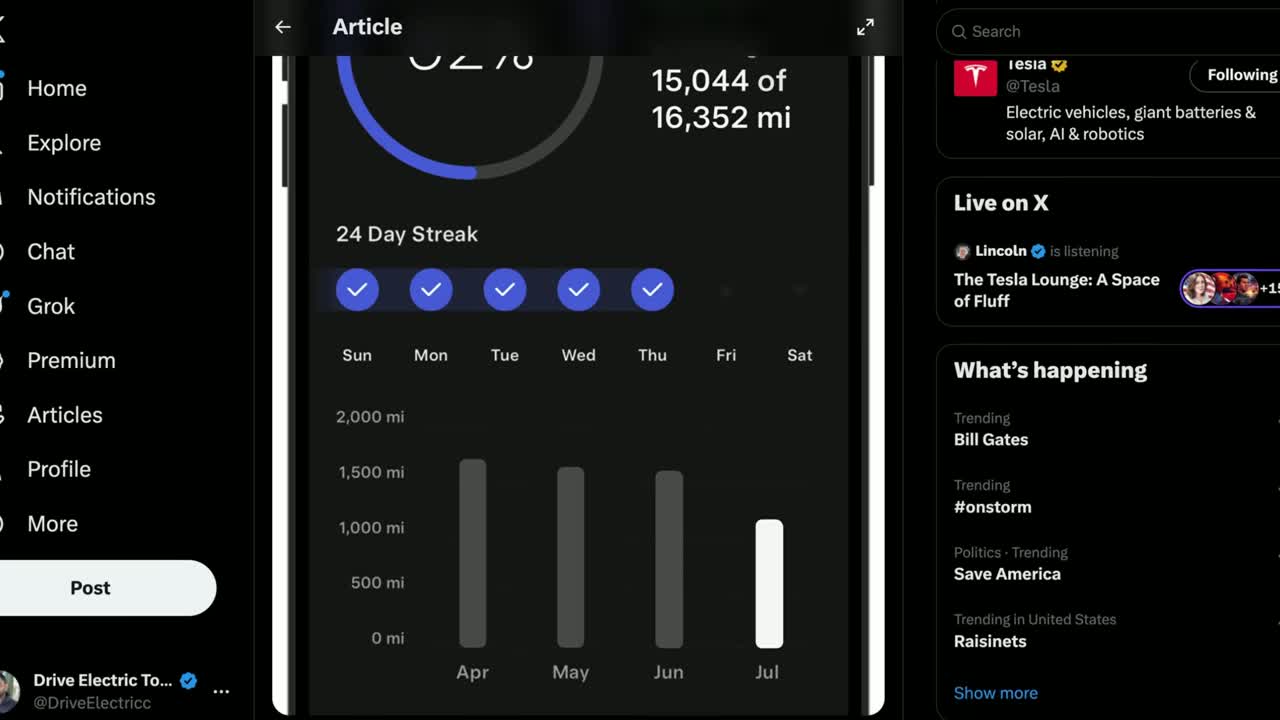
The new Self-Driving Stats panel in the mobile app is that shift made visible. FSD usage percentage, daily streaks, longest streak, total self-driving miles, a monthly graph, and a share button. That is not a safety disclosure. It is a gamified engagement dashboard — and it tells you exactly which number Tesla now wants to move.
Meanwhile, the safety half is still under federal review
None of this makes the safety category go away. NHTSA opened preliminary evaluation PE24031 in October 2024 covering roughly 2.41 million Teslas after four low-visibility crash reports. On March 18, 2026 the agency escalated it to engineering analysis EA26002, expanding coverage to about 3.2 million vehicles — Model S and X from 2016, Model 3 from 2017, Model Y from 2020, plus Cybertruck.
That is a 33% expansion in scope across seventeen months, and an engineering analysis is the last procedural step before a recall decision. The stated concern is narrow and technical: whether FSD’s degradation-detection system can recognize that sun glare, fog or airborne dust has compromised the cameras, and warn the driver with enough lead time. NHTSA has flagged nine candidate crashes, including one fatality and two injuries.
Preference takeovers addressed by Summer 2026
Safety takeovers addressed by Summer 2026
Open federal questions on low-visibility performance
So the honest read on this release: Tesla shipped a real fix for the larger, less dangerous half of the disengagement problem, and shipped nothing for the smaller, more dangerous half. Both statements are true at once, and most coverage of the update picks one and ignores the other.
What Preferred Routes still does not answer
Tesla used the word “prioritizes,” not “locks in.” Online routing still reacts to live traffic, and the company has not published how history is weighted against current travel time. If your habitual route is two minutes slower this morning, does FSD take it? Nobody outside Palo Alto knows, and that single threshold determines whether the feature works or quietly gets overruled every rush hour.
Three more open questions, none of them trivial:
- Learning speed. One trip? Three? Ten? A system that needs a month of repetition will not change behavior in the window where owners form an opinion.
- Profile separation. Two drivers, one car, opposite preferences. Does route history follow the driver profile and phone key, or does it blend into an average that satisfies neither?
- Multi-stop chaining. When the car predicts a school drop-off before work, does it build one route with two stops, or suggest them sequentially? Current behavior points to sequential, which means the feature still needs a mid-drive interaction — the exact thing it was supposed to eliminate.
There is also a quieter risk. A system trained on your history is a system trained on your mistakes. If you have spent two years taking a slower route out of habit rather than judgment, Preferred Routes will faithfully preserve that habit and cost you time forever. Personalization and optimization are not the same goal, and Tesla has now chosen the first one.
Does Preferred Routes change how FSD drives, or only where it drives?
Only where. The driving policy — how the car handles a given intersection, merge or lane change — is unchanged by this release. What changes is which intersections it encounters, because FSD executes turns and lane selections off the active navigation line.
Can I turn the destination prediction off?
Yes. Automatic Navigation lives under Controls → Navigation → Automatic Navigation. Suggestions are also non-binding — ignoring one and entering your own destination works the same as it always has.
Is the ~500-mile disengagement figure official?
No. Tesla does not publish a disengagement rate, and FSD is exempt from California’s AV disengagement reporting because it is an SAE Level 2 driver-assistance feature. That figure comes from third-party fleet analysis and should be read as an order-of-magnitude estimate, not a measurement.
The number to watch next
If Preferred Routes works, the visible effect will not be a safety statistic. It will be the FSD usage percentage in that new mobile app panel creeping upward — drivers leaving the system on through the stretch of road where they used to take over. Tesla built the measuring instrument and the intervention in the same release, which is either good product discipline or a convenient way to grade its own homework, depending on how charitable you feel.
Either way, the framing has shifted. For a decade the question was “how often does the car fail?” The more useful question for a supervised system with 4.97 billion engaged miles behind it is “how often does the driver disagree?” Those are different problems, they need different fixes, and Tesla just admitted as much by shipping one.
If the update has reached your car, the thing worth tracking is not whether the feature exists — it is how many trips it took before the car stopped suggesting the route you never drive.
Related reading on EVCUBE