Table of Contents
1. Introduction: The State of EV Fast Charging in the US
While the United States may not yet have the ultra-fast, five-minute EV charging capabilities seen in China, significant advancements are being made. The Porsche Taycan and the Lucid Gravity are leading the charge (pun intended!) in American EV fast-charging technology. These luxury EVs are engineered with high-voltage architectures, cutting-edge battery technology, and a relentless pursuit of efficiency, all aimed at minimizing charging times and maximizing your time on the road.
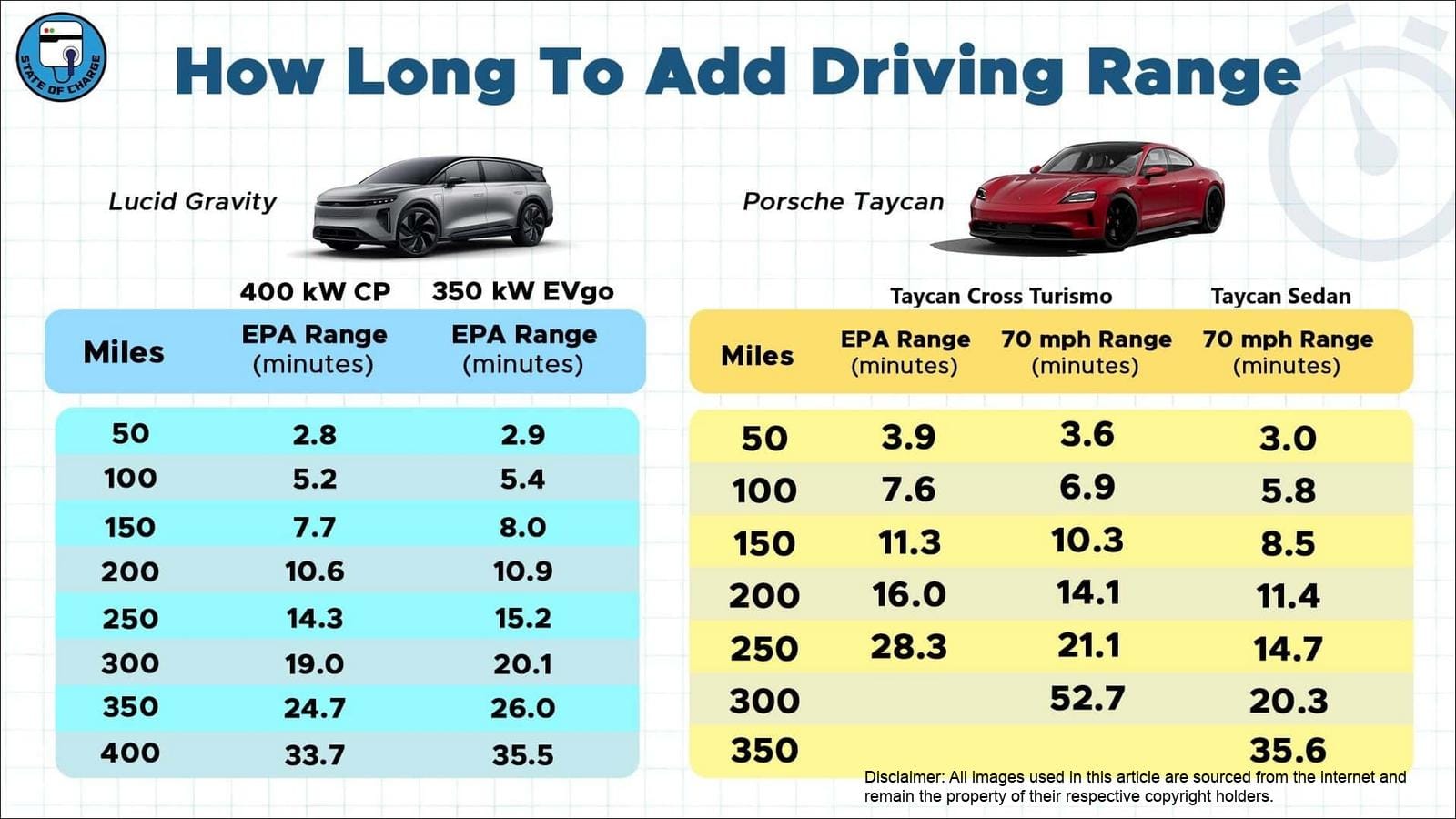
The Lucid Gravity, theoretically, can handle up to 400 kW of peak charging power, while the Porsche Taycan is rated for up to 320 kW. To see how these numbers translate to real-world performance, a head-to-head test was conducted to determine which vehicle truly reigns supreme in the realm of EV fast charging.
2. The Charging Showdown: Taycan vs. Gravity
Tom Moloughney, InsideEVs Contributing Editor and host of the State of Charge YouTube channel, orchestrated a real-world charging test between the Porsche Taycan and the Lucid Gravity. This test sought to determine which of these EVs could charge faster under identical conditions. As Tom put it, this was essentially an “EV charging drag race.”
According to the U.S. Department of Energy, the average DC fast-charging session in America takes about 42 minutes. However, this time can vary significantly based on factors like battery size, initial state of charge, charger speed, and even the weather. Many EVs, like the Kia EV6, can charge from 10% to 80% in approximately 20 minutes on a 350 kW charger. The charging curve, which indicates how long a vehicle can maintain its maximum charging speed, also plays a crucial role.
In this test, both the Taycan and the Gravity were connected to the same 350 kW EVGo charger and started charging from 0%. Here’s a breakdown of what happened:
| Time (Minutes) | Porsche Taycan | Lucid Gravity |
|---|---|---|
| 5 | Higher State of Charge (Smaller Battery), 23 kWh Dispensed | 30 kWh Dispensed, Faster Charging Speeds |
| 10 | 48% Charged, 311 kW | 42% Charged, 277 kW |
| 15 | Almost 70% Charged | 55% Charged |
| 19 | 80% Charged | 64% Charged |
| 27 | N/A | 80% Charged |
3. The Results Analyzed: Percentage vs. Range
At first glance, it might seem like the Taycan is the faster charger, reaching 80% in just 19 minutes compared to the Gravity’s 27 minutes. However, focusing solely on the percentage can be misleading. As Tom Moloughney pointed out, the Gravity had dispensed 10 more kilowatt-hours (kWh) of energy than the Taycan. This additional energy translates to approximately 40 to 50 miles of driving range for the Gravity.
The Taycan eventually reached 100% charge in 53 minutes, while the Gravity took 74 minutes. However, for most EV drivers, the charging time from a low state of charge to 80% is the most critical metric, especially for long road trips. Both vehicles impressively achieved this in under 30 minutes.
| Metric | Porsche Taycan | Lucid Gravity |
|---|---|---|
| Time to 80% | 19 minutes | 27 minutes |
| Time to 100% | 53 minutes | 74 minutes |
| Additional Range at 80% (Compared to Taycan) | N/A | 40-50 miles |
4. The Future of Charging and the Reign of Lucid
It’s important to note that the Lucid Gravity was somewhat limited in this test, as it was using a 350 kW charger despite being capable of accepting up to 400 kW. While 350 kW chargers are currently the most widely available high-speed option, the Gravity’s full potential remains untapped until 400 kW chargers become more prevalent.
When considering the actual miles of driving range added per minute of charging, the Lucid Gravity emerges as the clear winner. While the five-minute charging technology seen in China may eventually make its way to the United States, for now, the Lucid Gravity appears to be America’s fast-charging champion, offering a compelling combination of rapid charging speeds and substantial range gains.