Table of Contents
The Price of Performance: Electric Supercars and Range
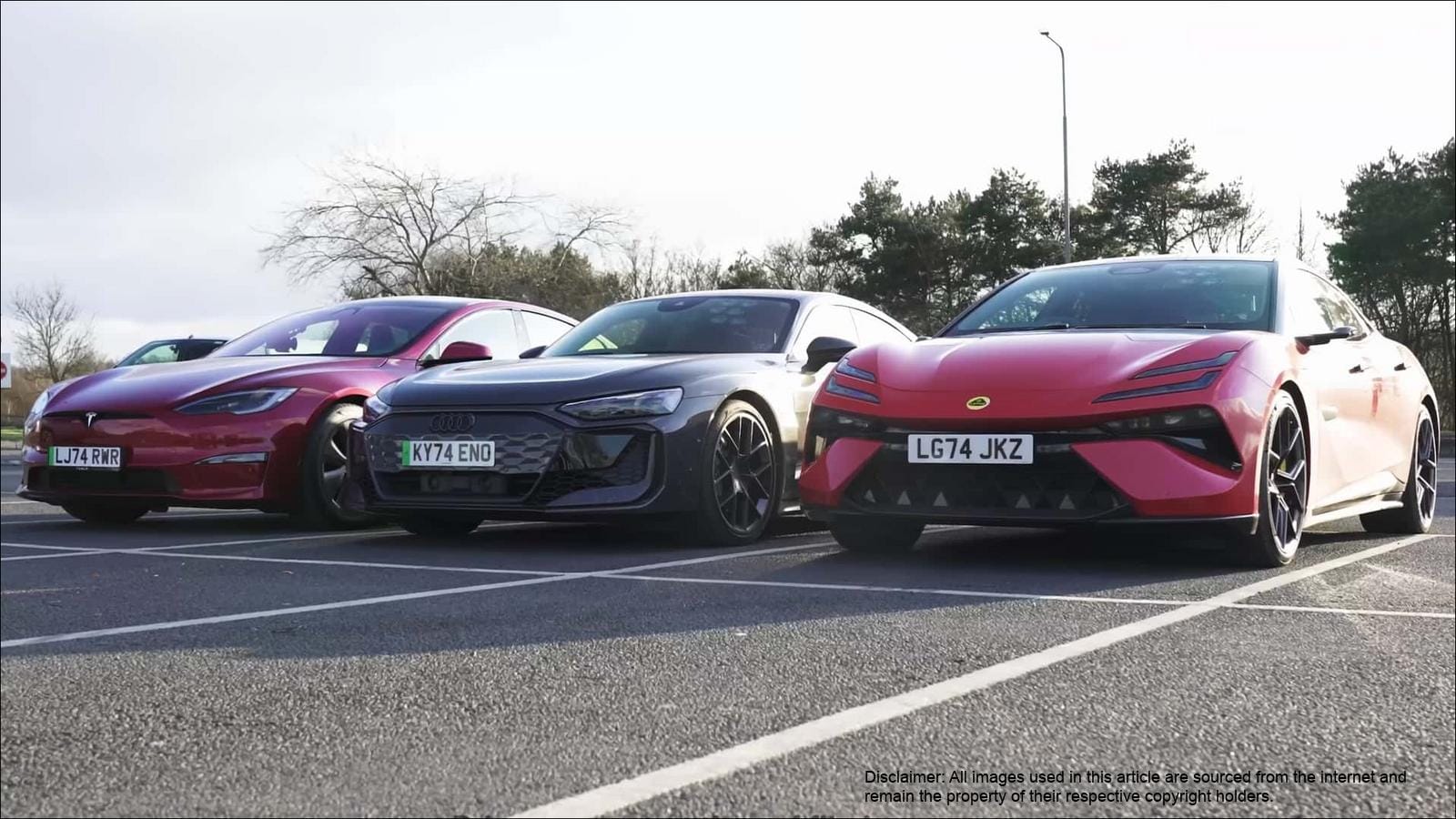
When you’re spending upwards of $100,000 on an electric vehicle, you expect certain things: blistering speed, opulent luxury, or perhaps a harmonious blend of both. But what about range? Can these high-performance EVs truly deliver on their advertised mileage, or does the pursuit of exhilarating performance come at the cost of practicality? Carwow recently conducted a real-world range test to find out, pitting three of the hottest performance EVs against each other: the Tesla Model S Plaid, the Audi RS E-Tron GT Performance, and the all-new Lotus Emeya R.
These aren’t your average EVs. We’re talking about machines boasting over 900 horsepower, colossal batteries nearing 100 kWh, and the ability to launch from 0 to 60 mph in under three seconds. The question isn’t whether they’re fast, but how far they can go when pushed to their limits.
Real-World Range Test: Tesla Model S Plaid vs. Audi RS E-Tron GT Performance vs. Lotus Emeya R
Carwow’s test aimed to simulate realistic driving conditions. Each vehicle was fully charged and then driven on public highways in the United Kingdom, with the ambient temperature hovering around 50 degrees Fahrenheit (10 degrees Celsius). Importantly, the cars were driven in “Sport” mode, prioritizing performance over efficiency. This is a crucial detail, as Sport mode typically results in reduced range compared to more economical driving modes.
Before diving into the results, it’s worth noting the manufacturers’ range claims. The Tesla Model S Plaid boasts an EPA-estimated range of 348 miles and a WLTP rating of 373 miles. The Audi RS E-Tron GT Performance is rated at 278 miles by the EPA and 364 miles under WLTP standards. The Lotus Emeya R, lacking an EPA rating, has a WLTP range of 301 miles, which would theoretically translate to around 210 miles using EPA’s more stringent methodology.
Surprising Results and Considerations
The results of the range test revealed some interesting insights. The Lotus Emeya R was the first to tap out, managing only 193.5 miles with an energy efficiency of 2.2 miles/kWh. Following the Lotus was the Audi RS E-Tron GT Performance, which traveled 258 miles, averaging 2.6 miles/kWh. Surprisingly, the Tesla Model S Plaid, despite being the oldest and arguably least expensive of the trio, lasted the longest, clocking in at 295 miles with an efficiency of 3.2 miles/kWh.
| Vehicle | Actual Range (Miles) | Efficiency (Miles/kWh) |
|---|---|---|
| Tesla Model S Plaid | 295 | 3.2 |
| Audi RS E-Tron GT Performance | 258 | 2.6 |
| Lotus Emeya R | 193.5 | 2.2 |
It’s important to remember that this test was conducted in Sport mode, which prioritizes performance and likely impacted the overall range. Driving in a more efficient mode could potentially yield different results, bringing the cars closer to their advertised figures. Furthermore, external factors like weather conditions, driving style, and terrain can also significantly influence EV range.