No products in the cart.
The global EV battery landscape has shifted decisively. Chinese companies now control every meaningful battery advance ? from sub-$100/kWh LFP packs and 1,000 kW megawatt charging to sodium-ion batteries that work at -40?F. Ryan Shaw’s comprehensive analysis separates real breakthroughs from vaporware and examines where this leaves Tesla and Western automakers.
The Cost Milestone: Battery Packs Below $100/kWh
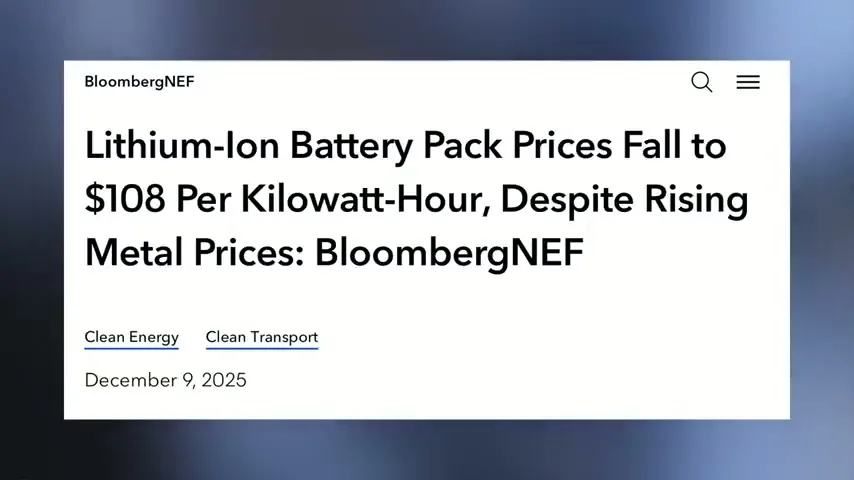
According to Bloomberg NEF, the average lithium-ion battery pack fell to $18/kWh in 2025 ? a record low. Packs going into pure electric cars hit $99/kWh, the second consecutive year below the $100 threshold that was long treated as the magic number where EVs could match ICE vehicles on manufacturing cost.
$99/kWhEV Pack Cost (2025)
$79/kWhCell-Level Cost
55%LFP Market Share (2025)
80%+LFP Share in China
The chemistry divide is clear: NMC (nickel-based) packs more energy into less weight but costs more. LFP (iron-based) is cheaper and safer but heavier. In 2025, LFP crossed 55% of all EV batteries deployed worldwide. In China, more than 80% of EVs sold run on LFP. The average LFP pack cost just $53/kWh in 2025 ? less than half the cost of NMC.
The Two Giants Controlling It All
Two Chinese companies dominate: CATL held ~35% of the global EV battery market through the first eight months of 2025. BYD held ~18%. Together, they produce more than half of every EV battery on the planet. And critically, China controls almost the entire supply chain ? from lithium mining in Australia and Chile through 90%+ of global refining, cathode, and anode production.
Real Breakthroughs vs. Vaporware
What Is Actually Shipping Today
CATL Shenxing 3rd Gen (April 2026): 10-80% in 3 minutes claimed. While the detailed spec is still emerging, this continues a trajectory where iron-based batteries went from “too slow to charge” to the fastest chemistry on the market in under three years.
BYD Super e-Platform (March 2025): The first mass-produced 1,000V architecture. Peak charging of 1,000 kW ? a full megawatt into a passenger car. In BYD’s live demo, the Han L sedan added approximately 95-110 real EPA miles in 5 minutes. This is the fastest charging you can actually buy today, available in the Han L and Tang L SUVs. The caveat: megawatt chargers barely exist outside BYD’s own Chinese network.
BYD Blade Battery 2.0 (March 2026): LMFP chemistry (adding manganese to the iron cathode) pushes density to 190-210 Wh/kg. Charges at 8C, going from 10-70% in about 5 minutes. First cars: Yangwang U7 with a 150 kWh pack delivering ~420 EPA miles.
CATL’s third-generation cell-to-pack: Fills 72% of pack volume with cells. The nickel version achieves 255 Wh/kg and over 1,000 km on China’s CLTC cycle (~400 EPA miles). Holds 13% more energy than a same-size pack built from Tesla 4680 cells. Found in Zeekr, Li Auto, and Xiaomi vehicles.
What Is Still Vaporware
Solid-state batteries: Promised for 2025 by Toyota and others. Still not in a single production car anywhere on Earth. The technology that was supposed to double range and charge in minutes remains in the lab. Toyota has pushed timelines to 2027-2028 at the earliest. QuantumScape has demonstrated promising data but no mass production timeline.
Silicon anode commercial dominance: While some silicon content is appearing in anodes from companies like Sila Nanotechnologies (Mercedes-Benz G-Class), full high-silicon anodes that dramatically boost energy density are still years from volume production.
Where This Leaves Tesla
Tesla’s 4680 cell was supposed to be its battery edge. CATL’s new cell-to-pack technology now holds 13% more energy than a same-size 4680 pack. Tesla’s sourcing strategy ? buying from CATL, BYD,??, and LG ? means it benefits from Chinese battery advances, but it cedes control over its supply chain to its biggest competitor.
The core tension: Tesla’s competitive advantage is shifting from battery technology to software (FSD, AI, robotics). Chinese manufacturers have matched or exceeded Tesla on battery cost and charging speed. If the battery was once Tesla’s moat, that moat has been filled.
| Technology | Status | Impact | Timeline |
|---|---|---|---|
| CATL/BYD LFP fast charging | Shipping | 10-80% in 5-8 min | Now |
| BYD 1,000V megawatt charging | Shipping | ~100 mi in 5 min | Now (China only) |
| CATL sodium-ion (Nasra) | Early production | 175 Wh/kg, -40?F capable | 2026 |
| CATL cell-to-pack 3.0 | Shipping | 72% pack efficiency | Now |
| Solid-state batteries | Lab/Prototype | 2x density promise | 2027-2030 |
| Full silicon anodes | Early production | ~20% density gain | 2026-2028 |
Sodium-Ion: The Wild Card
CATL’s Nasra sodium-ion battery hits 175 Wh/kg ? matching the low end of mainstream LFP. Its real advantages are cold-weather performance (retains more capacity at -40?F than LFP) and lifetime (10,000+ charge cycles, several times the life of a typical pack). Sodium is one of the most abundant elements on Earth (a component of table salt), making raw materials cheap and geopolitically stable. For applications where extreme cold resilience and longevity matter more than maximum range, sodium-ion could carve a significant niche.
Implications for Western Automakers
The Western response to Chinese battery dominance is fragmented. US tariffs create incentives for domestic production, but building battery supply chains takes 5-7 years. Europe is attempting to build gigafactories through Northvolt (which has struggled with production delays) and others. Meanwhile, Chinese battery costs keep falling and technology keeps advancing. The gap is not closing ? it is widening.
FAQ
Can Tesla buy Chinese batteries and still compete?
Yes ? Tesla already sources from CATL for LFP packs in its base models. However, relying on your primary competitor for core components is a strategic vulnerability, especially in a geopolitical climate where supply chains can be disrupted.
When will solid-state batteries actually arrive?
Realistic timelines now point to 2027-2028 for limited production and 2030+ for mass-market adoption. Toyota, once the most optimistic, has repeatedly pushed back its solid-state timeline. The technology works in labs; scaling manufacturing at competitive cost is the challenge.
Sources & Further Reading