EV Market Analysis · Teardown & Review
2026 Hyundai IONIQ 9 Teardown: 110 kWh, 422 HP, and a Three-Row SUV That Hides Its 6,000 lb
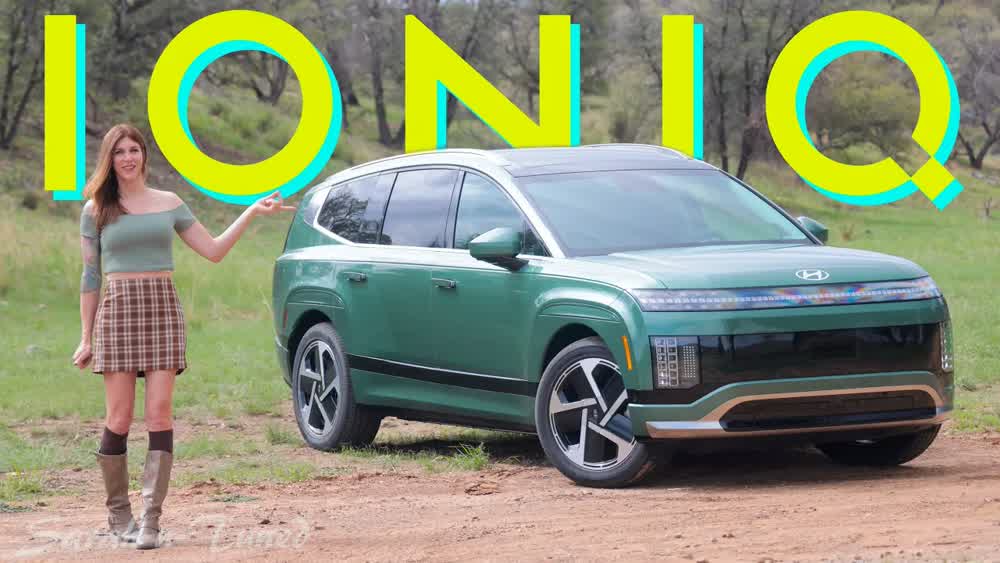
Hyundai’s biggest EV is also its most “Genesis-like” inside — and underneath, it’s a proper E-GMP machine. We pulled the 2026 IONIQ 9 Calligraphy Performance apart and gave it the beans. The headline: a 110.3 kWh pack, 422 hp, and a 10–80% charge in about 24 minutes — in a three-row family hauler that somehow drives like it weighs two tons less than it does.
This isn’t a spec-sheet rehash. The host — a mechanic by trade — lifted the IONIQ 9, crawled under the E-GMP floor, launched it, and spent 20 minutes fidgeting with the power-reclining third row. Here’s what actually matters.
The bones: E-GMP, 110.3 kWh, and two motors
The 2026 IONIQ 9 (chassis code ME1) rides on Hyundai’s E-GMP platform — the same 800V architecture as the IONIQ 5 and Kia EV9. Under the floor sits a 110.3 kWh NCM lithium-ion pack running at 610 volts across 504 cells, liquid-cooled. Power comes from two permanent-magnet synchronous motors (front EM16, rear EM18), each making 211 hp and 258 lb-ft for a combined 422 hp and 516 lb-ft. The whole Calligraphy Performance AWD tips the scales at roughly 6,080 lb.
IONIQ 9 charging: the 800V advantage
350 kW CCS: 10–80% in 24 min
NACS Supercharger: ~40 min
Level 2: ~9.5 hr (10–100%)
The pack actually climbs its curve as the session goes — ~211 kW at 10% rising to a 235 kW peak around 60%. Independent testers logged 23 min 19 sec to 80%. But Hyundai itself notes frequent max-rate DC charging isn’t ideal for long-term battery health.
The hardware that surprised a mechanic
Underneath, it’s more serious than the spaceship looks suggest:
- Five-link rear suspension with aluminum knuckles and Mando dampers; a 22 mm rear anti-sway bar and a chunky 27 mm up front.
- Brake-based torque vectoring, a two-piston front caliper on a 360 mm (14.2 in) rotor, and a single-piston rear on 345 mm.
- An MDPS rack with 2.93 turns lock-to-lock and a 41-foot turning radius — tidy for a 199-inch SUV.
- A hidden tow-hitch cutout rated for up to 5,000 lb (this unit wasn’t equipped, but the provision is there).
- 21×9 wheels (+58.5 mm offset, die-cast alloy) wrapped in 285/45 Hankook Ion Evo all-seasons.
The brake test drew a genuine “weird” — regen plus the calipers hauled the big SUV down shorter than expected, smoothly, with a taper at the end. For a 6,000-pound family bus, that’s reassuring.
Living with it: the part that converts skeptics
The host turned the review down twice. Glad he didn’t. The interior is what he called “more Genesis than Hyundai” — two-tone teal-and-white leather, suede headliner, real buttons and dials for climate (not all touchscreen), and a physical flipper for drive modes so you build muscle memory.
The back is where it earns the “luxury minivan for people who hate minivan doors” label:
- Second-row seats recline and are heated and ventilated, with their own climate zone and power slide.
- Even the third row reclines, with its own vents, USB-C, and cup holders — not poverty-spec.
- A 14-speaker Bose system the host said gave him “goosebumps,” a panoramic roof, and a range readout that shows best / worst / average case (at 72% it read 163 / 219 / 261 miles). Every EV should do this.
- Tech flourishes: ChatGPT baked into Hyundai’s AI assistant, nav-linked regen, and “vehicle active sound design” — yes, selectable spaceship noises.
The driving reality
On the road it “handles far better than a vehicle like this typically would” — the host compared it favorably to the VW ID. Buzz, noting it hides its weight well and stays buttery in comfort. No adaptive dampers, and i-pedal in sport can get “vomit-inducing” on lift-off, but in normal use it’s a quiet, quick, composed cruiser. The launch felt quicker than the on-paper number, and mid-roll punches still shove you back.
Price, range, and the one asterisk
The Calligraphy Performance tested sits in the mid-$70,000s (Calligraphy $74,990; Calligraphy Design $76,490 before destination). The base S RWD starts at $58,955 and, because it weighs substantially less, actually leads on range at a 335-mile EPA rating. The AWD trims land at 311–320 miles. Hyundai is currently dangling up to $10,000 in customer cash on some trims.
| Trim | Drive | Power | EPA range | MSRP (ex dest) |
|---|
| S | RWD | 215 hp | 335 mi | $58,955 |
| SE / SEL | AWD | 303 hp | 320 mi | $62,765 / $66,320 |
| Limited | AWD | 422 hp | 311 mi | $71,250 |
| Calligraphy | AWD | 422 hp | 311 mi | $74,990 |
The honest knock: Hyundai EV depreciation. Used IONIQ 5s are already discounting hard, and that hangs over the 9’s resale. For a buyer who keeps cars long, that’s noise. For a leaser, it’s somebody else’s problem — and the deals reflect it.
A Few Honest Questions
How fast does the IONIQ 9 really charge?
Hyundai quotes 10–80% in about 24 minutes on a 350 kW CCS stall (with the included adapter), and ~40 minutes at a NACS Supercharger. Independent testing beat the claim at 23 min 19 sec. The curve is unusual — it keeps climbing, peaking around 235 kW near 60% SOC.
Is it actually good to drive for such a big SUV?
Surprisingly yes. At ~6,080 lb it hides its weight, corners flatter than expected, and rides like “a cloud” in comfort. No adaptive dampers, and aggressive i-pedal can upset passengers, but the chassis is genuinely competent — better than the VW ID. Buzz in the host’s view.
Which trim should I look at?
The S RWD is the value play (lowest price, longest 335-mi range). The Limited is the sweet spot for the full luxury kit (422 hp, captain’s chairs, Bose, HUD, V2L) around $71K. The Calligraphy adds massage and design detail for the top of the range.
What’s the catch?
Depreciation — Hyundai EVs are discounting fast on the used market, which pressures resale. And like all big EVs, max-rate DC charging often isn’t great for long-term battery health, so treat 24-minute sessions as the exception, not the routine.
Sources
- Hyundai USA — 2026 IONIQ 9: 110.3 kWh, 422 hp, 10–80% in 24 min, 311–335 mi EPA, $58,955–$76,490
- Hyundai — Official IONIQ 9 specifications and charging architecture
- Ever Cars / Cars.com — Trim guide, 23:19 10–80% test, charging curve to 235 kW peak
- Automotive Addicts — Real buyer pricing, 422 hp confirmed, 10-year/100k battery warranty
- Source footage — 2026 IONIQ 9 Calligraphy Performance teardown and road test
Related reading on EVCUBE