EV Market Analysis · Comparison Test
Rivian R2 vs Tesla Model Y: Edmunds Rated Them a Tie — Here’s the Real Gap
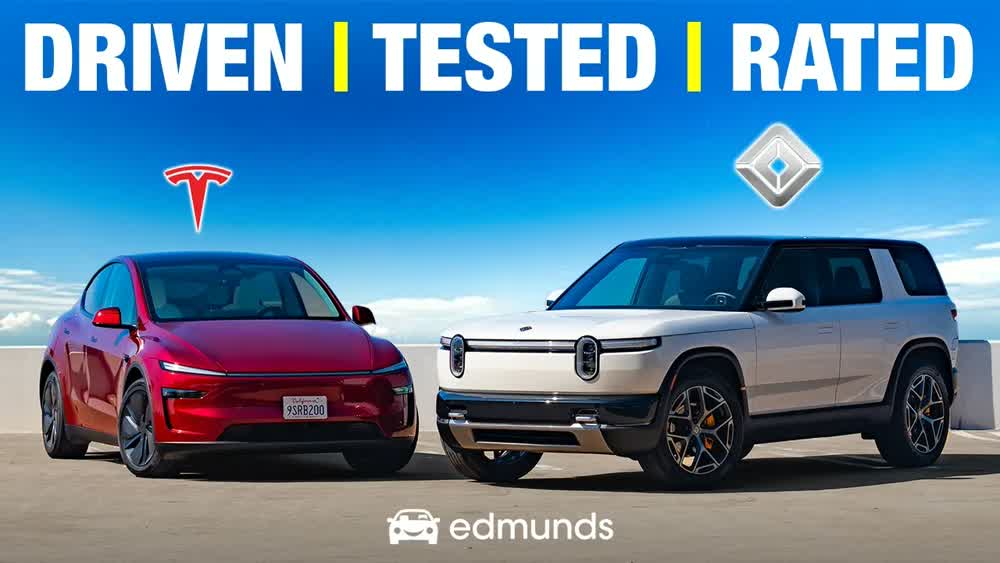
Two crossovers, two philosophies. Edmunds put the 2026 Rivian R2 and the 2026 Tesla Model Y through the same track and road tests and landed on a tie — both slot into second place in its EV SUV rankings. But a tie in the spreadsheet hides a canyon in the driveway. One is the iPhone of cars; the other is the droid you didn’t know you wanted.
This is the matchup every mass-market EV buyer is actually weighing in 2026. Both start around $45,000–$60,000, both are five-seat crossovers, and both plug into the Tesla Supercharger network thanks to native NACS ports. After living with both, the Edmunds crew found the gap isn’t about which is “better” — it’s about which kind of compromise you’re willing to make.
The Rivian R2: character, storage, and a 656-hp party trick
The R2 is what happens when Rivian shrinks the R1S and keeps the personality. The tested Performance trim makes 656 horsepower and 609 lb-ft from dual motors, hits 0–60 mph in 3.6 seconds, and ran the quarter-mile at over 120 mph. On the road it “just pulls and pulls” where lesser EVs go flat at speed. Under the floor sits an 88 kWh usable pack rated at 330 miles EPA, with a native NACS port in the same spot as a Tesla’s, so Supercharger access is plug-and-go.
Rivian R2 lineup (U.S., 2026–2027)
Performance: $57,990 · 330 mi · 656 hp
Premium: $53,990 · 330 mi
Standard RWD: $48,490 · 345 mi (2027)
The $45,000 entry R2 doesn’t arrive until late 2027. The RWD Standard actually leads on range at a Rivian-estimated 345 mi.
Inside, the R2 is the storage nerd’s dream: two glove boxes, a pull-out console drawer, a door-mounted flashlight, a 5.2 cubic-foot frunk, and a 120-volt outlet (1,900 W) in the cabin. It tows 4,400 lb and gets genuine off-road modes — Soft Sand and Rally — plus 9.6 inches of ground clearance that beats every other EV in the class. Edmunds gave it a top “X-factor” score because it “just feels special the moment you get into it.”
The misses are real, though. The cabin is noisier at highway speed (boxy shape, aggressive tires), the steering feels light and vague, and broken pavement sends vibration straight through the structure. There’s no Apple CarPlay or Android Auto, and climate vents are adjusted on the screen. Rivian’s Connect subscription — for satellite maps, the AI assistant, and apps — runs $15/month or $150/year.
The Tesla Model Y: range, efficiency, and the FSD edge
The 2026 “Juniper” Model Y is the version sold today, and it’s a markedly better car than the one it replaced — quieter, comfier, longer-range. The Long Range AWD tested by Edmunds carries a ~75 kWh pack and an EPA rating of 327 miles, which the testers matched exactly in real-world driving. The rear-drive Premium stretches to 357 miles. Tesla quotes 144–185 miles of range in 15 minutes of Supercharging.
| Spec | Rivian R2 (Performance) | Tesla Model Y (Long Range AWD) |
|---|
| Starting price (tested) | $57,990 | $48,990 |
| EPA range | 330 mi | 327 mi (357 RWD) |
| Battery (usable) | 88 kWh | ~75 kWh |
| Power / torque | 656 hp / 609 lb-ft | ~397 hp / 375 lb-ft |
| 0–60 mph | 3.6 s | 4.6 s |
| 10–80% charge | ~29 min | ~27 min (Supercharger) |
| Towing | 4,400 lb | 3,500 lb |
| Frunk | 5.2 cu ft | larger, lower load height |
Where the Y wins is the stuff you feel every day. It’s quieter (acoustic glass, slicker aero), tighter through corners, and noticeably more efficient — it went about 20 miles further on a charge than the R2 in Edmunds’ test and uses less electricity to do it, which compounds into lower running costs. And then there’s Full Self-Driving (Supervised): the reviewer called it “the real deal,” the one system that can drive you point-to-point today. That’s a two-edged sword — it costs $99/month now — but it’s a genuine differentiator.
Where each one actually wins
Forget the spec sheet for a second. Here’s the lived split:
- R2 wins: towing (4,400 vs 3,500 lb), cargo flexibility and clever storage, off-road ability, distinctive looks, and that effortless top-end pull.
- Model Y wins: real-world range and efficiency, cabin quietness, precise steering, and the only hands-off-ish highway driving in the class.
- Both tie: overall Edmunds score, 4-year/50,000-mile basic warranty, 8-year battery warranty, and native NACS Supercharger access.
One honest note on the battery warranty: Tesla’s is 8 years but varies by version — 100,000 to 120,000 miles — so if you drive a lot, read the fine print. Rivian’s is a flat 8 years / 120,000 miles.
The subscription tax you pay on both
Neither car escapes the paywall. Rivian Connect is $15/month; Tesla’s premium connectivity and FSD add up fast. You already pay for Spotify on your phone — you’ll pay again to use it in either SUV. It’s the quiet cost of the modern EV, and buyers should budget for it like they would for insurance.
Verdict: a tie, but pick by personality
Edmunds scores them neck-and-neck, with the Model Y’s range and efficiency weighted heavily in its final number. But the host would take the R2 home — for the way it looks inside and out, and the ability to wander onto a beach or trail, however briefly. The Model Y is the smarter, more efficient, more autonomous daily driver; the R2 is the one with soul and a flashlight in the door.
If you prioritize range, efficiency, and the stress-removed commute, the Model Y is the obvious choice. If you want a practical, premium, rugged EV that feels special every time you walk up to it, the R2 earns its tie — just know the quieter, thriftier Tesla is the one that’ll cost less to live with.
A Few Honest Questions
Did the Rivian R2 really match its range estimate?
No — and that’s the one blemish. In Edmunds’ real-world EV range test the R2 managed 304 miles on a charge, short of its 330-mile EPA rating. The Model Y, by contrast, matched its 327-mile EPA figure. The RWD Standard, rated ~345 mi, should do better when it arrives.
Which charges faster?
Essentially a wash. Rivian quotes 10–80% in about 29 minutes on a DC fast charger; Tesla quotes ~27 minutes to 80% on a Supercharger. Neither uses an 800V architecture, so both are quick but not in the 18-minute class of an IONIQ 5 or Mach-E.
Is Full Self-Driving worth it on the Model Y?
Edmunds calls FSD Supervised “the real deal” — the only system that can drive you point-to-point today, though you must stay attentive. It’s now $99/month on a new car, which is the main catch. For highway commuters and road-trippers it’s a genuine edge over the R2.
Which should I actually buy?
If range, efficiency, quietness, and hands-free highway driving top your list, get the Model Y. If you want maximum storage, towing, light off-road ability, and a crossover with real character, the R2 is the pick. Both are excellent; the “right” one is the one whose compromises you mind least.
Sources
- Rivian — Official R2 specs and pricing (88 kWh, 330 mi EPA, 10–80% in under 30 min, NACS)
- Edmunds — Rivian R2 vs Tesla Model Y comparison test (source footage & range data)
- EVinfo.net — Rivian R2 launch: trims, 656 hp, 29-minute charging, $45K entry timeline
- U.S. News — 2026 Tesla Model Y: 327–357 mi range, $39,990–$57,490, Juniper refresh
- Cars.com — 2026 Model Y range by trim and real-world efficiency
Related reading on EVCUBE