EV Charging & Infrastructure · Industry Watch
The NACS “DC-Only” Mess: Why Some 2026 EVs Have Two Charging Ports and a Confused Owner
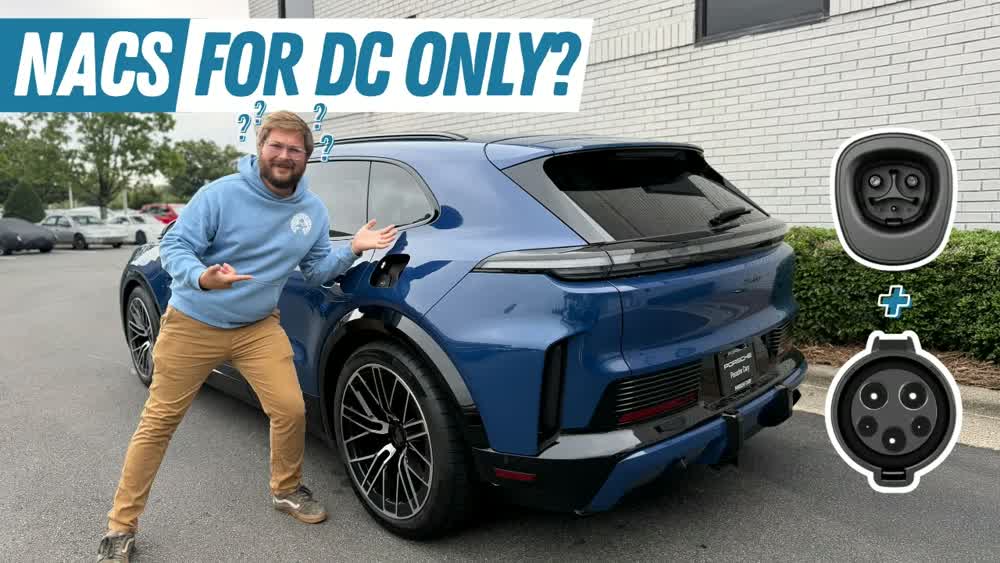
The industry is sprinting to NACS — the North American Charging Standard — and most brands are doing it right: one port that takes both AC and DC. But a handful of 2026 launches, led by the Porsche Cayenne Electric, screwed it up. They put a NACS port on one side that only does DC fast charging, and a separate J1772 port on the other side for AC. Roll up to a hotel with a Tesla Wall Connector and you’ll get an error, not a charge.
This is an “Out of Spec Bits” PSA, and it’s worth every EV buyer’s attention. The point isn’t to dunk on Porsche — it’s that a well-intentioned standards switch is producing genuinely confusing cars at the exact moment we’re trying to make EVs simpler.
What NACS actually is (and why it should be one port)
Modern NACS — now standardized as SAE J3400 — is the Tesla plug shape carrying CCS communication (ISO 15118). The elegant part is that the same physical pins handle both AC and DC. That’s the whole selling point: find any plug anywhere — a Supercharger, a Tesla destination charger, a home wallbox — and energy goes in. One shape, one location, zero guessing.
The history explains the hodgepodge. Tesla shipped its own port on the 2012 Model S (originally CAN communication for DC, like CHAdeMO, and pulse-width modulation for AC). Around 2020–2021 Tesla added CCS support through an adapter and an ECU module speaking ISO 15118. So “NACS” today is Tesla shape + CCS brains. Fine — but the benefit only lands if a car uses the port for both AC and DC.
The bad implementation: DC-only NACS + a separate AC port
On the Cayenne Electric, the driver’s-side rear fender has a J3400 (NACS) port that does DC fast charging only. The passenger’s-side rear fender has a J1772 port that does AC only. Porsche includes a CCS1-to-NACS adapter for DC, but there is no way to AC-charge through the NACS port.
The Cayenne Electric’s split personality
NACS (driver side): DC fast charge only
J1772 (passenger side): AC only
NACS AC wallbox: error / needs adapter
Porsche says a fix — AC + DC on the NACS side — is already in engineering, but it’s a hardware change that can’t ship before production and can’t arrive over the air.
The real-world trap: you pull into a friend’s house or a hotel lot with a Tesla Wall Connector (NACS AC). You plug into the obvious NACS port. The car throws a warning — it can’t take AC there. Most owners don’t know the AC/DC distinction, and the software does a poor job of saying “use the other side, or use an adapter.” That’s a bad first-EV experience for a six-figure SUV.
Who else is doing it
The Cayenne isn’t alone. The pattern — NACS for DC, separate J1772 for AC — also appears on the 2026 Mercedes-Benz CLA with EQ Technology (ports in the same location) and the 2026 Nissan Leaf. Mercedes has since updated later cars to run AC and DC through the NACS side; Porsche and Nissan are the ones shipping the split version. Tesla, Rivian, and the corrected Mercedes cars do it properly: one NACS port, both energies.
| Vehicle | NACS port | AC charging | Verdict |
|---|
| Porsche Cayenne Electric | DC only (driver side) | Separate J1772 (passenger side) | Confusing |
| 2026 Nissan Leaf | DC only | Separate J1772 | Confusing |
| Early 2026 Mercedes CLA | DC only | Separate J1772 | Fixed on later cars |
| Tesla / Rivian / updated Mercedes | AC + DC | Same port | Correct |
Why did this happen? A timing problem, not a stupidity problem
The host and reporting agree on the root cause: development timing. The Cayenne Electric was too far along — originally specced for CCS — when the U.S. market pivoted hard to NACS. Ripping in a NACS port that also handles AC requires a junction box in the power electronics to switch between the shared AC/DC pins. That adds complexity and a failure point, and when these cars were engineered, the supplier base for native NACS AC/DC solutions barely existed. So Porsche bolted a DC-only NACS port and kept the trusted J1772 for AC.
The Drive nailed the analogy: it’s the USB-A-to-USB-C dongle era all over again — consumers hoarding cables and adapters, unsure which end goes where. Porsche’s own energy-systems director confirmed the team knows it’s a problem and is already engineering the NACS side to do both, but early cars are stuck with the hardware as built. No OTA, no magic adapter unlocks AC through that port.
The fix, and the buyer’s takeaway
Porsche’s stated ideal: NACS ports on both sides, the driver’s side handling AC + DC and the passenger side AC only — no J1772 at all. Until then, the host’s blunt advice: if you’re going to adopt NACS, make sure it does AC and DC. If you can’t yet, keep CCS. At least with CCS you’d add a DC adapter for NACS stations and call it a day.
For shoppers, the practical read: a Cayenne Electric still charges brutally fast — 113 kWh pack, 800V, up to 400 kW, 10–80% in under 16 minutes — and the DC side reaches every Supercharger natively. The annoyance is purely the AC/DC split: at home or at a Tesla destination charger, know which side to use, and keep the included adapters in the frunk. It’s a first-adopter tax on an otherwise excellent charger.
A Few Honest Questions
Can I AC-charge a Cayenne Electric at a Tesla destination charger?
Not through the NACS port — it’s DC-only. You’d need a NACS-to-J1772 adapter into the separate J1772 port on the other side. The car should tell you that clearly; today it mostly just throws a generic warning.
Will Porsche fix this on existing cars?
No. Porsche says the AC+DC NACS fix is a hardware change already in engineering, but it can’t be applied to cars already built — no over-the-air update and no adapter can add AC to the DC-only port. Expect it on later production, possibly as a rolling change.
Which 2026 EVs get NACS right?
Tesla always has. Rivian’s native NACS does AC and DC on one port. Mercedes fixed it on cars after the earliest CLAs. The split DC-only implementations are currently the Porsche Cayenne Electric and the 2026 Nissan Leaf.
Does this hurt the Cayenne’s fast-charging speed?
Not at all. The DC side is excellent — 800V architecture, up to 400 kW peak, 10–80% in under 16 minutes, among the fastest-charging SUVs on sale. The issue is only the AC/DC port split, not raw charge rate.
Sources
- Porsche Newsroom — Cayenne Electric: J3400 (NACS) DC-only driver side, J1772 AC-only passenger side, 113 kWh, 400 kW, 10–80% in <16 min
- The Drive — Why the split port exists: CCS-to-NACS pivot mid-development, fix in engineering, no OTA
- EV Charging Stations — Cayenne Electric NACS DC-only + J1772 AC, 9.6/19.2 kW onboard, adapter details
- Out of Spec Bits (source footage) — The NACS DC-only PSA: Porsche, Mercedes CLA, Nissan Leaf
Related reading on EVCUBE