EV Charging & Infrastructure · Price Watch
The Quiet EV Charging Price War of 2026: Why a Fast Charge Now Costs More Than a Hybrid’s Tank
Somewhere in America, an EV driver plugs into a highway fast charger, watches the price tick up, and does the math out loud: “Wait — that’s more than I’d spend filling a hybrid?” They’re not wrong. And the war over that price is only getting louder.
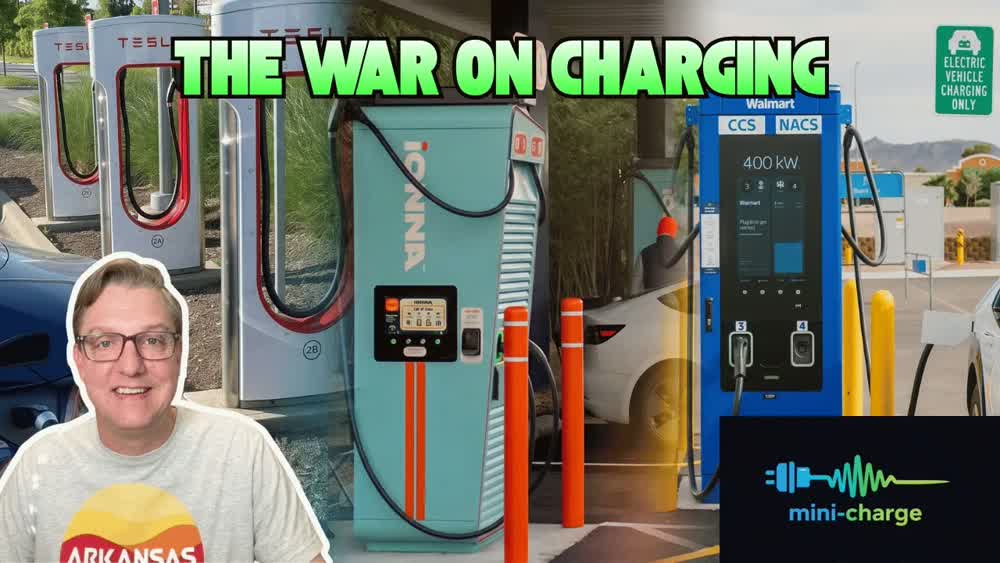
We’re in the middle of a quiet, vicious price war in Level 3 DC fast charging, and most people only notice it the first time they get the bill. On one side, drivers who were promised “electricity is dirt cheap” discover the promise only holds at the wall outlet in your garage. On the other, the giants — Tesla, Walmart, and newcomer coalitions like Ionity — are locked in a showdown over profit margins, grid fees, and your loyalty. Every one of them now wants you on a monthly subscription.
The promise that breaks at the interstate
If you charge at home overnight, the old pitch is 100% true. At residential rates around 17–18 cents per kWh, a typical mid-size EV burns about $0.04–$0.06 per mile — less than half what a 30-mpg gasoline car costs at $3.50 a gallon.
Then you pack for a road trip. The moment you lean on public DC fast chargers, the whole equation flips. Public fast charging now averages somewhere around $0.45–$0.55 per kWh. At a realistic 27–29 kWh per 100 miles, that’s about $0.13–$0.16 per mile. Run that against the same gas car — roughly $0.12 a mile — and the uncomfortable truth lands: an EV charged exclusively on the most expensive public networks can roughly match, or even slightly beat, a gasoline car on fuel cost.
Cost per mile by how you charge
Home ~$0.05/mi
Public DC ~$0.13–0.16/mi
Gas ~$0.12/mi
Home charging wins by a mile. On pricey public DC, the EV advantage nearly vanishes — exactly where casual road-trippers charge.
What a kilowatt-hour actually costs, by network
| Network | Casual rate | Membership | Member rate | Idle fee |
|---|
| Tesla Supercharger | $0.35–$0.55 (avg ~$0.45) | $12.99/mo | ~$0.10–0.15 less | $0.50–$1.00/min |
| Electrify America | ~$0.52 | Pass+ $7/mo (~25% off) | ~$0.39 | $0.40/min after grace |
| EVgo | ~$0.40–0.52 | varies | member discounts | per network |
| ChargePoint | ~$0.44 | app-based | ~$0.38 | host-dependent |
| Shell Recharge | ~$0.51 | $9.99/mo | ~$0.44 | session/block fee |
| Blink | ~$0.49 | app-based | ~$0.43 | varies |
A non-Tesla driver at a Supercharger pays roughly 30–40% more per kWh without a membership. The $12.99 monthly Supercharging Membership erases that gap by granting the Tesla-owner rate. The same logic runs across every network.
The map matters more than the rate card
Paren’s State of the EV Charging Industry report for Q2 2026 found the U.S. state-level average fast-charge price holding at about $0.538 per kWh — but the range is the story:
| Market | Typical per-kWh | Why |
|---|
| Hawaii | ~$0.856 (highest) | island grid, imported fuel |
| California / Northeast | $0.48–0.58 (peaks ~$0.70) | real-estate + demand charges |
| U.S. average | ~$0.538 | blended |
| Texas / Southeast | $0.25–0.36 (cheapest) | cheap power, some per-minute billing |
| Nebraska | ~$0.428 (lowest) | abundant grid capacity |
Off-peak can run 30–50% cheaper than peak at the same stall, but there’s no national schedule — each site sets its own bands. The Tesla app shows the exact rate before you plug in. Most drivers never look.
The subscription land-grab
Every app now wants a monthly fee. It’s a loyalty lock-in play. Electrify America’s Pass+ at $7 a month for roughly a 25% discount breaks even at about 54 kWh a month — a little more than one 10–80% charge of a mid-size EV. Tesla’s $12.99 membership breaks even around 80–130 kWh a month.
Is a charging membership worth it?
Charge 2×/mo: yes, saves money
Charge 1×/mo: casual is cheaper
The trap: drivers sign up to chase a two-cent difference, then stop using that network and keep paying. Buy one plan matched to your routes; cancel in the months you charge mostly at home.
The fees that don’t show on the sticker
- Idle fees: Tesla bills $0.50/min when a site is at least half full, doubling to $1.00/min when completely full, after a five-minute grace. Electrify America charges about $0.40/min after a 10-minute grace.
- Congestion fees: Tesla adds about $0.50/min while you’re still charging if the site is busy and your battery is above ~80%. Fix: charge to 70–80% and move — EVs slow past 80% anyway.
- Session/connection fees: EA adds about $1 to start a transaction at some sites; ChargePoint layers a service fee; Shell can carry a separate transaction or blocking fee.
The forgotten 36%: renters pay a “road trip tax”
The “electricity is cheap” story assumes a garage. About 36% of U.S. households rent, and a large share — apartment and condo dwellers — can’t install a home charger. For them, every mile is a public-charging mile. Independent analyses put their annual “road trip tax” at roughly $1,790–$2,050 above what a home-charger owner pays.
This is the quiet inequality of the EV transition. The drivers most likely to benefit from an EV’s lower running costs are often the ones least able to capture them, because they’re locked into the most expensive, least convenient part of the charging stack.
The new players are changing the board
- Walmart: crossed 100 fast-charging sites in 2026 using 400 kW hardware (ABB’s A400 and Alpitronic’s HYC400 Hypercharger), with plans for thousands of U.S. stores by 2030. Charging lives inside the existing Walmart app — no separate download — and Walmart+ members get a discount. With 5,200+ U.S. stores and ~90% of Americans within 10 miles of one, Walmart has the footprint to become one of the largest fast-charging networks in the country.
- Tesla still leads the buildout: in Q2 2026 Tesla added 1,185 new DC ports — about 27% of all U.S. additions — and holds more than half of all U.S. DC fast-charge ports.
- Ionity and coalitions: the European high-power consortium’s model — one membership unlocking a continent of 350 kW chargers — is the template every U.S. operator is copying.
The industry is also maturing past “install as many plugs as possible.” Q2 2026 added 4,382 new U.S. DC ports (down ~10% year over year) even as charging sessions rose 29% — ~72% of newly installed ports deliver at least 250 kW. The race is shifting from coverage to reliability and margin.
So who wins the price war?
Not the casual driver who walks up and taps a card. The winners are the people who treat charging like a utility bill — pick one network, buy its plan, charge off-peak, unplug at 80%, and move. The losers are renters, infrequent road-trippers, and anyone who ignores the fee schedule.
A Few Honest Questions About Charging Costs
Why is public charging so much more expensive than home?
Home electricity runs ~17–18¢/kWh. Public DC fast charging averages $0.45–0.55/kWh because operators pay commercial demand charges, grid fees, and land costs — and they price for convenience, not commodity power.
Is a charging membership worth it?
If you fast-charge on a given network at least twice a month, almost certainly yes — the discount usually covers the fee after one or two sessions. If you charge once a month or less, the casual rate wins.
What’s the biggest hidden fee?
Idle fees. A forgotten car at a busy Supercharger can rack up more in idle fees in 20 minutes than you’d save all month on a membership. Set a phone alert; treat chargers like gas pumps — fill, then move.
I rent and can’t charge at home. Am I stuck?
Not stuck, but you pay more. Look for workplace charging, apartment-friendly networks, and Walmart/Ionity sites where the per-kWh rate is lower. The “road trip tax” is real — budget for it.
Sources
Related reading on EVCUBE