
No products in the cart.

The Best Solar Battery System in 2026: 10 Key Metrics, Tesla Powerwall 3 vs the Rest
Picking a home battery is no longer about which box holds the most kilowatt-hours. In 2026 the real decision is about ecosystem, software, and backup behavior — because the three leading systems now land within a few percent of each other on price once you measure cost per usable kWh.
Spirit Energy — a UK installer that commissioned one of the first Powerwall 3s in the country — recently put the three most-quoted home batteries side by side and scored them across ten metrics: capacity, inverter performance, charge rate, power-cut protection, software, thermal management, EV charging, special features, warranty, and price. Their verdict is that you “won’t go wrong with any of them,” which is true. But for a U.S. homeowner the picture shifts: the federal 30% residential battery tax credit expired on December 31, 2025, so a 2026 install is an out-of-pocket purchase, and the comparison has to be made on capability, not just brand loyalty. Here is the American read on the same three systems.
Capacity and inverter flexibility
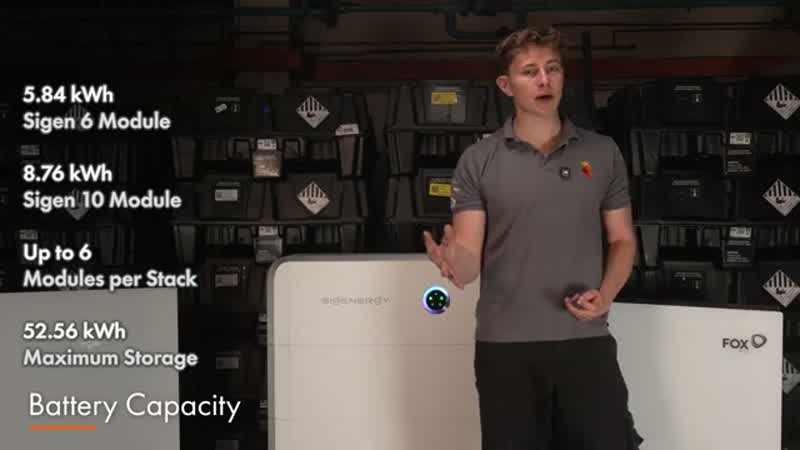
The Tesla Powerwall 3 is the simplest to size because it is the least flexible: one fixed unit holds 13.5 kWh of usable storage (about 15 kWh nameplate), and you scale by adding Expansion packs or stacking up to four units for a maximum of roughly 54 kWh. Sigenergy takes the opposite approach with the SigenStor modular tower — 5.84 kWh and 8.76 kWh modules that stack up to six deep for about 52.5 kWh per tower, letting you hit almost any capacity target instead of fixed increments. The Fox EVO sits in between at 9.73 kWh usable per unit, parallelable up to about 29 kWh.
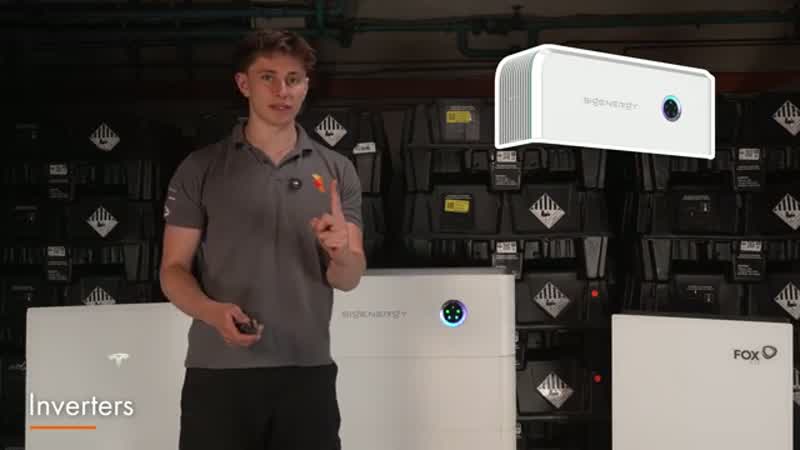
Where Tesla wins is the inverter. Its output rating is fully software-configurable, so if your utility caps how much you can export, an installer sets it in the app and can raise it later with no site visit. Sigenergy and Fox lock the inverter rating in hardware — a later change means swapping the energy controller. For U.S. homes on constrained feeders, that remote flexibility has real financial value.
Charge speed and backup power
Charge and discharge rates decide how useful a battery is during a short off-peak window or a long outage. The Powerwall 3 discharges at up to 11.5 kW but charges slowly at just 5 kW (8 kW with Expansion packs), so a full recharge from empty takes about 2 hours 40 minutes. Sigenergy scales charge/discharge with each module — roughly half the module’s capacity — capped by the energy controller (about 12 kW on a typical unit). The Fox EVO is the speed king: it charges and discharges at the full 10 kW in both directions, refilling from flat in under an hour.
On backup, the differences matter more than the spec sheets suggest. Tesla’s Backup Gateway 2 island the home within a brief interruption — fast enough that most appliances keep running, but it is not a true UPS, and three-phase backup is not yet available in the U.S. Sigenergy is the only one of the three with seamless (near-zero-millisecond) switchover and genuine three-phase backup, plus a 100-amp smart port you can dedicate to a heat pump. Fox backs up competently and adds a built-in LCD that a service tech can read without app access.
U.S. buyer takeaway: Most American homes are single-phase, so Tesla’s lack of three-phase backup is usually a non-issue. The bigger practical gap is charge speed — if your utility’s cheap-power window is short, the Fox’s 58-minute refill beats Tesla’s slow 5 kW intake.
Software, thermal management, and EV charging
Tesla’s edge is the app ecosystem and Virtual Power Plant (VPP) earnings. In the U.S., Tesla’s VPP programs have paid owners roughly $400 a year on the fixed plan and up to $1,000 or more on dynamic plans — a real, recurring offset to that lost tax credit. Sigenergy counters with the mySigen app and AI tariff optimization it claims delivers 20%+ more savings than standard algorithms, though that figure is the company’s own. Fox’s Fox Cloud handles solar diversion and scheduled charging competently.

Thermal handling splits the field. Tesla actively heats and cools the cells and even preconditions them using weather forecasts, holding an optimal window in both heat and cold. Sigenergy is more passive — heat packs engage at 0°C and cooling relies on natural convection. Fox uses active air-cooling fans plus a cold-weather warm-up function, so it manages temperature in both directions but reacts to current conditions rather than anticipating them. For hot-climate states like Arizona or Texas, Tesla’s predictive cooling is the safer long-term bet.
EV charging is where the ecosystem argument lands hardest. Tesla owners pair a Wall Connector (up to 7.4 kW AC) that appears right inside the same app as the Powerwall. Sigenergy’s standout is a DC charging module (12.5 or 25 kW) that slots into the stack and is vehicle-to-grid (V2G) and vehicle-to-home (V2H) ready — meaning your car can one day power your house. Fox offers its own 7.3 kW AC chargers with solar diversion.

Warranty and the real price story
The warranties diverge most. Tesla backs the Powerwall 3 for 10 years at 70% capacity retention with no throughput limit and a reputation for simply swapping failed units. Sigenergy gives 10 years at 60% retention or about 3,000 cycles (whichever comes first), with a paid 15-year extension. Fox offers the longest standing coverage: 12 years at 70% retention with a 4,780 kWh throughput cap that most daily cyclers will outlive on the calendar term.
On price, the surprise is how close they are once you normalize. U.S. marketplace data (EnergySage, early 2026) puts the Powerwall 3 around $998 per usable kWh installed, with Sigenergy’s SigenStor frequently lower at roughly $560–$600 per kWh thanks to modularity, and Fox positioned as the value play, typically a notch below Tesla per kWh. After the federal credit’s expiration, state and utility programs — California’s SGIP, Massachusetts’ ConnectedSolutions, Hawaii’s steep rates — are now the main levers that change the math.
The 10-metric scoreboard
| Metric | Tesla Powerwall 3 | Sigenergy SigenStor | Fox ESS EVO |
|---|---|---|---|
| Usable capacity | 13.5 kWh/unit, ~54 kWh max | 5.8–8.8 kWh modules, ~52.5 kWh/tower | 9.73 kWh/unit, ~29 kWh max |
| Inverter | Integrated, software-configurable | Fixed energy controller (~12 kW) | Fixed 10 kW |
| Charge rate | 5 kW (8 kW w/ packs) | ~half/module, capped 12 kW | 10 kW (full, ~58 min) |
| Backup | Gateway 2, brief switchover | 0 ms, 3-phase, 100A smart port | Backup + built-in LCD |
| Software | Tesla app, VPP $400–$1k/yr | mySigen AI tariff optimization | Fox Cloud, solar divert |
| Thermal | Active, predictive | Passive (heat packs + convection) | Active air-cooling + warm-up |
| EV charging | Wall Connector 7.4 kW AC | DC 12.5/25 kW, V2G/V2H | AC 7.3 kW, solar divert |
| Special features | Storm Watch, no display | 5-layer fire safety, modular | Lowest cost, LCD |
| Warranty | 10 yr / 70%, no limit | 10 yr / 60% or ~3,000 cycles | 12 yr / 70%, 4,780 kWh |
| Price ($/kWh) | ~$998 (EnergySage) | ~$560–$600 | Lowest of the three |
Which one should an American buyer choose?
If you want the most proven single unit with the best VPP earnings and strongest cold-weather performance, the Powerwall 3 remains the default all-rounder — especially if you already drive a Tesla. If you have an EV and want built-in V2G charging, three-phase needs, or capacity you can grow in small steps, Sigenergy is the most flexible tower, though watch its 2025 single-phase inverter recall history in some markets. If you are budget-first and want fast charging with the longest warranty, the Fox EVO is the value pick that still ticks most boxes.
Bottom line: The choice is no longer a price decision — it is a capability and ecosystem decision. Size to your actual daily use, confirm your utility’s export and VPP rules, and pick the system whose charger and app you will actually live with for the next decade.
FAQ
Is the federal 30% battery tax credit still available in 2026?
No. The Section 25D residential clean energy credit for battery storage expired for systems placed in service after December 31, 2025. A 2026 install is an out-of-pocket purchase, so state programs like California’s SGIP and utility VPP payouts now matter far more to the return on investment.
Which of these batteries earns the most from the grid?
Tesla’s U.S. VPP programs are the most established, paying owners roughly $400 a year on the fixed plan and up to $1,000 or more on dynamic plans per Powerwall. Sigenergy and Fox rely more on time-of-use arbitrage and tariff optimization through their apps, with V2G still emerging rather than paid out at scale.
How much does a home battery cost per kWh in 2026?
U.S. installed pricing averages about $700–$1,450 per usable kWh (EnergySage, early 2026), with the Powerwall 3 near $998/kWh, Sigenergy’s SigenStor often lower around $560–$600/kWh thanks to modularity, and Fox positioned as the most affordable per kWh of the three.
Do I need three-phase backup in a typical U.S. home?
Usually not — most American homes are single-phase, so Tesla’s lack of three-phase backup is a non-issue. Three-phase backup is a real advantage only for larger or mixed-phase properties, where Sigenergy is currently the only one of the three that handles it seamlessly.
Sources:
- Spirit Energy — “What’s The Best Solar Battery System in 2026? 10 Key Metrics — Tesla Powerwall 3 vs Sigenergy vs Fox” (full ten-metric walkthrough; transcript D:/tmp/evbatch/_YWMtMdGJUY/transcript_clean.txt)
- Tesla Powerwall 3 technical specification (energylibrary.tesla.com) — 13.5 kWh usable, 11.5 kW continuous, ~89% round-trip, 10-yr/70% warranty, up to 4 units + 3 Expansion (54 kWh); installed price $13,000–$16,500 (smartenergyusa.com, 2026)
- Sigenergy SigenStor specs (sigenergy.com, solarinfo.uk) — BAT-6.0 (5.84 kWh) / BAT-9.0 (8.76 kWh) modules, up to ~52.5 kWh/tower, ~97–98% round-trip, 10-yr/60% or ~3,000 cycles, DC EV module 12.5/25 kW V2G/V2H, ~$560–$600/kWh (EnergySage, 2026)
- Fox ESS EVO / EP5 specs (fox-ess.com, solent-solar.com) — 9.73 kWh usable/unit, ~95–97% round-trip, 10 kW charge/discharge, 12-yr/70% warranty, 4,780 kWh throughput; value-positioned per kWh
- U.S. cost & incentive data — EnergySage best-home-batteries (2026), mysolarfy.com solar-battery-cost (July 2026, ~$1,100/kWh average), energyrebatecalculator.com (25D credit expired 12/31/2025), jouleio.com home-battery-cost-per-kWh (state payback)