No products in the cart.
China’s New 2026 EV Engine Just Changed the Game – Tesla, BYD, and Toyota Are Watching
A new electric drivetrain from China is not just adding miles of range. It is redefining what an EV powertrain can be, from a $10,000 city car to a 1,000-volt charging monster that fills a battery faster than a coffee run.
Headlines about Chinese EVs usually focus on one of two stories: cheap city cars or huge battery packs. The real 2026 story is more interesting and harder to copy. A single Chinese company now controls the motor, the battery, the silicon-carbide power chips, the charging architecture, and the manufacturing scale needed to put them together at a price Western rivals cannot match. That is the engine behind the hype, and it is why Tesla, BYD, and Toyota are all watching closely.
The “engine” is actually a vertically integrated powertrain
When BYD unveiled its Super e-Platform in March 2025, it did not launch one new part. It launched a whole system. The architecture runs every major component at 1,000 volts: the battery, the motor, the power electronics, even the air conditioning. The Flash Charging Battery accepts 1,000 amps at a 10C rate, giving a peak charging power of 1 megawatt, or 1,000 kW. BYD claims the platform can add 400 kilometers of range in about five minutes, which is roughly the time it takes to fill a gasoline tank.
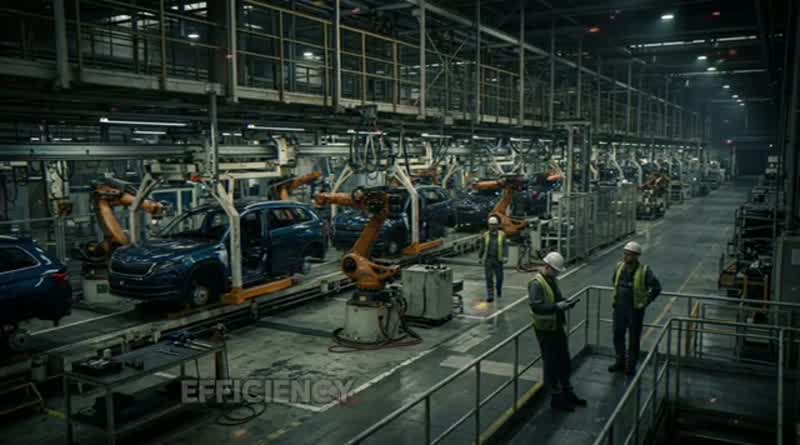
The platform also carries a new 1,500-volt silicon-carbide power chip and a single-module motor rated at 580 kW. That is the kind of output that used to require two motors in a performance car. BYD says its dual-gun charging can even boost existing public chargers, making the system practical outside a small network of proprietary stations.
The 30,000 rpm motor: why the numbers matter
The most eye-catching piece is the motor itself. BYD calls it the world’s first mass-produced 30,000 rpm electric drive motor. Peak power density is reported at 16.4 kW per kilogram, roughly 2.7 times the benchmark most observers consider advanced and a big jump over the roughly 6.0 kW/kg figure cited for the Tesla Model Y integrated drive unit. BYD claims the motor stays above 97% efficiency across more than 90% of its operating range, and at 120 km/h highway cruising it can run at 92-95% efficiency.
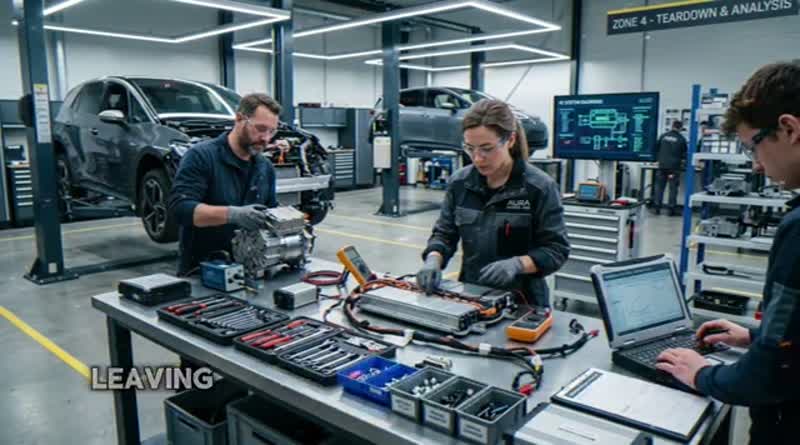
Higher highway efficiency is where most EVs lose range. A motor that stays efficient at high rpm can stretch the same battery pack further, especially on road trips. Chinese reports suggest the design can boost highway range by 15-20% compared with older permanent-magnet motors. Those are manufacturer claims, not independent EPA results, but they explain why the industry is paying attention.
What a $10,000 EV can teach Detroit
The technology is not locked behind a luxury badge. The 2026 BYD Seagull is a four-seat battery hatchback priced from about $10,300 in China. It uses a 55 kW motor, a lithium iron phosphate Blade Battery, and official consumption figures of 9.9 to 10.1 kWh per 100 km on the CLTC cycle. That is roughly the same efficiency as a Tesla Model 3 but in a much smaller, cheaper package with a battery chemistry widely considered safer than nickel-cobalt alternatives.

BYD makes the motor, the battery cells, the electronics, and even the semiconductor chips in-house. That vertical integration is the reason a $10,000 EV is possible without turning into a penalty box. Legacy automakers buy most of those parts from suppliers, which makes matching that price nearly impossible without subsidies or losses.
The battery side of the breakthrough
Fast charging is the other half of the story. CATL’s Shenxing Plus battery, an LFP chemistry pack, is claimed to add roughly 370 miles of range in a 10-minute top-up and deliver 621 miles of total range on a full charge. Those numbers are calculated on China’s CLTC cycle, so EPA figures would be lower, but the underlying technology is real: a 4C charging rate and an energy density of 205 Wh/kg.

BYD’s own Flash Charging Battery goes further on the power side. Its 10C rate and 1,000 kW peak power are the production numbers that make “five-minute charging” credible. The question is no longer whether the chemistry works; it is whether public charging infrastructure can keep up. For context on why charging speed is becoming the new battleground, see our earlier look at why 800V is the new baseline.
Why Tesla, BYD, and Toyota are watching
Tesla is still the software, brand, and charging-network leader. But the hardware gap is closing fast. Toyota’s response is already visible: the GAC Toyota bZ 7, built for China, will use Huawei’s DriveONE six-in-one electric drive system with a 22,000 rpm motor and a reported motor-system efficiency of 97.5%. That is higher than the 96.5% reported for the Tesla Model S and 96.8% for the BYD Seal, according to Chinese industry reports. When Toyota’s own China-market car borrows Chinese technology, the shift is obvious.

| Powertrain | Peak power | Power density | Highway efficiency | Key feature |
|---|---|---|---|---|
| BYD Super e-Platform | 580 kW single motor | 16.4 kW/kg | 92-95% at 120 km/h | 30,000 rpm motor |
| Tesla Model 3/Y | ~250-380 kW | ~6.0 kW/kg | 84-87% at 120 km/h | Fixed-field PM motor |
| Toyota bZ 7 (Huawei DriveONE) | 220 kW | Not disclosed | 97.5% system efficiency | 22,000 rpm 6-in-1 unit |
| VW ID. series | ~150 kW | ~3.8 kW/kg | Standard PMSM | Conventional layout |
The U.S. reality check
There is a catch. Most of this hardware is sold only in China. Tariffs and trade rules keep the Seagull and the Han L out of the U.S. market for now. And Chinese range and charging claims are based on CLTC, which is more optimistic than EPA testing by a meaningful margin. Real-world U.S. highway range would be lower, and the megawatt charging network barely exists anywhere yet.
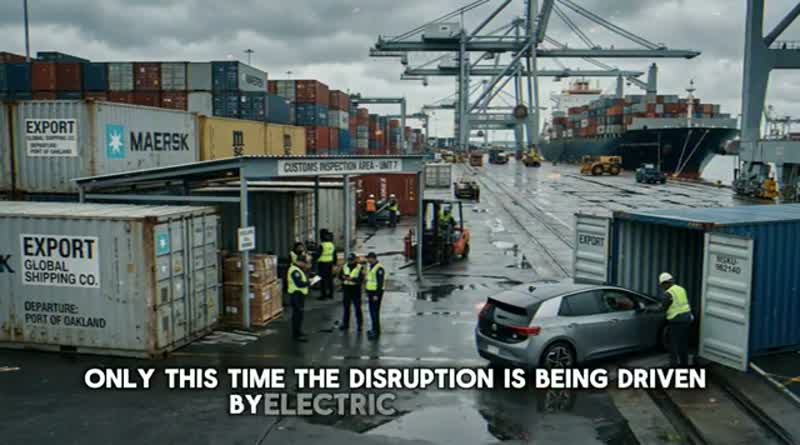
Still, the global pressure is real. Chinese automakers exported more than 1.5 million EVs in 2023, and that number keeps climbing. Ford CEO Jim Farley has repeatedly acknowledged that Chinese EVs are a serious competitive threat in Europe and beyond. The breakthrough is not that one car beat Tesla. It is that a Chinese company can now build a better powertrain, cheaper, at a scale no one else can match.
The buyer takeaway: You probably cannot buy this Chinese powertrain in America today. But it is already raising the bar for everyone else. The next EV you do buy, from any brand, will likely be faster-charging, more efficient, and cheaper because of this competition.
FAQ
What is the “new Chinese EV engine” the video refers to?
There is no single piston engine. The phrase points to a new generation of Chinese electric drivetrains, led by BYD’s Super e-Platform with a 30,000 rpm motor, 1,000-volt architecture, and 1,000 kW charging. It also includes cheaper, vertically integrated systems like the Seagull’s powertrain and CATL’s faster-charging LFP batteries.
Is the BYD Seagull really a Tesla competitor?
No. The Seagull is a small city car with a 55 kW motor and a top speed of 130 km/h. A Tesla Model 3 is larger, quicker, and far more powerful. The comparison is about efficiency and cost per mile, not performance. The Seagull shows what is possible at a price point no Western brand can currently match.
Are the 370-mile, 10-minute charging claims real?
They are based on CATL’s published Shenxing Plus specs, measured on China’s CLTC cycle. The chemistry and charging rate are real, but real-world EPA range would be lower. Similarly, BYD’s 400-km-in-five-minute claim uses Chinese test conditions. Independent U.S. verification is still pending.
Will these Chinese EVs be sold in the United States?
Not in the near term. Tariffs and regulatory barriers keep most Chinese-built EVs out of the U.S. market. The impact will be indirect: U.S. and European automakers must match the efficiency and pricing pressure, or lose ground in global markets where Chinese EVs are already selling well.
Sources:
- RISE FROM FAILURE — “China’s New 2026 EV Engine Just Changed Everything” (YouTube, source video)
- BYD official press release — Super e-Platform launch, March 2025 (1,000V architecture, 1,000 kW flash charging, 30,000 rpm motor, 580 kW single motor)
- BYD Media — “BYD Super e-Platform opens era of fuel and electricity at the same speed”
- CarNewsChina Data — BYD Seagull 2026 specs: 55 kW, 135 Nm, 9.9-10.1 kWh/100km, 305-405 km CLTC, $10,290-$12,640
- InsideEVs — “CATL’s Latest LFP Battery Can Gain 370 Miles Of Range In 10 Minutes Of Charging”
- electrive.com — “CATL renews its battery line-up” (third-generation Shenxing battery, 10C/15C charging)
- wcevcar.com — “The 2026 GAC Toyota bZ 7 will be equipped with Huawei DriveONE motors” (97.5% system efficiency, 22,000 rpm)
- Chinese industry reports on BYD’s 30,000 rpm motor and variable-flux efficiency claims (presented with caveats pending independent verification)
- Related EVCUBE: 800V is the new baseline