No products in the cart.
Tesla’s Corpus Christi Lithium Plant: Inside the 2026 Buildout
Tesla’s lithium refinery near Corpus Christi, Texas is now the largest of its kind in North America — and a bet that the cheapest future battery is the one refined at home. A July 2026 drone flyover shows a plant that’s operational, expanding, and quietly reshaping where America’s lithium gets processed.
For most of the EV era, the dirty secret of “American-made” batteries was that the lithium inside them was mined overseas, shipped to China for refining, and only then returned as battery-grade chemical. Tesla’s Gulf Coast refinery breaks that loop. Located near Robstown, just outside Corpus Christi, it became operational in January 2026 and reached full integrated capacity in February — the first facility in North America to take hard-rock spodumene concentrate and convert it all the way to battery-grade lithium hydroxide on a single site.
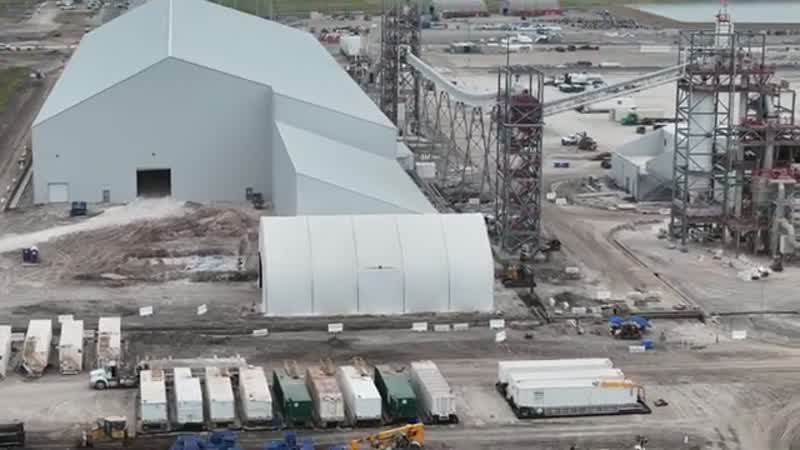
What the plant actually does
The refinery runs an alkaline, acid-free leach process — a deliberate departure from the conventional sulfuric-acid roasting used by most of the world’s lithium refiners. Instead of producing hazardous sodium-sulfate waste, Tesla’s process yields a benign, sand-like byproduct called analcime (or anhydrite) that can be sold into the concrete industry. The company says that translates to more than 30 percent lower emissions and roughly 60 percent fewer costly reagents than traditional methods, with closed-loop water systems to limit freshwater draw. Output is battery-grade lithium hydroxide — the cathode input for high-nickel cells used in Model 3, Model Y, Cybertruck, and stationary storage.
| Metric | Figure |
|---|---|
| Annual output | ~50,000 tonnes LCE (about 50 GWh) |
| EVs supplied per year | ~1,000,000 |
| Capital investment | More than $1 billion |
| Permanent jobs | 250+ |
| Operational since | January 2026 (full capacity Feb 2026) |
| Process | Spodumene-to-hydroxide, acid-free |
| Byproduct | Analcime / anhydrite (concrete additive) |
What the July 2026 flyover shows
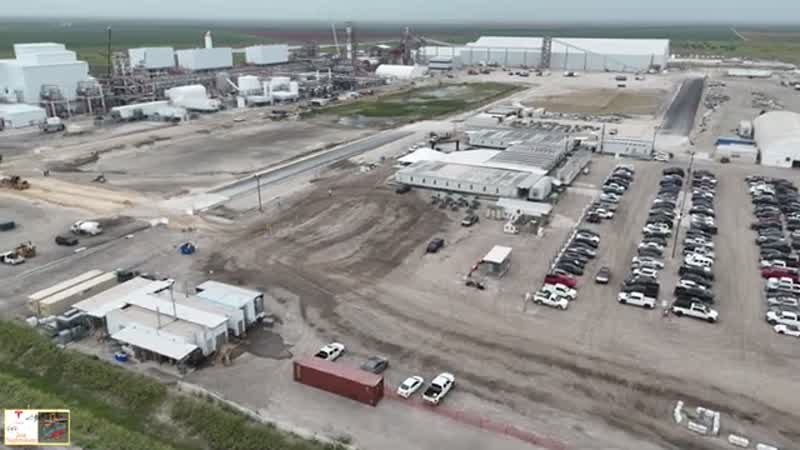
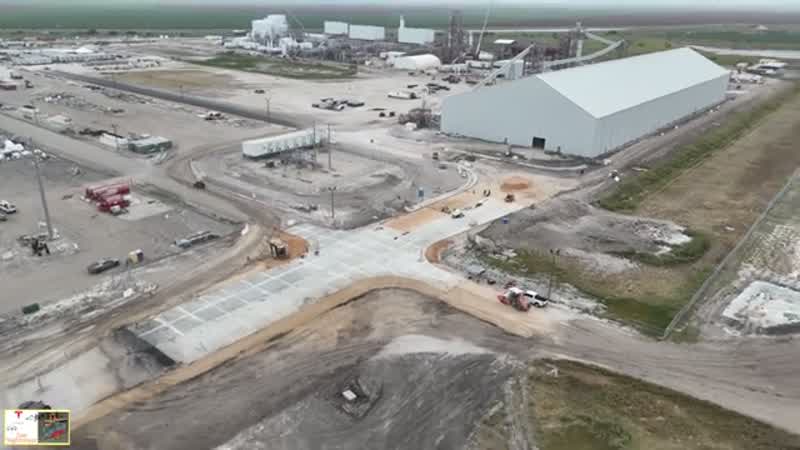
Joe Tegtmeyer’s latest drone tour, filmed in July 2026, shows a site that is clearly running but also still maturing. On the day of the flight, crews were performing maintenance on the rotating cooler of the calcination kiln — work that briefly paused production on that line. Across the site, contractors were pouring concrete roadways to replace the dirt and mud that has plagued operations, and preparation was underway for the second of two parallel processing trains. Only one processing line is built so far; the staged transformers, pipes, and equipment in the material yards strongly suggest the mirror-image second half is being readied. A new substation already feeds the site, and large lined ponds — full after a wet Texas spring — manage process water on-site.
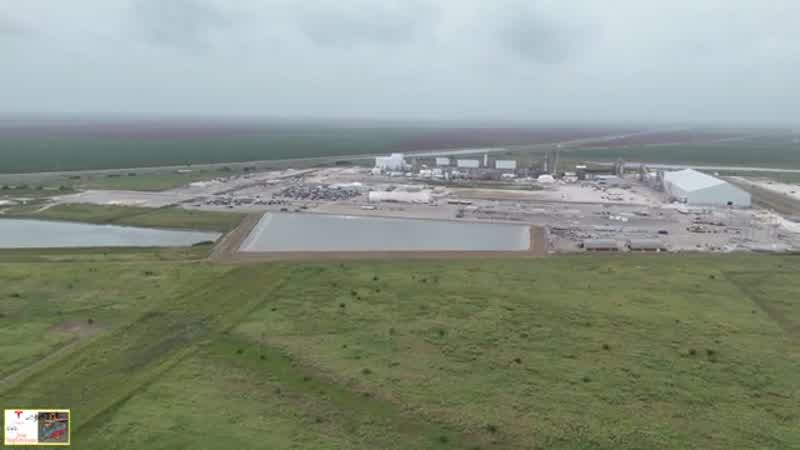
The strategic point: At full capacity the plant can supply lithium for roughly one million vehicles a year — enough to cover the vast majority of Tesla’s North American production. That insulates Tesla from lithium spot-price swings and tightens its grip on battery cost.
The catch: the ore still comes from abroad
Despite the “energy independence” framing, the Robstown refinery processes imported spodumene concentrate — much of it from Australia. The plant is a domestic refining operation, not a domestic mining operation, so it remains exposed to foreign feedstock and shipping. Closing that upstream gap is the work of a different set of projects: direct-lithium-extraction (DLE) efforts targeting the lithium-rich Smackover formation across Texas and Arkansas, and the Salton Sea in California. Tesla’s refinery solves one link in a long chain; true supply-chain independence requires those upstream sources to scale as well.
Why it matters for U.S. buyers
For American car shoppers the refinery is mostly invisible today — the packs in cars on the road were sourced years ago. But three effects are worth watching. First, owning refining capacity smooths pack-cost volatility, which supports more predictable pricing on new vehicles and on Powerwall and Megapack storage. Second, in-house refining reduces the risk that a high-volume program — Cybertruck, Semi, or a future affordable model — gets throttled by material shortages. Third, as federal battery-sourcing rules tighten, packs built with U.S.-refined lithium qualify more easily for available incentives. That last point dovetails with the broader pressure on EV pricing as the federal $7,500 credit has expired — domestic content is now one of the few levers left to keep costs down. For context on where cell chemistry is heading next, our report on Toyota’s solid-state battery timeline covers the demand side of the same equation.
“The largest lithium refinery in the Americas is operational. This marks the beginning of energy independence for North America.” — Elon Musk, on X
Frequently asked questions
Where is Tesla’s lithium refinery located?
Near Robstown, Texas, just outside Corpus Christi. Groundbreaking was in 2023, and the plant became operational in January 2026.
What does the refinery produce?
Battery-grade lithium hydroxide from spodumene concentrate, using a proprietary acid-free alkaline leach process. Its benign byproduct, analcime, is repurposed for concrete.
How much lithium can it make?
At full capacity, about 50,000 tonnes of lithium carbonate equivalent per year — roughly 50 GWh, enough for around one million electric vehicles annually.
Is the lithium mined in the U.S.?
Not yet. The refinery processes imported spodumene concentrate. Domestic upstream supply depends on separate direct-lithium-extraction projects that are still scaling.
Sources: Joe Tegtmeyer drone flyover of the Robstown/Corpus Christi site (July 2026); Tesla statements on X; reporting from Supply Chain Digital, Electrek, EnergyX, and Mining Global on the refinery’s capacity, process, and timeline. Video: Tesla lithium refinery update — Joe Tegtmeyer.