No products in the cart.
Solar Panel Features Nobody’s Talking About in 2026
Walk the floor of the world’s biggest solar trade show and one thing becomes obvious: the panel your installer quotes isn’t a commodity. The features that quietly move your real-world output — and your payback — are the ones almost nobody mentions in the sales pitch.
For most American homeowners, a solar quote is a black-rectangle conversation. How many watts? What’s the price per watt? What’s the warranty? Those questions are fine as far as they go — but they miss the features that actually decide whether your system performs on a hazy February afternoon or a soot-streaked, leaf-covered roof in November. We walked the floor of Intersolar, the industry’s largest trade show, and the panels worth talking about weren’t the ones with the biggest wattage number. They were the ones engineered for the weather and the roof you actually have. Here’s what to ask about in 2026.

The “floor” matters more than the “ceiling”
Every panel is rated on a perfect day: 1,000 watts per square meter, 25°C (77°F), no cloud, no haze, no shadow. That’s the “ceiling” — and it’s the only number most quotes show. But you don’t live on the ceiling. You live on the floor: overcast mornings, late-afternoon winter light, and the haze that sits over a real American rooftop most of the year.
The spec sheet number that actually matters is the low-irradiance figure — how much power the panel keeps when light drops to about one-fifth of standard rating. A strong panel doesn’t just make less power in weak light; it loses efficiency proportionally slower, holding its curve as the sun fades. A weak one falls off a cliff. Two panels with identical rated wattage and price can behave completely differently the moment a cloud rolls in. There’s a second trap hiding on the same sheet: the temperature coefficient. A panel that’s brilliant in weak light but bleeds power in the heat may actually lose the race in a hot-climate state like Arizona, Texas, or Florida. The question to ask your installer isn’t “how much does this make in perfect sun?” It’s “how much of that does it keep when the weather turns gray and hot?”

Frameless panels: your roof’s dirt dam is disappearing
Here’s a detail the industry doesn’t shout about: the aluminum frame around a standard panel is a problem. That lip is a dam. Dirt collects against it, snow piles up behind it, water sits in the channel — and on a pitched residential roof, none of it goes anywhere. Pollen, bird droppings, leaves, and in the right ZIP code, snow all sit there, blocking the light and quietly killing the output you paid a premium to protect.
The fix is elegantly simple: remove the frame. Edgeless (frameless) panels have no lip, no channel, no dam. Rain hits the glass and runs straight off. Snow has nothing to catch on, and dirt has nowhere to build up. A year ago these were a curiosity from a handful of manufacturers; in 2026 they’re everywhere on the show floor. For a homeowner in a leafy Northeast suburb or a snowy Mountain-West climate, that’s not a cosmetic upgrade — it’s free cleaning you never have to schedule.

Bifacial — but only if you ask “what’s underneath?”
Bifacial panels generate from both faces, not just the sky-facing side. Every manufacturer will happily quote you a bifaciality factor — 80%, 85%, 90% — which describes how well the rear face performs versus the front under test conditions. But that number is potential, not promise. The rear side only harvests light that’s reflected up onto it, and reflection depends entirely on what’s beneath the array.
| Installation type | Typical rear gain | Best for |
|---|---|---|
| Dark pitched roof, flush-mounted | ~2–5% | Most U.S. homes — minimal bonus |
| Raised flat roof, light membrane | 5–15% | Low-slope and commercial-style roofs |
| Ground mount, open racking, gravel/white surface | 10–20%+ | Yards, barns, agrivoltaics |
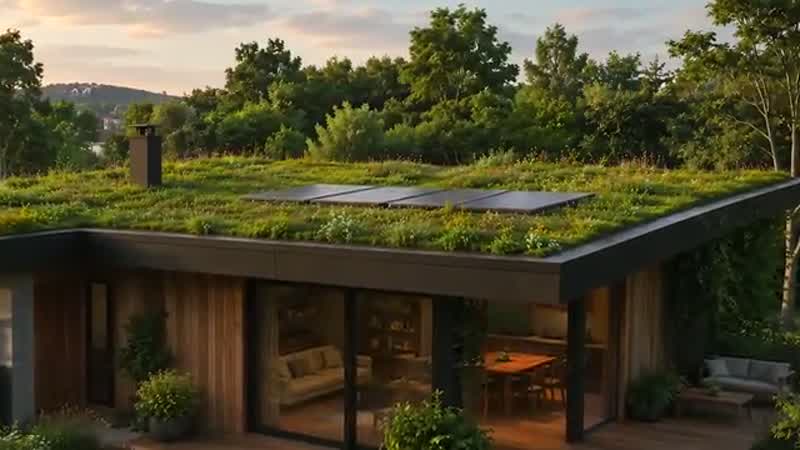
| Vertical “fence” array over green roof | East/West harvest | Combining solar with vegetation |
The lesson: a bifacial panel on a dark, close-mounted roof may deliver almost nothing extra — you paid for a shiny number on a data sheet. The same panel on a raised rack over a light surface, or as a vertical array over a green roof, can genuinely bank 10–20% more annual energy. Before you specify bifacial, ask what’s underneath the array. The installation, not the spec, decides the bonus.
When the roof has to disappear: BIPV and colored tiles
Some homeowners don’t want to see panels at all. The standard answer is an all-black module that vanishes on a slate roof — but black doesn’t disappear on terracotta, concrete tile, or a heritage property in a conservation district. For those jobs, building-integrated photovoltaics (BIPV) stop being a niche product and start being the only thing that gets the project approved. Manufacturers now offer panels with color, texture, and surface finishes that read as roof tile from the street — a roof that happens to generate electricity, not a panel bolted on top.
There’s a real efficiency trade-off: colored cells absorb less light than optimized black cells, and that’s physics. But on a job where the alternative is a planning rejection, 0% efficiency beats 20% every time. If your home sits in a historic district or a homeowners’ association with strict rules, BIPV is the feature that turns “no” into “yes.”

Glare, glass, and your planning office
A rooftop full of mirrors sounds like a joke until a planning officer asks for a glare assessment — common near airports, listed buildings, and conservation areas, and occasionally for a neighbor with a direct sightline. The surprise: the glare isn’t coming from the cells, which absorb light by design. It comes from the smooth glass, which creates a directional, mirror-like reflection. Textured or coated glass scatters that reflection so no single point takes the hit. It’s a specification decision made long before anyone climbs onto the roof — and it can be the difference between a signed permit and a stalled project.
The incentives changed — so every watt counts
Here’s the context that makes all of the above matter more than ever for a U.S. buyer in 2026. The federal 30% residential solar Investment Tax Credit (Section 25D) — the single biggest financial driver of rooftop solar for nearly two decades — ended on December 31, 2025 under the One Big Beautiful Bill Act. Homeowner-owned systems placed in service after that date no longer get the credit; only third-party leases and PPAs, plus commercial systems, retain it through 2027. That 30% cushion was worth roughly $6,000–$9,000 on a typical install.
So the math shifted. Installed costs in 2026 still run around $2.10–$3.00 per watt before incentives, or roughly $21,000–$27,000 for a typical 8 kW home system — and without the federal credit, payback leans harder on state programs, utility rebates, and net metering. That’s exactly why low-light performance, a self-cleaning frameless design, and a well-specified bifacial gain stop being trivia and start being real money on your electric bill. In California, NEM 3.0 slashed export credits by 75–90% versus the old NEM 2.0 rules, which makes pairing solar with battery storage (a Tesla Powerwall, Enphase IQ 5P, or similar) practically essential — store your midday surplus and use it during expensive evening peak hours instead of selling it back for pennies. California homeowners aren’t without help, though: state rebates like the new $3,500 first-time-buyer credit and the SGIP battery program still stack on top of net metering. Elsewhere, net metering rules vary wildly by state and utility, so the value of every exported kilowatt depends entirely on your address.
Why features matter in 2026: With the 30% federal credit gone, the panel you specify is doing more of the financial work. A module that holds its output in weak light, sheds its own dirt, and (where the site allows) harvests a bifacial bonus directly shortens your payback — no subsidy required.

Permitting is the other place time and money leak. Local approvals can eat 25–40% of a project timeline, and interconnection waits stretch from days to two months depending on your utility. Streamlined, automated permitting isn’t just a federal talking point — the same push to cut red tape that’s reshaping large energy projects (see the conservative clean-energy permitting agenda) is reaching rooftop solar through tools like NREL’s SolarAPP+. Ask any installer for their track record with your specific utility before you sign. And as home batteries multiply, virtual power plants are turning stored energy into a grid resource — a trend that runs alongside the broader U.S. build-out of firm generation and faster licensing that’s reshaping how home storage gets valued.
Bigger modules, plug-in solar, and panels in surprising places
The physics of “more watts” is simple: make a bigger panel. That’s why utility-scale modules now stretch past 3 meters. Residential panels are sized for what two people can actually carry up a ladder, which is why the good-looking, all-black, lower-profile modules tend to carry more modest ratings — aesthetics and logistics set the ceiling before cell technology even gets a vote. But manufacturers keep hunting the edge case. Germany’s balcony-solar rules cap a plug-in system at exactly 2 kW (four 500 W panels), and sure enough, 500 W modules built to fill that limit perfectly now ship straight to your door — a hint at where renter- and apartment-friendly plug-in solar is heading in the U.S.
And then there’s the stuff that makes you stop walking: a solar panel built into a car’s hood — not stuck on top, but the hood itself, trickle-charging the 12 V system every hour it sits in a parking lot. Or a retractable solar awning for an RV that shades you and powers the van in the same 60-second motion. None of it is mainstream yet, but it shows where the panel stops being a rectangle and starts being a surface.
What to actually ask your installer in 2026
The panel is a decision, not a default. Before you sign, ask for the low-irradiance figure and temperature coefficient (not just STC wattage), whether frameless modules make sense for your climate, what’s underneath any bifacial array you’re quoted, and whether BIPV or textured glass solves a planning or HOA problem. With the federal credit gone, those answers do more of your financial work than the brochure ever admits — and the right combination can shave years off payback without a single subsidy.
FAQ
Is the 30% federal solar tax credit still available in 2026?
No. The residential 30% Investment Tax Credit (Section 25D) ended for homeowner-owned systems on December 31, 2025 under the One Big Beautiful Bill Act. Leases, PPAs, and commercial systems retain it through 2027. State rebates, utility incentives, and net metering still apply, so solar can still pencil out — especially in high-electricity-cost states.
Do bifacial solar panels really produce more energy?
They can, but only when the surface beneath reflects light onto the rear face. Expect roughly 2–5% on a dark, flush-mounted roof, 5–15% on a raised light-colored flat roof, and 10–20% or more on a ground mount over gravel or a reflective surface. Ask what’s underneath the array before paying extra for a high bifaciality number.
Are frameless solar panels worth it?
For homes with leaf, pollen, bird-dropping, or snow buildup, frameless panels reduce dirt and snow trapping because there’s no aluminum lip to dam up debris. They’re not a must for every roof, but in messy climates they cut the cleaning burden and protect real-world output.
Why does California need battery storage with solar now?
Under NEM 3.0, export credits fell 75–90% versus NEM 2.0, so selling surplus midday power back to the grid barely pays. Pairing solar with a Powerwall or Enphase IQ 5P lets you store that energy and use it during expensive evening peak hours — which is where the real savings now live, supported by California’s SGIP battery rebate.
Sources:
- eFIXX — Intersolar walkthrough: low-irradiance performance, temperature coefficient, frameless panels, bifaciality, BIPV, glare/textured glass, integrated solar (car hood, RV awning)
- Transcript (D:/tmp/evbatch/OL9k4onY0r8/transcript_clean.txt) — bifaciality factors 80–90%; bifacial gain by installation; frame-as-dam; BIPV for planning approval; glare from glass not cells
- Energy Rebate Calculator — Federal Solar Tax Credit 2026: Section 25D expired Dec 31, 2025 under OBBBA; 2026 installed $/watt and payback shifts by state
- Solar Price List — California NEM 3.0: export rates $0.03–$0.08/kWh (75–90% below NEM 2.0); payback 8–11 years with battery; SGIP battery rebate up to $1,000/kWh
- Solar Stack / Accelerate Solar — 2026 panel tech: TOPCon/HJT 24–25% efficiency, bifacial gain tables, IEC 61215:2021 certification for incentives
- Related EVCUBE: California’s $3,500 first-time-buyer rebate, Clean-energy permitting reform, U.S. firm generation build-out