No products in the cart.
Walmart Is Quietly Winning the EV Charging War
While everyone argued about Tesla Superchargers and the federal NEVI program, Walmart turned its parking lots into one of the fastest-growing DC fast-charging networks in America. In the first two weeks of July alone it opened 11 new sites — and only Tesla deployed more new charging ports in the U.S. last quarter.
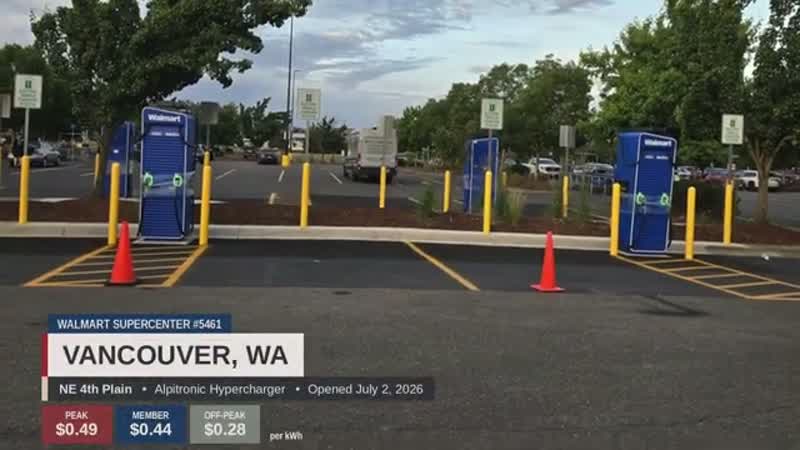
There is a quiet story hiding in plain sight at the edge of America’s parking lots. The country’s largest retailer is building a coast-to-coast network of 400-kW DC fast chargers, and it is doing so faster than almost anyone expected. According to Landon West of The Arkansas eTraveler, who has tracked the rollout daily since the first units went into the ground in Springdale, Arkansas, the Walmart network closed June at 74 locations and crossed 85 live sites in the first two weeks of July 2026 — 11 openings in a fortnight, a pace he says beats anything the network has done before. For a company that barely had a public charging presence two years ago, that is a staggering ramp.

The numbers nobody expected
The scale is what makes this a story rather than a footnote. By the end of June, Walmart’s network had passed 600 individual stalls (612, per State of Charge’s monthly tally) — an average of about 8.4 stalls per location, with larger sites planned for up to 16. Every stall runs on 400-kW DC hardware, the kind of speed that puts a meaningful charge into a modern EV in the time it takes to do a grocery run. And here is the stat that should reset how the industry thinks about retail charging: in the second quarter of 2026, only Tesla deployed more new charging ports in the United States than Walmart. Not Electrify America. Not EVgo. Not ChargePoint. Walmart.
West, who partners with Tom Moloughney of State of Charge on a dedicated monthly “State of Walmart EV Charging” series, frames it bluntly: 11 new openings in early July is faster than the already-stunning 25-site burst the network posted in the first two weeks of May. A single month — June — added 12 locations, a 20% jump. At that clip, crossing 100 active sites is a question of weeks, not quarters. The Arkansas eTraveler now lists 141 locations marked “coming soon / under construction” and more than 180 additional sites spotted in permitting or media reports. The installed-or-planned total is already over 400.
Why this matters: Walmart operates more than 5,200 stores in the U.S., including Sam’s Club locations. Electrifying even 10% of that footprint would make it one of the largest fast-charging networks in the country. The company says roughly 5.4% of the U.S. population is already within 10 miles of a Walmart charger — and the buildout is just getting started.
Why a Walmart parking lot is the perfect charging spot
The genius of the Walmart play is not the charger hardware. It is the location. The single biggest friction point in everyday EV ownership is not range — it is convenient, predictable access to a fast charger where you already are. Gas stations solve that for combustion cars because you detour for fuel anyway. Walmart solves it by removing the detour entirely.
You are already there. The average Walmart trip is a 30-to-60-minute errand, and that dwell time lines up almost perfectly with a 10–80% fast-charge session on a 400-kW stall. Plug in, grab a cart, do your shopping, come back to a topped-off battery. There is no separate “charging trip” to plan, no anxious waiting at a highway plaza, no wondering whether the stall will be working when you arrive. Real-time availability is already piped into Google Maps, PlugShare, and Chargeway, so drivers see live status before they ever pull in.
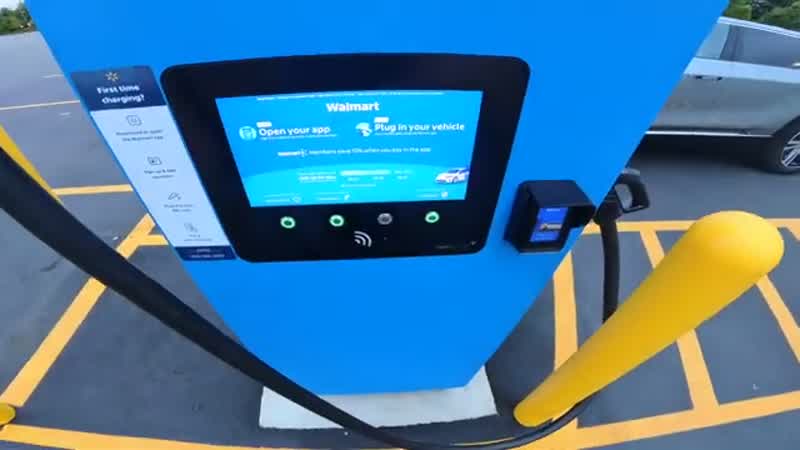
This is the model that makes retail charging the most natural place to charge for the majority of drivers who are not on a cross-country road trip. As we’ve argued before, charging speed — not just range — is what wins the 2026 EV argument, and a 400-kW stall in a lot you visit weekly is about as good as convenience gets.
What Walmart is actually building
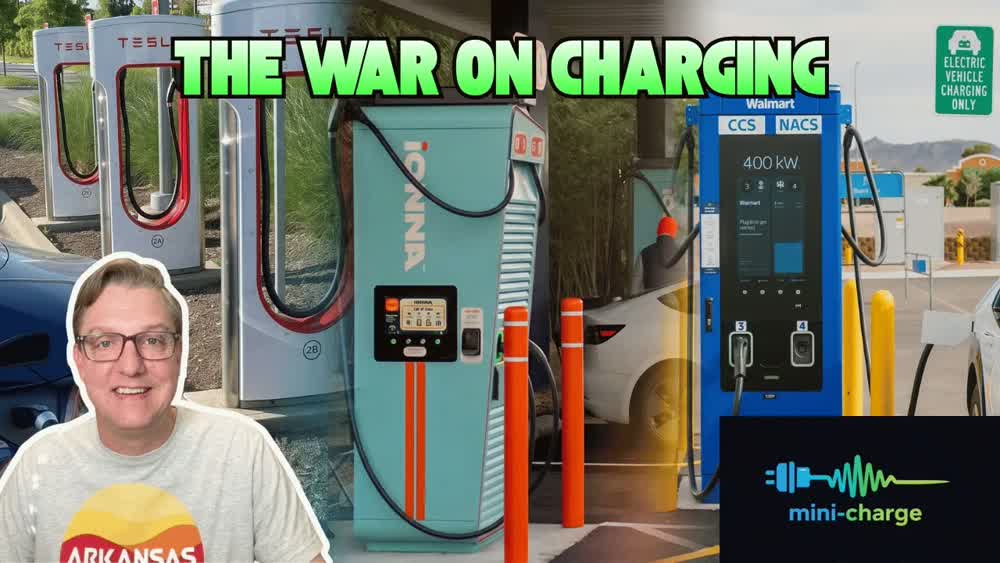
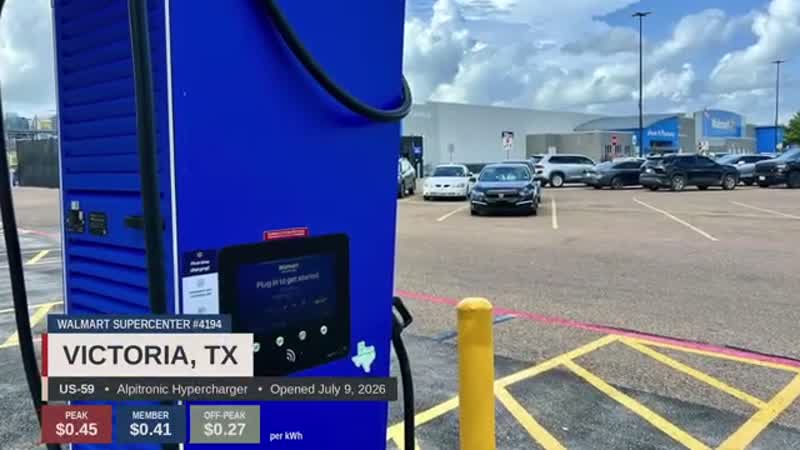
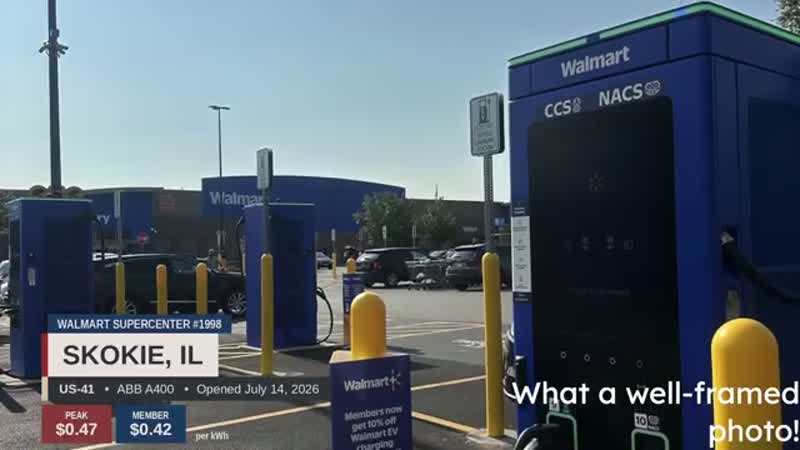
Walmart is not reselling someone else’s network. It owns and operates the chargers directly — a deliberate choice that lets it standardize performance, set pricing, and fold charging into its own app ecosystem. The hardware is exclusively 400-kW DC, split between two suppliers: ABB A400 and Alpitronic HYC400. Each cabinet feeds two ports — one CCS1 and one NACS (SAE J3400) — so both legacy and Tesla-style connectors are covered at every site. That dual-connector strategy is the quiet key to compatibility during the industry’s transition to NACS.
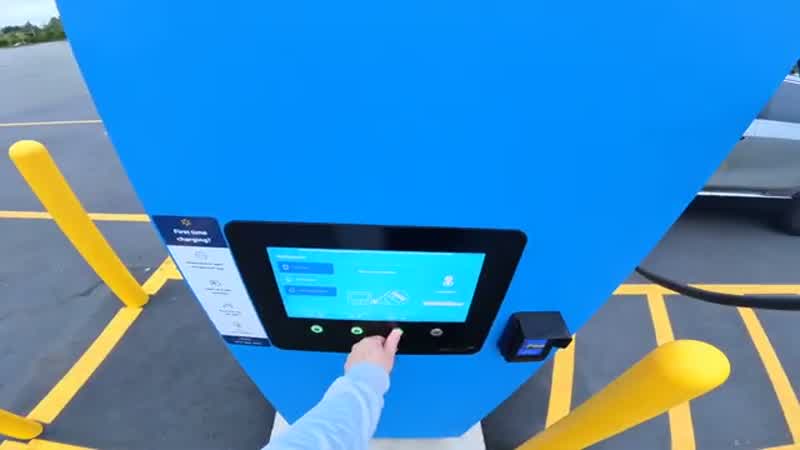
Pricing is transparent and member-friendly. A typical on-peak rate runs around 47 cents per kWh, with 42 cents for Walmart+ members and as low as 29 cents off-peak at sites with time-of-use rates. There are no idling fees, and Walmart has committed to clear, up-front pricing with no surge-style dynamic pricing based on how crowded a site is. Walmart+ subscribers who start and pay through the Walmart app get a steady 10% discount. Payment today is app-led — “open the Walmart app, scan the QR code, choose your connector, confirm and pay” — but the company confirmed it is adding credit-card terminals to new and existing stalls after customer feedback, so you won’t always need the app.

One telling detail from the rollout: Walmart initially placed the NACS holster on the right side of the cabinet, then realized most Teslas (and a growing share of new EVs) have their NACS port on the left rear. It is now flipping the layout so the NACS cable sits on the left, with CCS1 on the right — a small but telling sign the company is sweating the real-world driver experience rather than just dropping boxes in asphalt.
Walmart vs the rest of the charging field
So where does a retailer stack up against the dedicated networks and the travel-center giants it now competes with? The table below puts Walmart next to the players it is quietly overtaking.
| Player | U.S. DC fast-charging footprint (mid-2026) | What sets it apart |
|---|---|---|
| Walmart | 85 sites / 600+ stalls (July 2026) | You’re already shopping there; 400 kW; Walmart+ 10% off |
| Tesla Supercharger | 37,736 stalls | Purpose-built road-trip network, NACS, Magic Dock CCS |
| Electrify America | 5,664 stalls | Highway corridors + retail hosts (incl. legacy Walmart/EA sites) |
| EVgo | 5,047 stalls | Urban hubs; Pilot & Flying J travel-plaza deal |
| ChargePoint | 4,777 stalls | Mostly Level 2; owner-operated model |
| Travel centers (Buc-ee’s, Sheetz) | dozens of sites | Destination stops built around food and fuel |
Walmart is still a fraction of Tesla’s size, and it is not trying to be a cross-country road-trip network first. Its edge is the everyday errand. But the growth rate is the headline: industry watchers call Walmart the “dark horse” most likely to crack the top 10 networks, and it is climbing on the back of real-estate advantage no dedicated operator can match. While Electrify America and EVgo scramble for host sites, Walmart owns the asphalt.
The NACS and Supercharger context
Walmart’s native NACS connector is more than a compatibility checkbox — it drops the network straight into the mainstream of American charging. With Tesla having opened the vast majority of its Supercharger stalls to non-Tesla EVs, and NACS now the de facto standard for new U.S. models, a Walmart stall that speaks both CCS1 and NACS is future-proofed for almost everything on the road. For a driver in a newer NACS-equipped EV, the experience is nearly as frictionless as a Supercharger, minus the membership wall.
And the comparison to gas stations is the one legacy automakers and fuel retailers should fear. A Walmart charger does not need a separate convenience-store business to make money — the store is the business, and the charger is a reason to choose this parking lot over the one across the highway. That is a structural advantage Sheetz and Buc-ee’s have leaned on for years, and now the world’s largest retailer is playing the same game at 5,200-times the scale.
Why 100 sites is just the start
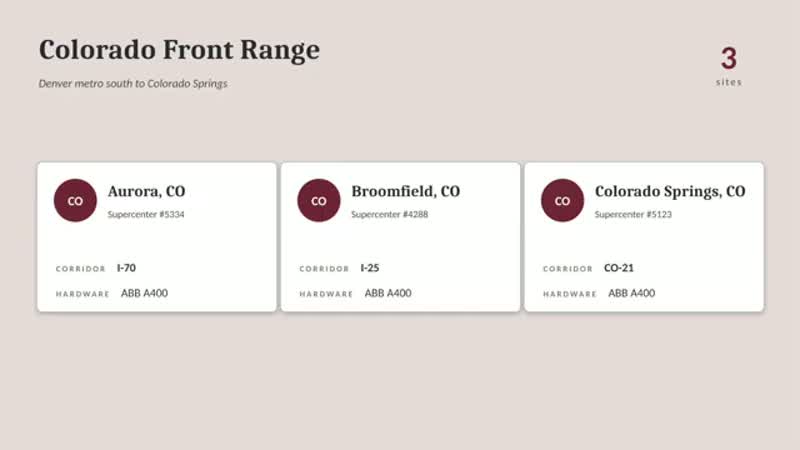
The pipeline is the real story. West’s tracking shows 141 sites under construction or coming soon and 180-plus in permitting — and those are only the ones spotted publicly. With more than 5,200 U.S. stores and Sam’s Clubs to draw from, the ceiling is essentially the company’s real-estate footprint. Adam Happel, Walmart’s General Manager for Retail EV Charging, told InsideEVs the company is “not in this game for the short term” and envisions thousands of chargers across as many locations as possible. The federal NEVI program and state incentives help, but Walmart’s buildout is largely a self-funded land grab built on property it already owns.
There are rough edges. The ABB A400 NACS holster had early durability issues Walmart is replacing, and app-only payment is a hurdle the company is only now fixing with card readers. Plug & Charge — plug in and charge with no app or card — is not yet supported, though Walmart says it is considering it. But none of that changes the trajectory. A retailer that already sees millions of cars in its lots every day does not need to invent demand; it just needs to install the stalls.
Should you charge at Walmart?
If there is a Walmart with chargers on your regular route, it is one of the lowest-friction ways to fast-charge in America today: 400-kW speed, transparent pricing, no idle fees, and a 10% break if you are a Walmart+ member. It will not replace a Supercharger on a 1,500-mile road trip, but for weekly errands it is arguably the most convenient charger you can use — you were going to be there anyway. As the broader EV price war pushes more Americans into EVs, convenient retail charging like this is exactly what closes the “where do I plug in?” gap that still scares off buyers. The war for everyday charging may already have a quiet winner.
FAQ
How many Walmart EV charging sites are live in 2026?
As of mid-July 2026, Walmart’s network had crossed 85 active DC fast-charging sites with more than 600 stalls, up from 74 at the end of June. The tracker lists 141 sites under construction or coming soon and 180-plus in permitting, with a total pipeline above 400 locations.
How fast are Walmart’s chargers, and what connectors do they use?
Every Walmart stall runs on 400-kW DC hardware from ABB (A400) or Alpitronic (HYC400). Each cabinet has two ports — one CCS1 and one NACS (SAE J3400) — so both legacy and Tesla-style EVs can charge. Time-of-use sites can drop to around 29 cents per kWh overnight.
How much does it cost to charge at Walmart?
Typical on-peak pricing is about 47 cents per kWh, 42 cents for Walmart+ members, and as low as 29 cents off-peak at time-of-use locations. There are no idling fees, pricing is shown up front, and Walmart+ subscribers get a steady 10% discount when they pay through the Walmart app.
Can I pay without the Walmart app?
Today most sites are app-led — you scan a QR code in the Walmart app to start and pay. Walmart has confirmed it is adding credit-card terminals to new and existing stalls after customer feedback, and the first card-terminal site is already in trial, so app-free payment is rolling out.
Sources:
- The Arkansas eTraveler (Landon West) — July 2026 Walmart EV charging update: 74 sites end-June → 85 by mid-July; 11 openings in two weeks; only Tesla added more Q2 2026 ports
- State of Charge / State of Walmart EV Charging (July 2026) — 73 locations / 612 stalls end-June; 400-kW ABB A400 & Alpitronic HYC400; 17 states; 5.4% of population within 10 miles
- InsideEVs — interview with Adam Happel, Walmart GM Retail EV Charging: app payment, card terminals planned, no idle fees, Walmart+ 10% discount, NACS cable moved to left
- EVChargingStations.com — Largest DC Fast-Charging Networks in the US (June 2026): Tesla 37,736 stalls; Electrify America 5,664; EVgo 5,047; ChargePoint 4,777; Walmart flagged as top-10 “dark horse”
- Transcript (D:/tmp/evbatch/PwbHNXb7Cco/transcript_clean.txt) — Cincinnati Supercenter 2250 (July 1, four ABB A400 units / 8 stalls, 47¢/42¢/29¢ pricing); Taylor’sville UT 1686; 25-site May record
- Related EVCUBE: 800V charging baseline, The EV price war, EVs nobody’s buying in Q2 2026