No products in the cart.
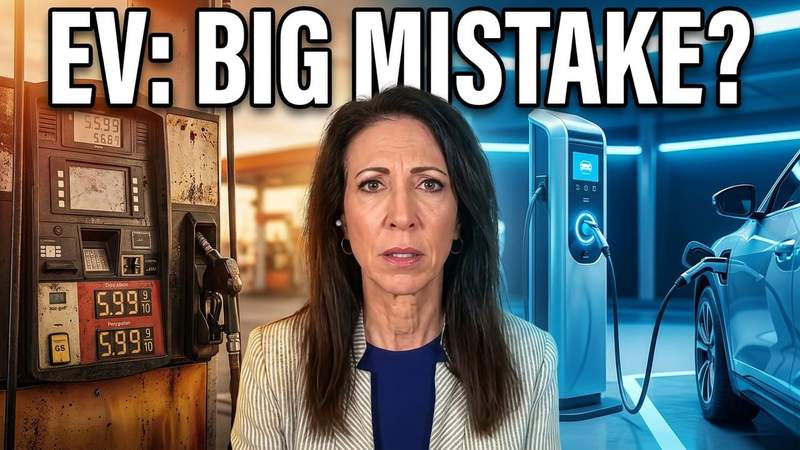
With gasoline prices climbing once again, millions of American drivers are asking whether an electric vehicle can save them money at the pump. But according to Lauren Fix, automotive expert and founder of Car Coach Reports, the rush to EVs driven by high gas prices may carry hidden costs that far outweigh the savings. From crippling battery replacement bills to the uncertainty of federal tax credits, the economics of switching are far more complex than a simple fuel-cost comparison.
Key numbers
The real cost of switching to electric
Replacing a battery on a used Chevy Bolt or Volt runs between $7,000 and $8,000 and requires a certified ASC technician.
New electric vehicles remain significantly more expensive than the average new gas-powered car, which sits around $48,000.
Rapid depreciation means buyers of used EVs may face massive value loss on top of expensive battery and maintenance costs.
Administration officials have suggested fuel prices could drop significantly within weeks, questioning the urgency of an immediate EV purchase.
Analysis
The used EV trap: battery costs that eclipse fuel savings
One of the most overlooked financial hazards in the EV market is the cost of battery replacement on used electric vehicles. Fix highlights that a used Chevy Bolt or Chevy Volt with a degraded or failed battery faces a repair bill between $7,000 and $8,000. Unlike a traditional gas vehicle where a battery replacement is a simple trip to an auto parts store, EV battery work must be performed by a certified ASC technician who specializes in high-voltage electric car systems.
“This is not something you would replace yourself like you just used to go to Sears and get a battery and put it in,” Fix notes in the interview. “Those days are gone. This has to be done by a certified ASC technician who specializes in electric cars. And that’s expensive.”
For a family purchasing a used EV to save on fuel costs, an unexpected $7,000-plus battery replacement can wipe out years of gasoline savings in a single service visit. The equation becomes particularly grim when the used EV was purchased at the top of the market, with inflated prices driven by demand spurred by high gasoline costs.

Analysis
Government policy whiplash: mandates, tax credits, and uncertainty
The current administration has pushed aggressively for EV adoption through a combination of mandates and consumer incentives. Federal tax credits of up to $7,500 have been a cornerstone of this strategy, effectively subsidizing the purchase of new electric vehicles for qualifying buyers. However, Fix raises a critical point: these incentives are not guaranteed to last, and their potential expiration could dramatically alter the financial calculus for prospective EV buyers.
“There’s such a wealth of information,” Fix says, noting that policy uncertainty combined with Chinese EVs entering through the Texas border creates a volatile market environment. She points to Ford as a manufacturer that recognizes the affordability crisis, with the company developing a $30,000 EV truck solution. The Ford Maverick has already demonstrated strong market success as an affordable alternative, proving that consumers want value, not just electrification.
Meanwhile, Senator Bernie Moreno is fighting against policies that would further mandate EV production without addressing affordability. The tension between regulatory pressure to electrify and the market reality of high prices leaves consumers caught in the middle, making purchasing decisions based on today’s incentives that could vanish tomorrow.
Analysis
The comparative economics: EV vs. gas-powered total cost of ownership
A fair comparison between EVs and gas-powered vehicles must go beyond the price at the pump. While the average EV owner saves roughly $800 to $1,200 annually on fuel costs compared to a driver paying $4.00 per gallon, these savings are quickly eroded by higher insurance premiums, elevated depreciation rates, and the risk of expensive out-of-warranty battery repairs. Used EV insurance can run 15-25% higher than comparable gas models due to repair complexity and parts availability.
Fix further points to the geopolitical dimension: Treasury Secretary Scott Bessent has indicated that gas prices could drop “within 2 weeks, or up to 6 weeks” depending on policy outcomes. The United States currently imports only about 3% of its oil from Venezuela, meaning domestic supply is less constrained than many consumers assume. If gas prices do fall significantly, the fuel-cost argument for an immediate EV purchase weakens considerably.
For the budget-conscious buyer, a new gas-powered compact car at $22,000-$25,000 still undercuts the average EV by more than $30,000. Even factoring in fuel savings over five years, the gas vehicle often emerges as the more economical choice for drivers who cannot take full advantage of home charging or who drive primarily highway miles where gas engines are most efficient.

Comparison
EV vs. gas: total cost of ownership comparison (5-year estimate)
| Cost category | New EV (avg. $56,000) | New gas car (avg. $48,000) | Used EV (3 yr old) | Used gas car (3 yr old) |
|---|---|---|---|---|
| Purchase price | $56,000 | $48,000 | $28,000 | $24,000 |
| Annual fuel/energy cost | $600 | $1,800 | $600 | $1,800 |
| Annual insurance | $1,900 | $1,500 | $1,700 | $1,300 |
| 5-year battery risk | Under warranty | N/A | $0-$8,000 | N/A |
| 5-year depreciation | -$28,000 | -$19,200 | -$8,400 | -$7,200 |
| 5-year total cost | ~$69,500 | ~$55,000 | ~$38,700-$46,700 | ~$31,500 |
FAQ
Common questions about EVs and high gas prices
Is buying an EV a mistake when gas prices are high?
Not necessarily for every buyer, but the economics depend heavily on your specific situation. If you drive primarily in the city, have access to home charging, can afford a new EV under warranty, and plan to keep the vehicle for 8+ years, an EV can still save money. However, buying a used EV specifically because gas is expensive carries significant risk from battery degradation and replacement costs.
How much does it really cost to replace an EV battery?
According to Lauren Fix, an automotive expert, battery replacement on used EVs like the Chevy Bolt or Volt costs between $7,000 and $8,000 and must be performed by a certified high-voltage technician. This can instantly negate years of fuel savings for the owner.
Will gas prices stay high enough to justify an EV purchase?
Treasury Secretary Scott Bessent has indicated that gas prices could drop significantly within 2 to 6 weeks, depending on policy outcomes. If fuel prices ease, the fuel-cost argument for switching to an EV loses much of its urgency.
What affordable EV options exist under $30,000?
Ford has been developing a $30,000 EV truck solution, building on the success of the Maverick. However, most new EVs still average around $56,000. The used market offers more affordable entry points, but buyers must carefully evaluate battery health and remaining warranty coverage.
Are federal EV tax credits guaranteed?
No. The current $7,500 federal tax credit for qualifying EVs is subject to legislative changes. If these credits expire or are reduced, the effective price of a new EV could rise significantly, and the resale value of previously purchased EVs may be affected as well.
Sources