No products in the cart.
Toyota’s first EV, the bZ4X, was recalled for wheels that could fall off. Four years later, the 2026 bZ Woodland is the family SUV Toyota hopes finally puts it on a US buyer’s shortlist next to the Tesla Model Y and Hyundai IONIQ 5. Doug DeMuro just drove one, and the spec sheet does something the bZ4X never could: compete.
From a wheel recall to a real contender: how Toyota got here
The Toyota bZ Woodland is not Toyota’s first electric SUV. It’s the third. Toyota launched the bZ4X in 2022 and almost immediately recalled 95,000 vehicles because the wheels could detach. Sales cratered. Through September 2025, Toyota moved just 61 bZs in a month — a 90% collapse from the prior September.
Then Toyota did the rare thing: it actually listened. For 2026, it dropped the awkward “4X” suffix entirely, swapped in a 74.7 kWh battery that delivered a 25% range boost to a 314-mile top EPA estimate, added a native NACS port so owners could pull up to any Tesla Supercharger, and started at under $35,000. It worked. The renamed 2026 bZ became the third best-selling EV in the US in Q1 2026 behind only the Model 3 and Model Y, with 10,000+ units moved.
The Woodland is the next move. It is a stretched, ruggedized version of that same car — about six inches longer than the bZ, with 8.4 inches of ground clearance, standard X-MODE all-wheel drive, and 3,500 pounds of towing capacity that the regular bZ doesn’t have. In H1 2026 Toyota sold 554 Woodland crossovers, plus 17,553 bZs and 3,748 C-HRs — a combined 21,855 EVs, up 136% year-over-year.

SIGNAL: Toyota’s 2026 EV lineup is built around one bet — fix range, charging, and price, and the buyers will come. Q1 2026 said they were right.
The quirks Doug actually flagged
Doug scored the Woodland a 54/100 — higher than every rival he compared it to — and called it Toyota’s first “really compelling” EV. But it earns that score with some of the strangest cabin ergonomics in the segment.

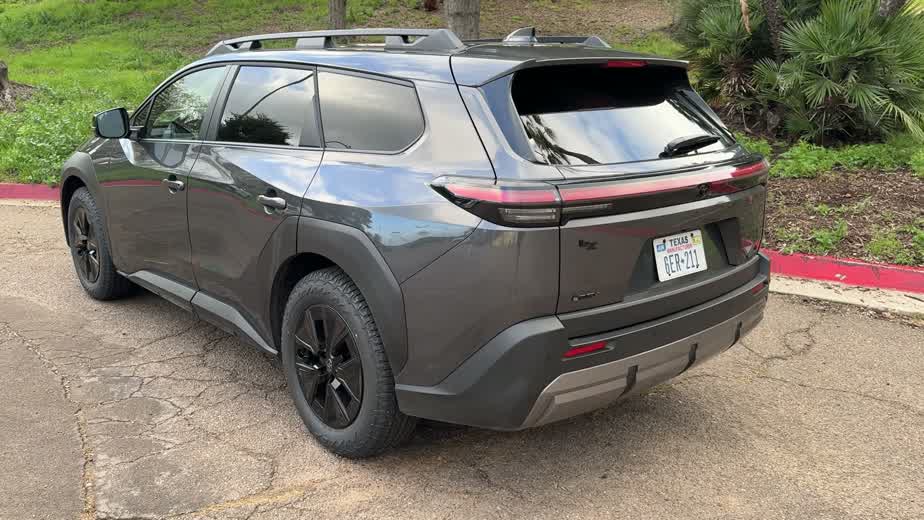
The wheel arches wear black plastic cladding so wide it wraps forward into the front bumper — Doug thought Toyota gave him a gray press car on purpose to hide how aggressive the cladding looks. The optional Dunlop Grandtrek AT30 all-terrain tires are visually odd on what is essentially a wagon, but they actually deliver a softer ride by way of more sidewall, at the cost of more tire noise on rough pavement.

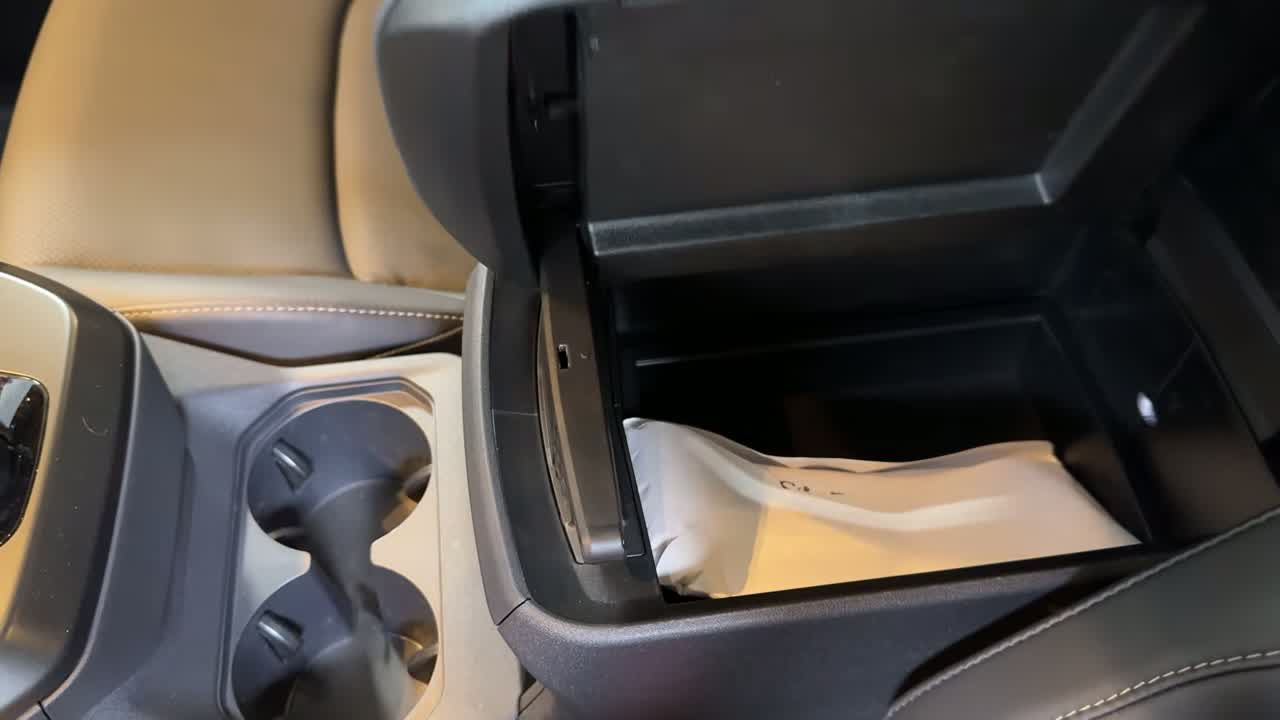
Inside, the gauge cluster sits far enough back that you look at it over the top of the steering wheel — not through the rim, like every other car. The gear selector is a twist dial that you press down first, then rotate. The center console is wide enough to hold two Qi wireless charging pads side by side, opens from both sides so either front occupant can reach in, and has a hidden lower shelf for extra storage. There is a dedicated headlight-washer button to the left of the steering wheel, which Doug noted is the kind of thing German luxury cars had in the 1990s.
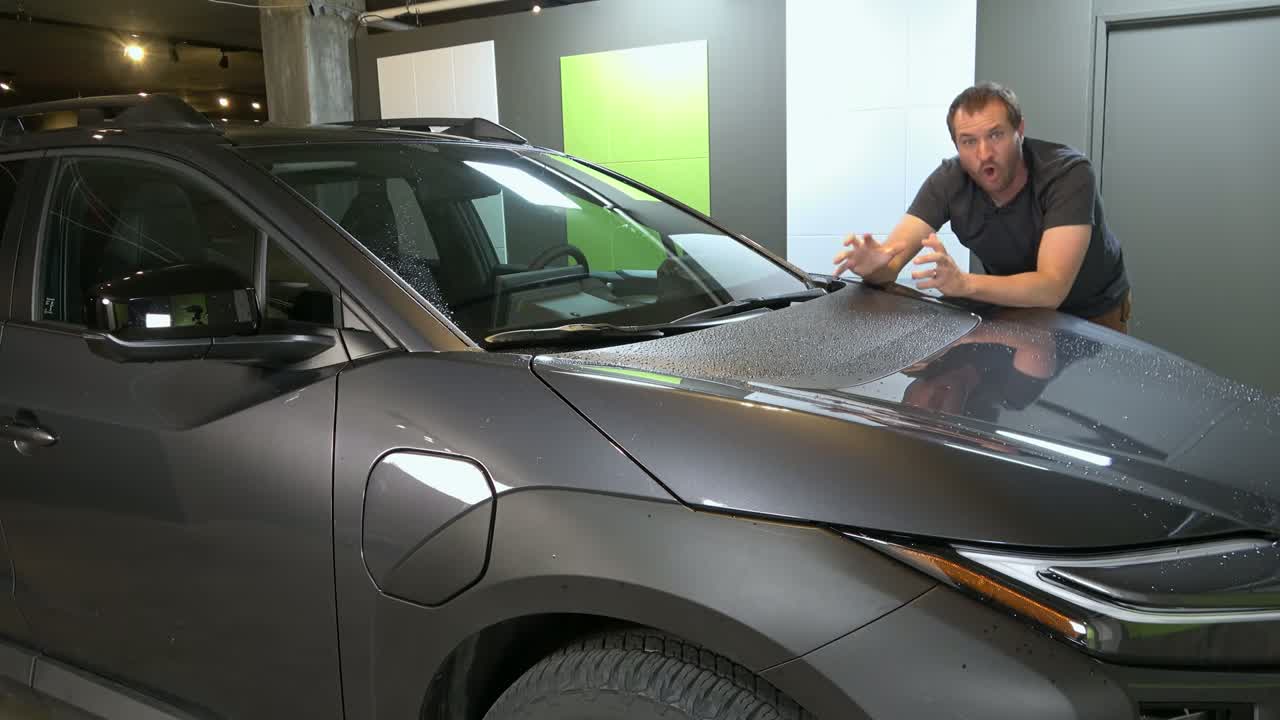
And then there is what isn’t there: no glove box, and no front trunk. The cargo hold is the only storage you get beyond the cabin. It is, Doug joked, the kind of omission you’d expect on an Italian car — and he’s not wrong that it shows up in supercars more often than family SUVs.
Tailgate badging, explained
Toyota split the name across the tailgate: “bZ” on the left, “Woodland” on the right. Doug thinks the “bZ” prefix will quietly disappear over the next model years — the original bZ naming plan was to ship a bZ2 and bZ6, and consumers hated it. The Toyota logo itself is unusually small, the opposite of where the industry is heading.
On-road behavior: not exciting, but quiet and quick
Doug’s drive note was unusual: he liked the Woodland more than he expected, mostly because it felt more solidly built than a Subaru Outback or Toyota RAV4 — both of which it physically resembles. The steering is predictable rather than sharp, there is no sport mode, and acceleration from a stop and in the mid-range both feel genuinely quick at 4.4 seconds to 60 mph.
What surprised him was the seating position. For a wagon-shaped crossover, you sit car-low, not SUV-high. If you’ve been cross-shopping a Jeep or a Highlander expecting elevated visibility, you’ll be a little disappointed. If you’ve been cross-shopping an Outback, you’ll find the cabin more solid and the powertrain noticeably quicker.
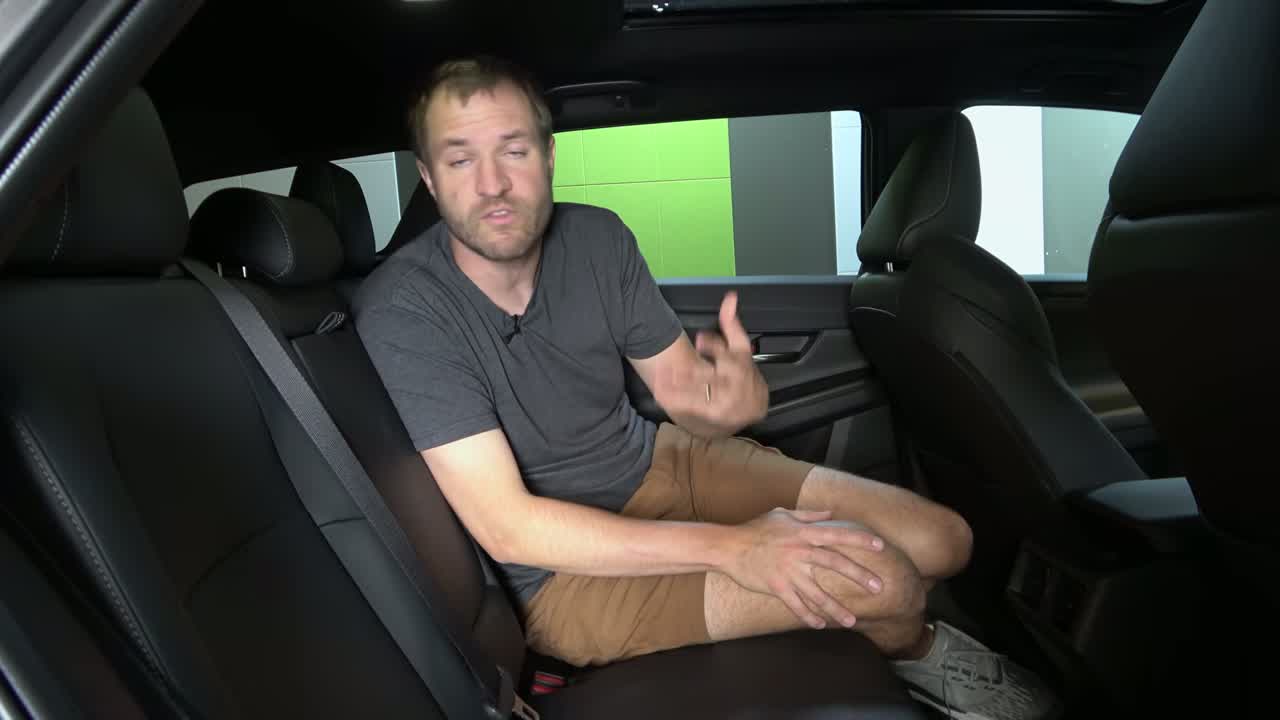
The rear seat is genuinely roomy. The transmission tunnel hump is gone because there’s no driveshaft, so three-across is theoretically possible, though the climate vent console still cuts into the middle passenger’s knee room. Heated rear seats and two USB-C ports are standard.

Specs at a glance
| Item | Spec |
|---|---|
| Powertrain | Dual permanent-magnet motors, standard AWD |
| Combined output | 375 hp (37 hp more than the 2026 bZ) |
| 0–60 mph | 4.4 sec (Toyota estimate) |
| Battery | 74.7 kWh total / ~67 kWh usable |
| EPA range | 281 mi (all-season); 260 mi (all-terrain) |
| EPA efficiency | 117 MPGe combined |
| DC fast charge | 150 kW peak, 10–80% in ~30 min |
| AC charge | 11 kW onboard, 0–100% in ~7 hr |
| Ground clearance | 8.4 in |
| Towing | 3,500 lb |
| Cargo (seats up / folded) | ~33.8 / 74.3 cu ft |
| Starting MSRP | $45,300 (base) / $47,400 (Premium) |
| US dealerships | Arrived March 2026 |
SIGNAL: Toyota is offering up to $5,500 in lease cash on the 2026 bZ Woodland right now — about 12% off the sticker — because it is still a slow seller in a segment where wagons and EVs each lose roughly 30% of shoppers compared with crossovers and hybrids.
How it stacks up: Model Y, IONIQ 5, EV6
The Woodland lands directly in the mid-size electric SUV fight. Here is how its AWD configuration compares with the three US-segment benchmarks at the closest price and spec tier.
| Model | Powertrain | EPA Range | 0–60 mph | Starting MSRP | DC Fast Charge |
|---|---|---|---|---|---|
| Toyota bZ Woodland (2026) | 375 hp AWD | 281 mi (260 w/ A/T) | 4.4 s | $45,300 | 150 kW |
| Tesla Model Y Long Range AWD (2026) | 397 hp AWD | 327 mi | 3.9 s | $48,990 | 250 kW |
| Hyundai IONIQ 5 SE Long Range AWD (2026) | 320 hp AWD | 290 mi | 4.6 s | $41,000 | ~250 kW (800V) |
| Kia EV6 Light Long Range AWD (2026) | 320 hp AWD | 295 mi | ~5.0 s | $45,200 | ~250 kW (800V) |
Three takeaways from the table:
- Range is the Woodland’s real weakness. At 281 miles it sits 9 mi behind the cheapest AWD IONIQ 5 ($41,000), 14 mi behind the AWD EV6, and 46 mi behind the Model Y Long Range. Spec the optional A/T tires and the Woodland drops to 260 mi — roughly 20% short of the Model Y.
- Charging is also behind. Toyota’s 150 kW DC peak looks slow next to the 250 kW peak on the Model Y and the 800V architecture in the Hyundai and Kia, which both add about 200 miles of range in under 20 minutes. The Woodland takes roughly 30 minutes for 10–80%, and that’s only if you pre-condition the pack with an active Drive Connect subscription.
- Price is mid-pack. At $45,300, the Woodland is $4,300 more than the IONIQ 5 SE Long Range AWD but delivers 9 fewer EPA miles, and $4,310 less than the Model Y Long Range AWD but with 46 fewer miles. The Premium trim at $47,400 narrows the Model Y gap to $1,590.
The other thing the table doesn’t show: Toyota still has roughly 1,200 franchised US dealers with EV-trained staff, and every one of them can service the Woodland under warranty. Hyundai and Kia are catching up fast, but Toyota’s dealer footprint is still the largest in America. For a buyer in a smaller market where the nearest Tesla service center is two hours away, that matters more than 46 miles of range.
US availability and the catch nobody mentions
Woodlands have been at US dealers since March 2026. Two things US shoppers should know that Doug did not dwell on:
- The federal $7,500 Clean Vehicle Credit expired on September 30, 2025 under the One Big Beautiful Bill Act. A buyer who waited for the Woodland did not lose the credit — they were never eligible for it on a vehicle that arrived in March 2026. But the credit’s absence is reshaping the segment: Hyundai cut IONIQ 5 prices by up to $9,800 across the lineup specifically because the credit disappeared, which is why the SE Long Range AWD now opens at $41,000 instead of $49,350.
- Toyota is advertising $5,500 in lease cash on a new 2026 bZ Woodland, plus 0% APR for 72 months. That’s an effective 12% discount off the sticker before any state incentives.
Doug’s bet is that dealers will be even more aggressive within six months. Both EVs and wagons have been slow sellers in 2026 — combining the two in one vehicle makes discounting more likely, not less.
FAQ
Is the bZ Woodland the same car as the Subaru Trailseeker?
Yes and no. Both are co-developed on Toyota’s e-TNGA platform with Subaru, share the 74.7 kWh battery, and are built in Japan. The Trailseeker is roughly $5,300 cheaper starting (about $41,000), tunes the suspension and styling for Subaru’s traditional audience, and uses different interior trim. If you want the X-MODE off-road calibration tuned by the company that built the Outback, the Trailseeker is the better pick. If you want Toyota’s dealer network and the $5,500 lease cash, the Woodland is.
How does the Woodland compare to the old Toyota bZ4X?
Almost every spec is better. The 2026 bZ (formerly bZ4X) hits up to 314 miles of EPA range with the 74.7 kWh battery — a 25% improvement over the 2025 bZ4X’s ~252 mi. The Woodland, being longer, heavier, and more powerful, drops to 281 mi (or 260 with the A/T tires) but adds 8.4 in of ground clearance, 3,500 lb of towing capacity, and 37 more horsepower than the standard bZ. The NACS port, 14-inch touchscreen, and dual Qi chargers are new across the bZ family for 2026.
What’s the real-world range in winter and at highway speed?
Toyota has not published an official winter number. Real-world testing of the closely related standard bZ AWD in cold weather returned roughly 222 miles on a full charge — about 23% below the EPA estimate. Expect the Woodland to land in the same band: roughly 215–240 miles of real-world range at 70 mph in mild weather, and somewhere in the 180–210 mile band below freezing with the heat pump running. The A/T tire option will cost you another 21 EPA miles before any weather penalty.