China’s Clean Air Playbook: The Same Policy Engine That Built the World’s Largest EV Charging Network
June 16th, 2026
By EVCUBE .NET
No Comments
China didn’t just clean its air—it built the world’s most advanced EV charging ecosystem along the way. From 68 µg/m³ PM2.5 in 2013 to 28 µg/m³ in 2025, the same centralized policy engine that transformed Beijing’s skies is now deploying 1 million EV chargers per year and pushing NEV adoption past 62.9%. Here’s how the playbook works and what it means for the US.
China’s Two Transformations Are the Same Story
Viewed separately, China’s air quality turnaround and its EV charging buildout look like independent policy successes. They are not. Both rest on the same state capacity: the ability to set a national target, allocate capital at scale, and enforce compliance across 31 provinces.
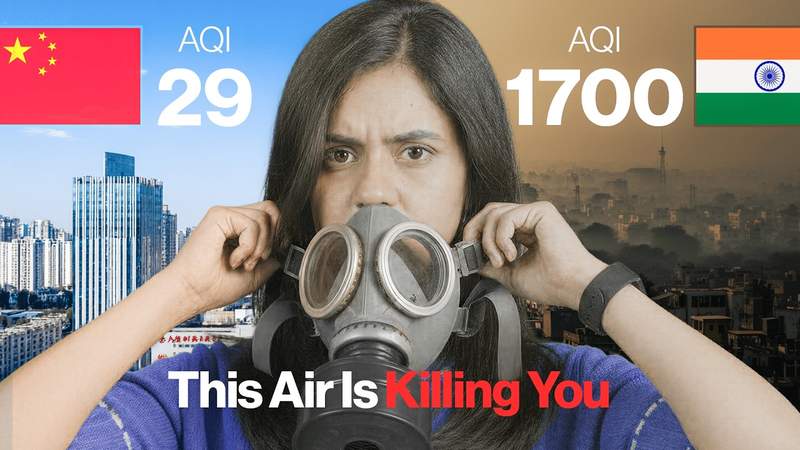
The video “How China Fixed Its Air in 5 Years (And Why India Can’t)” by Aevy TV (2.4M views) documents the first transformation—how Beijing went from “airpocalypse” to WHO-aligned standards in a single decade. But the infrastructure that enabled the 89.3% good-air-quality days China recorded in 2025 is the same infrastructure now powering the world’s largest EV charging network.
By the Numbers: The Clean Air → EV Charging Link
68→28
PM2.5 µg/m³ (2013→2025) World’s fastest air quality improvement
62.9%
NEV market share (May 2026) Record high, every month climbing
1M+
Chargers installed in 2025 alone Nearly 50% YoY growth
The causal chain is straightforward: coal phase-down → grid decarbonization → excess renewable capacity → cheap electricity for EVs → charging infrastructure buildout. China didn’t build EV charging instead of cleaning its air—it built EV charging as part of cleaning its air.
China’s PM2.5 trajectory: from 68 µg/m³ (2013) to 28 µg/m³ (2025). The country now operates the world’s most stringent PM2.5 standard at 25 µg/m³ annual limit. Source: SCIO, China Daily (Feb 2026)
The Five-Year Playbook
The Aevy TV video focuses on three pillars of China’s cleanup: (1) industrial restructuring—shutting down steel and coal plants near cities, (2) energy transition—building the world’s largest renewable capacity, and (3) enforcement—holding local officials accountable for air quality metrics. Each pillar has a direct EV charging parallel.
The same factories that were forced to retrofit for emissions compliance now produce EV chargers. China manufactures 70%+ of the world’s EV charging equipment. When BYD launched its 1,500-kW flash charger in April 2026, it wasn’t a prototype—it was a product ready for 20,000 stations by year-end. The company hit its 5,000th flash charging station 27 days after launch.
Pillar 2: Energy Transition → Grid-Ready Charging
China added more renewable capacity in 2025 than the entire US grid. This oversupply of clean electricity makes EV charging economically viable without the tariff battles the US faces. Where US DC fast chargers often run on grid mix that’s 40%+ natural gas, China’s chargers increasingly pull from solar and wind—reinforcing the air quality gains.
Just as provincial governors face air quality KPIs, they now face EV charging deployment targets. One southern province alone plans 3 million chargers. This top-down accountability is the single biggest difference from the US approach, where NEVI funds flow through a fragmented system of state DOTs, utility commissions, and private operators.
China’s EV charging infrastructure growth. Nearly 50% year-over-year increase in total charge points, with BYD alone deploying 2.4x more charging power per month than Tesla.
China vs US: A Contrast in Execution
Metric
China
United States
NEV / EV market share (May 2026)
62.9%
~8-10% (est.)
Public DC fast chargers (2026)
1M+ added in 2025 alone
71,482 total operational
Federal charging investment
$100B+ (national target-driven)
$5B NEVI (2% deployed in 4 years)
Policy model
Top-down, province-level KPIs
State-administered, private-led
Grid readiness
Coordinated grid + charging buildout
Fragmented utilities, interconnection queues
PM2.5 (2025)
28 µg/m³
~8-12 µg/m³ (already clean)
The US has a very different starting point—its air is already much cleaner than China’s. But the EV charging gap is widening fast. Only 2% of the $5 billion NEVI program has been spent four years after Congress approved it. A federal judge recently ruled that the Trump administration unlawfully suspended the program, unfreezing funds. But even at full deployment, NEVI would add roughly 500,000 charger ports—half of what China adds in a single year.
Why India Can’t—and What It Means for Global EV Adoption
The divergence between China and India on air quality mirrors their divergence on EV infrastructure. Without centralized policy capacity, India’s EV adoption remains below 5%.
The Aevy TV video’s central question—why India can’t replicate China’s air quality success—applies equally to EV charging. India’s PM2.5 averages ~50-55 µg/m³ (6th worst globally). Its EV penetration remains below 5%. The same missing ingredients explain both failures:
No provincial enforcement mechanism—India’s states have targets but no accountability
Coal dependency—India’s grid is 70%+ coal; electrifying transport without cleaning the grid shifts pollution, not solves it
Capital constraints—India lacks the state-directed lending that China uses for infrastructure buildouts
For the US and Europe, the lesson isn’t to copy China’s model—it’s to recognize that EV charging infrastructure is infrastructure policy, not just transportation policy. The $5 billion NEVI program, designed as a one-time grant pool, doesn’t come close to the sustained, multi-sector investment that China dedicates annually.
The Infrastructure Takeaway
Key insight: China’s air quality and EV charging successes share a root cause—state capacity for infrastructure deployment. The US has cleaner air than China and doesn’t need China’s policy model. But if the US wants EV charging to reach the scale of China, it needs more than a grant program. It needs interconnection reform, utility rate design that rewards off-peak charging, and permitting acceleration—infrastructure policy, dressed as transportation policy.
Timeline: The Parallel Transformations
2013
China’s “Airpocalypse”—PM2.5 hits 68 µg/m³ in Beijing. National Air Pollution Prevention Action Plan launched. EV charging infrastructure: negligible.
2018
PM2.5 down to 39 µg/m³. China passes 50% global EV market share. Charging network: 300,000 public chargers.
2020
China commits to carbon neutrality by 2060. NEV penetration: 5.4%. Charging buildout accelerates.
2023
PM2.5: 30 µg/m³ (approaching WHO Phase 1 target). NEV penetration: 35%. Public chargers: 2.7 million.
2025
PM2.5: 28 µg/m³—best in recorded history. NEV penetration: ~55%. 1M+ chargers installed in single year.
2026
New PM2.5 standard (25 µg/m³). NEV share: 62.9%. BYD 1,500 kW flash charging: 5,000 stations in 27 days.
Through a three-pronged strategy: industrial restructuring (shutting down polluting plants near cities), energy transition (building the world’s largest renewable capacity), and enforcement (holding local officials accountable for air quality targets). PM2.5 dropped from 68 µg/m³ in 2013 to 28 µg/m³ in 2025—a 59% reduction.
How many EV chargers does China have in 2026?
China installed over 1 million EV chargers in 2025 alone, with nearly 50% year-over-year growth. As of mid-2026, China operates the world’s largest EV charging network by a wide margin. BYD alone deployed 2.4x more charging power per month than Tesla.
What is China’s NEV market share in 2026?
China’s New Energy Vehicle (NEV) penetration reached 62.9% in May 2026, a record high. In the first week of June 2026, it climbed further to 66.7%. ICE vehicles have completely disappeared from China’s top 10 best-selling models.
Why can’t India replicate China’s air quality success?
India lacks three enabling factors: (1) provincial enforcement mechanisms with real accountability, (2) a decarbonized grid (70%+ coal), and (3) state-directed capital for infrastructure. India’s PM2.5 averages ~50-55 µg/m³—roughly double China’s current level.
How much of US NEVI funding has been spent?
Only about 2% of the $5 billion NEVI program has been deployed four years after Congress approved it. A federal judge ruled the Trump administration’s suspension of the program was unlawful in early 2026, but bureaucratic fragmentation, utility interconnection delays, and state-level bottlenecks continue to slow deployment.
Is China’s air quality improvement linked to its EV push?
Yes. Both are outcomes of the same policy capacity: centralized target-setting, coordinated grid and transport planning, and province-level accountability. Coal phase-down freed grid capacity for renewables, which in turn made EV charging cleaner and cheaper—creating a virtuous cycle between air quality and EV adoption.
What is China’s new PM2.5 standard?
China adopted GB 3095-2026 in February 2026, tightening the PM2.5 annual limit from 35 µg/m³ to 25 µg/m³—aligning with WHO Phase 2 interim targets. A transitional phase (2026-2030) sets a 30 µg/m³ annual / 60 µg/m³ daily interim standard.
How many DC fast chargers does the US have?
The US has approximately 71,482 DC fast charger ports operational as of mid-2026. While private-sector growth (Tesla Supercharger network, ChargePoint, EVgo) has been steady, the pace is far below China’s, which adds more public chargers in a month than the US has total.
Discover the most attractive leasing and financing options for electric vehicles (EVs) this November 2024. Whether you’re looking to lease or finance, there are some excellent deals available that cater…