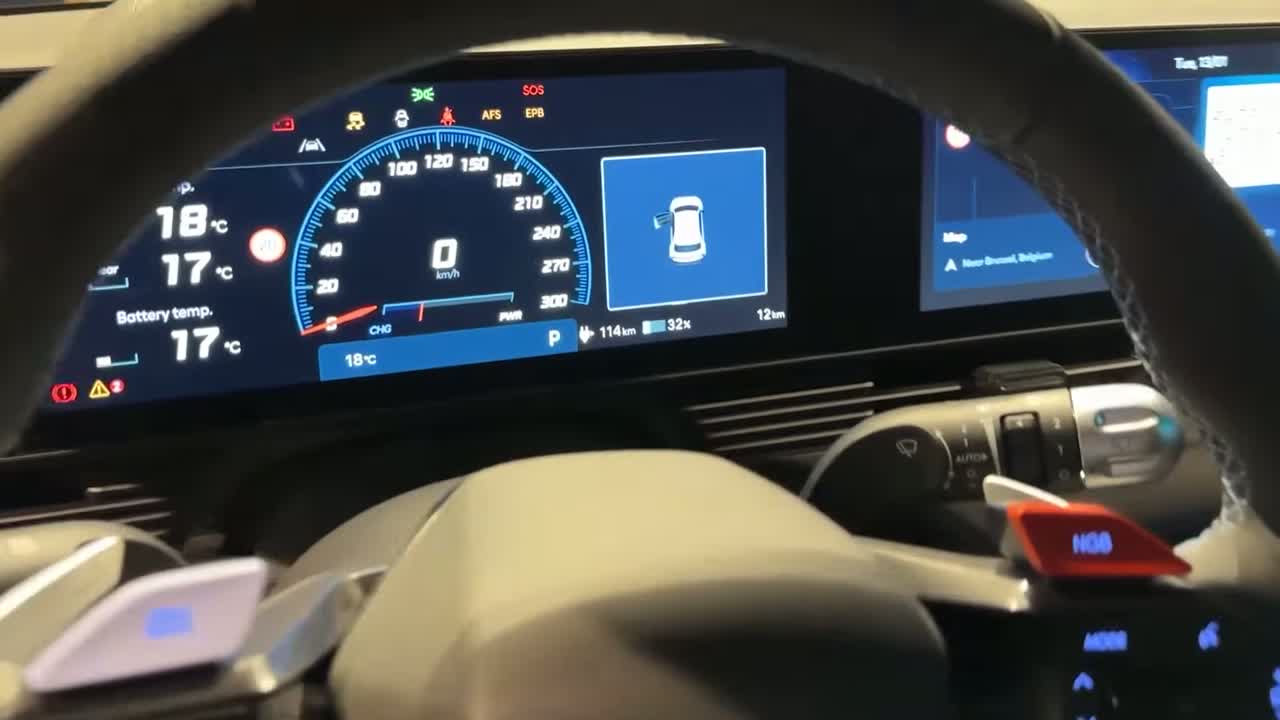
Hyundai didn’t just refresh the IONIQ 5 for 2026 — it quietly reset the price the rest of the US EV industry now has to match. A 245-mile electric SUV that starts at $35,000, recharges from 10% to 80% in about 18 minutes, and is built in Georgia is no longer the “value alternative” to Tesla. In several ways, it just became the car to beat.
Why the 2026 IONIQ 5 Is the Story Everyone’s Watching
For three straight years, Hyundai has set a new US sales record — roughly 980,000 vehicles sold in America in 2025 alone, the best in the company’s history. That matters because no automaker earns a place in the US EV market on a single good car. It earns it through trust, a service network, and millions of satisfied owners every year. Hyundai has spent years building exactly that, and the 2026 IONIQ 5 is the clearest signal yet of how it intends to spend that capital: by bringing its latest technology to American buyers first.
This isn’t a facelift dressed up as a new model. It is a deliberate move inside Hyundai’s long-term electrification strategy — new battery chemistry options, faster charging, improved software, and rising local production. The IONIQ 5 is the spearhead, not the whole army.

The $35,000 Reset: Price Is the New Battlefield
The headline number is simple and brutal for competitors: the 2026 IONIQ 5 SE Standard Range starts at a manufacturer’s suggested retail price of $35,000 (excluding freight, tax, title, and license). For that, buyers get a 125 kW (168 hp) rear-wheel-drive motor, a 63 kWh battery, and an EPA-estimated 245 miles of range. That is the price point where a first-time EV shopper actually starts saying “I could do this.”
And the cut is not marginal. Independent reviewers and pricing trackers note Hyundai lowered the IONIQ 5 lineup for 2026 by as much as $9,800 — roughly 17–20% on several trims — versus the outgoing model. A long-range RWD IONIQ 5 now opens near $37,500 with an EPA-estimated 318 miles, while the dual-motor AWD variant lands around $41,000 with 290 miles. For context, the 2026 Tesla Model Y RWD starts at $39,990, and a Toyota bZ4X or Volkswagen ID.4 typically opens above $42,000.
Price aggression vs. class average~20% lower
One honest caveat: the $35,000 figure excludes destination charges, taxes, and fees, and the base trim trades away range and features found higher up the ladder. Nobody should buy on the sticker alone. But as an opening move, it reframes the entire segment.
800V vs 400V: The Charging Edge That Actually Matters
Underneath the retro-futuristic body sits Hyundai’s E-GMP (Electric-Global Modular Platform) — a ground-up EV architecture with an 800-volt electrical system. Most mainstream rivals still run 400-volt architectures. The practical difference shows up at the charger: the IONIQ 5 can go from 10% to 80% in about 18 minutes on a 350 kW DC fast charger, versus roughly 30 minutes on a typical 150 kW 400V competitor.
New for 2026, the IONIQ 5 also adopts a native NACS port, giving it direct access to Tesla’s Supercharger network across North America. Combined with a liquid-cooled battery thermal system and a 10-year / 100,000-mile warranty on the battery and electric powertrain (Hyundai states it can cover the pack if capacity falls below 70% during the warranty period), the ownership story is about removing friction, not just adding specs.
10–80% DC charge (800V vs 400V class)~18 min
2026 IONIQ 5 vs Tesla Model Y, Toyota bZ4X & VW ID.4
Almost nobody buys an EV by looking at one brand anymore. Here is how the 2026 IONIQ 5 lines up against its three biggest US rivals on the numbers that decide a purchase — starting price, EPA range, battery, and peak charging.
| Model (2026, US) | Starting MSRP | Top EPA Range | Battery | Peak DC Charge | 10–80% Time | Architecture |
|---|
| Hyundai IONIQ 5 SE Std Rng RWD | $35,000 | 245 mi | 63 kWh | ~233 kW | ~18 min | 800V (E-GMP) |
| Tesla Model Y RWD | $39,990 | up to 357 mi | ~75 kWh | 225 kW | ~15 min | ~400V (NACS) |
| Toyota bZ4X XLE FWD | $42,700 | 252 mi | 74.7 kWh | 150 kW | ~30 min | 400V |
| Volkswagen ID.4 Pro S RWD | $43,995 | 275 mi | 77 kWh | 175 kW | ~30 min | 400V |
The read is clear. Tesla still wins on raw range and network density; Toyota leans on brand trust but trails on charging speed; VW offers a comfortable European ride but a slower 400V charge. The IONIQ 5’s wedge is the intersection of lowest entry price, 800V charging, and a spacious, comfortable cabin. It doesn’t beat Tesla on every line — it beats it on the lines a daily driver feels most.
Hyundai didn’t just refresh a car; it reset the price the rest of the industry has to match.
Cross-Time: What Actually Changed From 2025 to 2026
The 2025 IONIQ 5 carried a 77.4 kWh battery across most trims. For 2026, Hyundai split the strategy into a 63 kWh standard-range pack (for the $35,000 entry) and an 84 kWh long-range pack (for 318-mile RWD and 290-mile AWD variants). The move deliberately lowers the floor while protecting the headline range figures up top.
Alongside that: a native NACS port (previously CCS with an adapter), a now-standard Level 1/Level 2 charging cable, and a broader rollout of colors like Ultimate Red and Cosmic Blue Pearl. The single biggest external shift, though, is policy — the federal EV purchase tax credit effectively ended on September 30, 2025, which makes Hyundai’s outright price cuts far more consequential than a sticker propped up by incentives.
Cross-Market: Built in Georgia, Priced for America
The IONIQ 5 is not just imported and re-priced; it is assembled in the United States at Hyundai Motor Group Metaplant America (HMGMA) in Bryan County, Georgia. That local production insulates US pricing from currency swings and import tariffs, shortens delivery times, and supports Hyundai’s stated $26 billion US investment between 2025 and 2028.
Step back and the market context explains the aggression. According to the IEA’s Global EV Outlook, electric cars now account for roughly 20% of global new-car sales, with the United States among the world’s largest and most contested EV markets. When a legacy-flavored automaker localizes production and undercuts the segment leader on price at the same time, it is playing a long game — not chasing a single quarter’s headline.
The Honest Verdict
Can the 2026 IONIQ 5 truly “challenge Tesla”? On ecosystem and Supercharger ubiquity, Tesla still leads. But the IONIQ 5’s answer is smarter than a spec-sheet brawl: a $35,000 starting price, 800V charging that halves typical wait times, a class-leading warranty, and US-built supply. For the buyer who wants a reliable, fast-charging, family-friendly EV without marrying a single brand’s network, the 2026 IONIQ 5 has earned a spot at the very top of the shortlist.
FAQ: Quick answers on the 2026 Hyundai IONIQ 5
What is the starting price of the 2026 IONIQ 5?
The SE Standard Range RWD starts at $35,000 MSRP (excluding freight, tax, and fees), per Hyundai USA.
How fast does it charge?
On an 800V 350 kW DC fast charger, the IONIQ 5 goes from 10% to 80% in about 18 minutes, thanks to its E-GMP 800V architecture.
What is the EPA range?
Up to 245 miles on the 63 kWh SE Standard Range, and up to 318 miles on the 84 kWh long-range RWD trims.
Does it use Tesla Superchargers?
Yes — 2026 models add a native NACS port for direct access to the Supercharger network in North America.
What about the battery warranty?
Hyundai covers the battery and electric system for 10 years or 100,000 miles, and states it may cover the pack if capacity drops below 70% during that period.
Related reading on EVCUBE
Sources
- Hyundai Newsroom — 2026 IONIQ 5 “Best EV Experience” (EPA 318 mi, 10–80% in ~18 min, native NACS, HMGMA Georgia assembly)
- Hyundai USA — IONIQ 5 SE Standard Range: $35,000 MSRP, 168 hp, 245 mi EPA
- Car and Driver — 2026 IONIQ 5: price cuts up to $9,800, 63/84 kWh batteries, 168/225/320 hp motors
- Kelley Blue Book — 2026 IONIQ 5 trims, specs, and owner ratings
- IEA Global EV Outlook 2026 — trends in electric cars (global market context)
- World Bank — electric mobility and EV market research publication
Where do you land? Would you take the $35,000 IONIQ 5 over a Tesla Model Y, or is the Supercharger network still the dealbreaker for you? Tell us in the comments — and if you’re cross-shopping, the comparison table above is the fastest way to decide.