Volvo’s 2026 XC60 Recharge is the most refined plug-in hybrid the brand has ever sold — but in a year when a $41,500 Toyota out-ranges it on electricity and a $42,900 Tesla out-ranges it on everything else, the real question isn’t how good it is. It’s whether the plug-in formula still makes sense at all.
A 455-HP Sleeper That Asks the Wrong Question
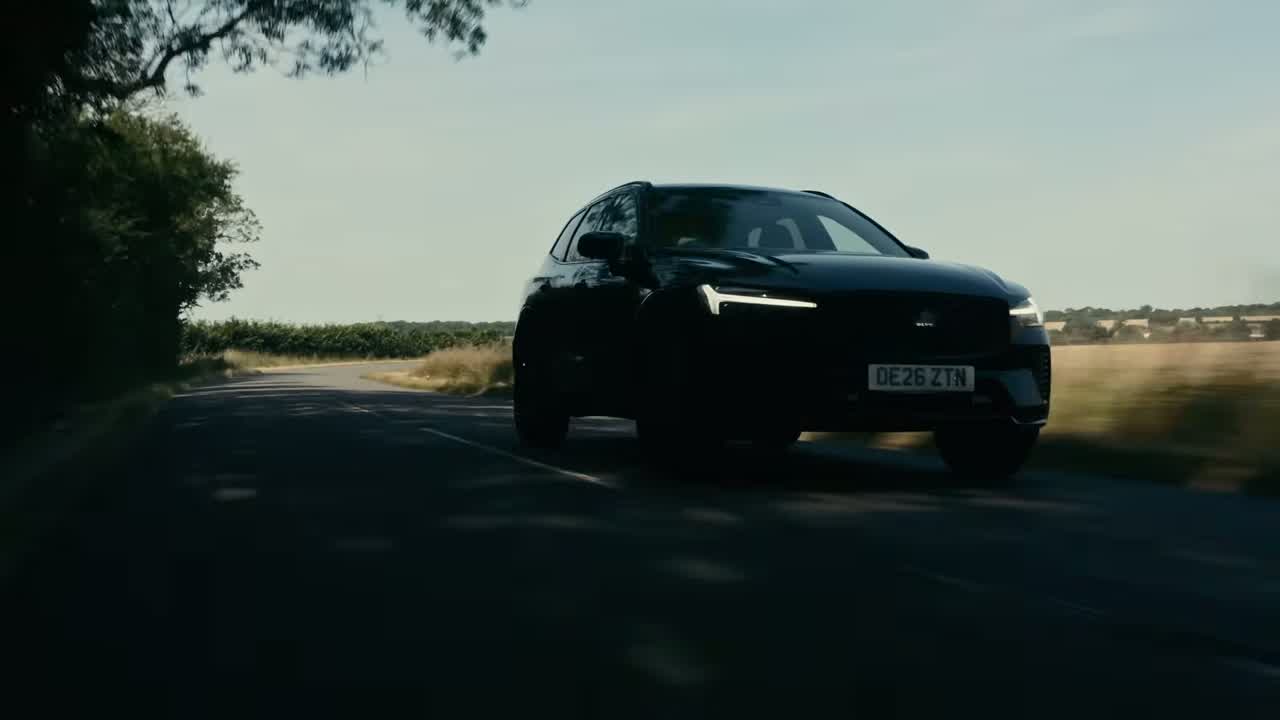
The XC60 has been Volvo’s best-seller since 2017, with more than 1.5 million sold worldwide. The 2026 update is a light refresh rather than a reboot: a new crisscross grille, deleted side chrome, slightly darker taillights, two new paint colors (Forest Lake and Aurora Silver), fresh 21-inch wheel options, and the murdered-out Black Edition Ultra with black Onyx paint, black 21-inch wheels, and black badges.
Inside, the biggest change is the screen. The old integrated display is gone, replaced by an 11.2-inch panel running on Qualcomm’s Snapdragon platform. Volvo says it is twice as fast, renders graphics 10 times quicker, and carries 21% better pixel density than before. There is a genuine miss, though: the XC60 still ships without wireless Apple CarPlay or Android Auto, so your phone plugs in via USB-C. For a $62,000-plus vehicle in 2026, that omission stings.

What 455 HP Actually Buys You
The range-topping T8 is the star. Its 2.0-liter turbo four, paired with two electric motors, makes a combined 455 hp and 523 lb-ft of torque — more than a V8 Ford Mustang GT — and launches to 60 mph in a claimed 4.5 seconds. Day to day, it feels calm; you only meet the violence when you floor it.
In pure-electric mode Volvo quotes up to 35 miles of EPA-estimated range, though the reviewer saw a realistic 30–35 miles. An 18.8-kWh battery feeds the rear motor, and a full AC top-up takes about 5 hours on a 16-amp charger. Total range, gas plus electrons, is roughly 560 miles. Fuel economy lands at 63 MPGe combined and 28 MPG on gas alone once the battery is empty; the reviewer managed 40 MPG in hybrid cruising but only about 24 MPG when using the engine to charge the battery on the move.
Straight-line punch
Electric share of a typical day
The Comparison That Hurts: XC60 Recharge vs the Field
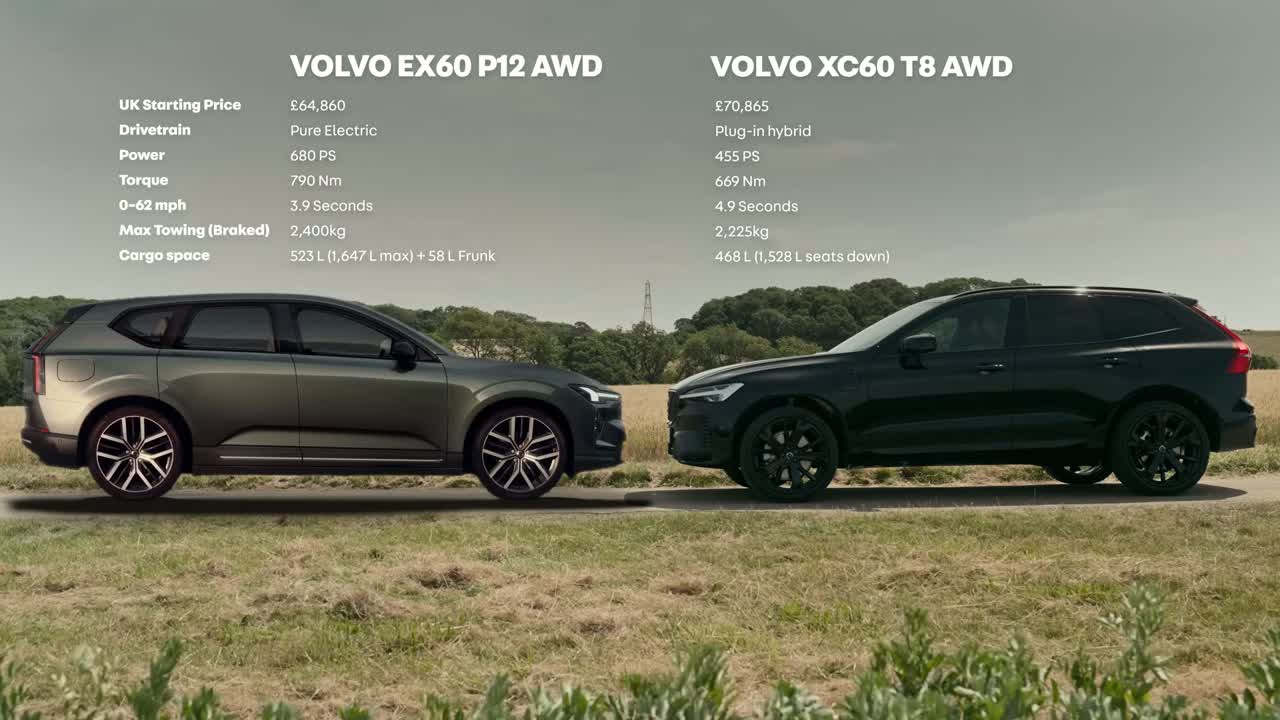
Put the XC60 next to its rivals on paper and the polish starts to look expensive. Here is the 2026 playing field, all US pricing and EPA figures:
| Vehicle | Type | EPA electric range | 0–60 mph | Start price (US) | Battery | AC charge | MPGe (comb.) |
|---|
| 2026 Volvo XC60 Recharge T8 | PHEV | 35 mi | 4.5 s | $62,545 | 18.8 kWh | ~5 hr | 63 |
| 2026 Toyota RAV4 Plug-in Hybrid | PHEV | 54 mi | 5.4 s | $41,500 | 22.7 kWh | ~2.5 hr | 101 |
| 2026 Volvo EX90 (Twin Motor) | BEV | 305 mi | 5.3 s | $78,090 | 106 kWh | 22 min DC | 84 |
| 2026 Tesla Model Y Long Range | BEV | 327 mi | 4.6 s | $49,900 | 81 kWh | NACS | ~111 |
The XC60 is the most powerful car here and ties for the quickest sprint to 60. On every other axis that matters to a plug-in buyer — electric range, charge speed, cargo, and price — it sits at or near the bottom.
Toyota Just Raised the Plug-In Bar
The 2026 RAV4 Plug-in Hybrid (the car formerly called the RAV4 Prime) is the XC60’s most direct rival, and it quietly embarrasses Volvo’s effort. Toyota’s PHEV serves 324 hp and a 0–60 run of 5.4 seconds, but the headline is efficiency: 54 miles of EPA electric range — about 54% more than the XC60’s 35 — from a larger 22.7-kWh battery that refills in roughly 2.5 hours on a 6.6-kW Level 2 charger. That is nearly twice as fast as the Volvo’s 5-hour slog.
The RAV4 also beats the XC60 on value and practicality: it starts at $41,500, roughly $21,000 less than the Volvo, returns up to 101 MPGe combined, and offers 33.6 cu ft of cargo behind the rear seats versus the XC60’s 16.5 cu ft. For a buyer who actually wants the plug-in formula, Toyota makes the stronger case on paper.
The Full EVs Make the Bubble Feel Small
Then there is the existential threat: the all-electric competition. Volvo’s own EX90 — the XC60’s electric cousin — delivers up to 305 miles of EPA range from a 106-kWh pack, 449 hp, and, thanks to an upgraded 800-volt architecture for 2026, a 10–80% DC fast-charge in about 22 minutes. It starts at $78,090, which is more than the XC60, but it is a seven-seater with vastly more capability. One caveat our own testing has flagged: the EX90’s real-world range tends to fall short of its EPA number, so treat the 305-mile figure as a best case. (Read our EX90 real-world range test.)
The Tesla Model Y Long Range is the one that should worry Volvo most. It starts at $49,900 — about $12,600 less than the XC60 — yet delivers 294–327 miles of EPA range, a 4.6-second 0–60 run, an 81-kWh battery, and access to the NACS Supercharger network, which adds up to roughly 75 miles in 5 minutes. For similar or lower money, buyers get eight to nine times the electric range and genuine fast-charging.
So — Polished, or Already Obsolete?
The XC60 Recharge is not a bad car. It is a beautifully made answer to a question fewer Americans are asking. Its strengths are real: a calm, quiet ride on optional air suspension, genuinely premium materials, effortless 455-hp punch, and zero charging-anxiety because the gas engine is always there. For a driver who wants one car that occasionally does a 35-mile electric commute but can also cross a state without planning a charging stop, it fits.
But “polished” is not the same as “future-proof.” In 2026 the XC60’s electric range is the smallest of the four, its AC charging is the slowest by a wide margin, its starting price is the highest of the group, and the federal $7,500 clean-vehicle credit that once softened EV pricing expired on September 30, 2025 — so neither the Volvo nor its rivals get a point-of-sale subsidy this year. Against the RAV4 PHEV it loses on range, speed, and price; against the Model Y and EX90 it loses on range and charging by an order of magnitude.
Refinement & ride
Electric range (vs rivals)
Charge speed
Value for money
Our verdict: the XC60 Recharge is not obsolete, but the window is closing. Buy it if you love the way it looks and drives and refuse to live with charging infrastructure. If you want the smartest plug-in, the RAV4 PHEV wins. If you want the smartest Volvo, the EX90 is the future. And if you want the most car for the money, the Model Y is the one to beat.
Can the XC60 Recharge run as a pure EV?
Yes. In “Pure” drive mode it runs on battery alone for up to 35 miles EPA, but in the default Hybrid mode the car drives electrically anyway until the battery drains, then the gas engine takes over seamlessly.
How long does it take to charge?
A full AC top-up takes about 5 hours on a 16-amp charger, and there is no DC fast-charge port — this is a plug-in hybrid, not a battery EV. That is the slowest charge time of the four vehicles compared here.
Does it qualify for the $7,500 federal tax credit?
No. The federal clean-vehicle credit expired on September 30, 2025, and plug-in hybrids rarely qualified at the full rate regardless. There is no point-of-sale subsidy for the XC60 in 2026.
Is the XC60 Recharge better than the EX90?
Different missions. The EX90 is the all-electric sibling with up to 305 miles of range, far more cargo, and 800-volt fast charging, but it costs more and depends on charging infrastructure. The XC60 wins only if you specifically want a petrol engine as backup.
Related reading on EVCUBE