No products in the cart.
Thirteen thousand miles, three dogs, one cracked windshield, and a lot of FSD later — one owner’s full year with a Tesla Model Y reveals the truth the spec sheet hides: maintenance is almost nothing, depreciation is almost everything, and the real range number sits about 8% below the sticker. Here’s the damage report.
The Model Y is the best-selling EV on earth for a reason — in the U.S., 2026 pricing runs from $39,990 for the Standard RWD to $48,990 for the Premium AWD and $57,490 for the Performance. But a buyer’s guide only tells you what it costs to take delivery. This is what it costs to live with one, after 13,000 miles that included road trips, dogs, rock chips, and daily full self-driving use.
Maintenance: the almost-nothing report
In a full year, this owner’s only scheduled maintenance was washer fluid and cabin air filters. No oil changes, no spark plugs, no transmission service. The Model Y’s HEPA filter is rated for every 3 years (or 4 in clean climates), and the cabin filters — a DIY job that takes about 25 minutes — cost roughly $150 if Tesla does it. Tesla’s own recommendations: rotate tires every 6,000-plus miles (the owner does it at 5,000 because EVs wear rubber faster), replace wiper blades when needed. His previous Model Y went 80,000 miles with plenty of original parts still in place.
SIGNAL: The stereotype that EVs cost nothing to maintain is mostly true — but the real trade is different: EVs shift the cost from the service bay to the tire shop and the body shop. Heavy weight plus instant torque wears tires faster, and soft paint plus fragile camera glass means rock chips are an inevitability, not a maybe.
What actually went wrong
- Hood latch short circuit — threw constant sensor errors; replaced free under the basic warranty after an hour at Tesla service.
- Front bumper camera — the glass lens is pockmarked with rock-chip scratches (“looks like acne”); so far clarity is fine, but if it fails, FSD fails. A $10 Amazon cover fixes it.
- Cracked windshield — a rock chip turned into a $1,600 replacement.
- Rattles — trunk rattle from loose trim; a window squeak traced to broken clips, both fixed free.
- Plastic clips — brittle under the frunk/HEPA access; expect one or two to break.
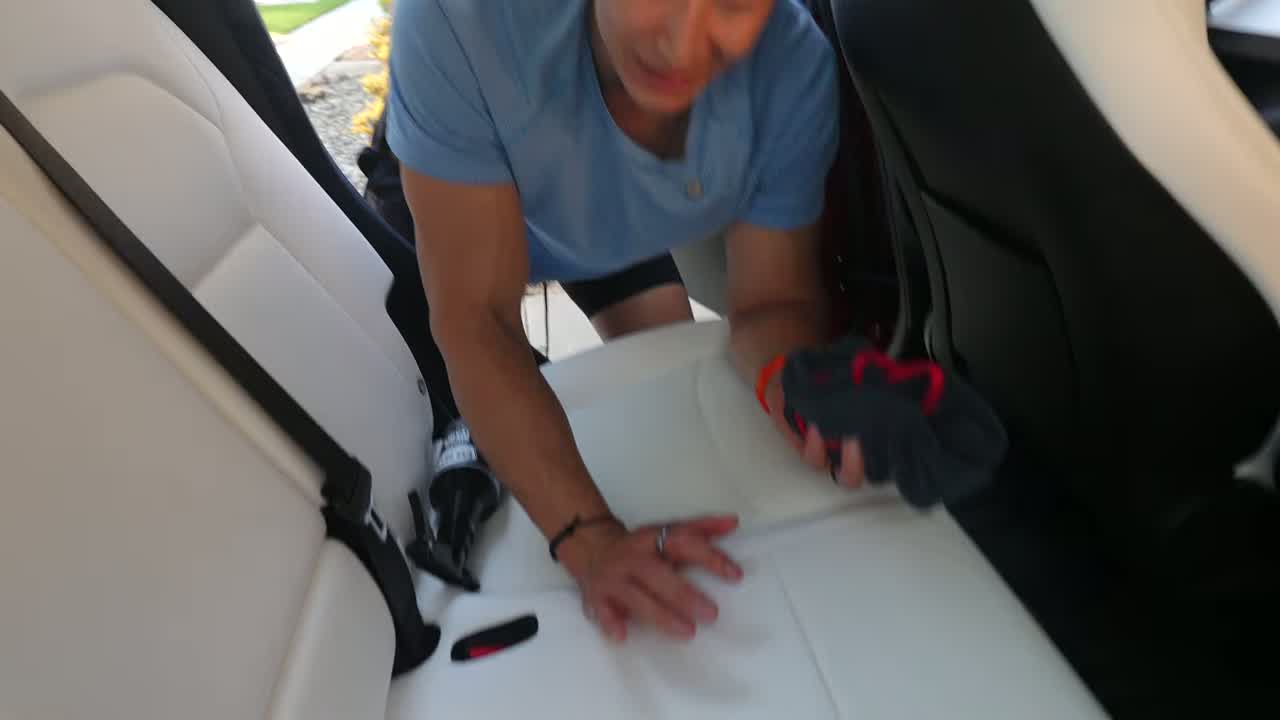
The white seats, by contrast, shrug off everything: mud, ketchup, coffee, and protein shakes wiped clean with a baby wipe (with ceramic coating help). The carpet is the real interior villain — a dirt-and-hair magnet that needs all-weather floor mats.
Real-world range and cost
At 100% charge, this Model Y Premium now shows 302 miles versus the 327-mile EPA figure at delivery — roughly 7.6% degradation after one year and 13,000 miles, which is within the normal break-in curve for modern packs. Real-world efficiency: about 271 Wh/mile in mixed local driving with aero covers, and the owner reports no practical change to road-trip habits despite the displayed range loss.
| Metric | Claimed / EPA | Real-world (owner) |
|---|---|---|
| Range at 100% (Premium AWD) | 327 mi | 302 mi after 1 yr (~7.6% loss) |
| Efficiency | ~28 kWh/100 mi | 271 Wh/mi city (aero covers on) |
| 0–60 (Premium AWD) | 4.6–4.8 s | feels quick, “all-wheel drive + boost” |
| Maintenance (year 1) | — | washer fluid + filters (~$150 DIY or $0) |
| Warranty fixes | — | hood latch + window clips, $0 |
On total cost of ownership, the math is clear: U.S. ownership-tracking data puts the Model Y’s 3-year depreciation around 46% (roughly $22,000 off a $48,000 base), with insurance averaging $1,900–3,800 a year depending on profile. Electricity replaces fuel entirely — this owner charges from solar-plus-Powerwall, driving on literal sunshine — and a home 240V outlet or Wall Connector costs $500–1,500 to install. The hidden costs are depreciation, insurance, and the occasional $1,600 glass bill, not the service bay.
Is FSD worth it after a year?
The owner’s verdict is unambiguous: FSD is the main reason to buy a Tesla. A supervised FSD run through an In-N-Out drive-thru mostly worked — one disengagement when it swung wide for the payment window, but it stopped at the order board and pickup window on its own. On highways and commutes it “drives like a human” and makes the car genuinely relaxing. The caveats: it’s supervised (you must watch the road), it disengages in edge cases, and it depends on the front camera — which is exactly the component collecting rock chips. If you’re not going to use FSD, the ownership case gets thinner.
After a year, the Model Y is “pretty perfect” in hindsight — if by perfect you accept soft paint, a fragile front camera, and a cabin that rattles occasionally. The big stuff — range, charging, FSD, and a zero-oil-change life — is legit. It’s the little stuff that keeps Tesla service centers busy.
How much did the windshield cost?
About $1,600 for a replacement after a rock chip cracked it. The glass roof is also a very expensive part if it ever breaks — another reason owners add PPF and careful coverage.
Is battery degradation a real problem?
At ~7.6% after 13,000 miles, this owner says road trips are unaffected — he stops at the same Superchargers as before. Most modern packs level off after the first year or two, and Tesla warrants battery capacity.
Which 2026 Model Y should you buy?
If range matters most: Premium RWD ($44,990, 357 mi EPA). If you need all-weather or seven seats: Premium AWD ($48,990, 327 mi). If budget is everything: Standard RWD ($39,990, 321 mi) — but you lose the glass roof, premium audio, and ventilated seats.