Tesla isn’t building a better Uber. It’s building a ride-hail network that makes the Uber app — and the cut it takes on every trip — completely unnecessary. The most important word in ride-hailing this year isn’t a launch city or a spec sheet. It’s a two-letter answer: “No.”
The two-letter answer that should worry Uber
Here is the detail most analysts skipped. Uber CEO Dara Khosrowshahi reportedly called Elon Musk and asked for a robotaxi partnership — for Tesla to start supplying autonomous vehicles to Uber’s network. Musk said no. Not “let’s talk,” not “here are our terms.” Just no. When pressed on what Uber actually brings to the table, the answer is uncomfortable: a network of users. Tesla already has that. Hundreds of millions of people have the Tesla app; many also have the X app, where an AI assistant could one day simply suggest a ride.
The strategic point is structural, not petty. Uber’s entire business is an app that connects two parties — a rider and a driver — and takes a fee for the introduction. Once the driver disappears, the introduction disappears with it. As FutureAzA puts it in the source video: “If you don’t need to get connected, if you’re able to connect yourself, why am I paying you this astronomical markup?” That is the curiosity gap at the heart of this story, and the rest of the market is now racing to close it.
Why the middleman is the weakest link
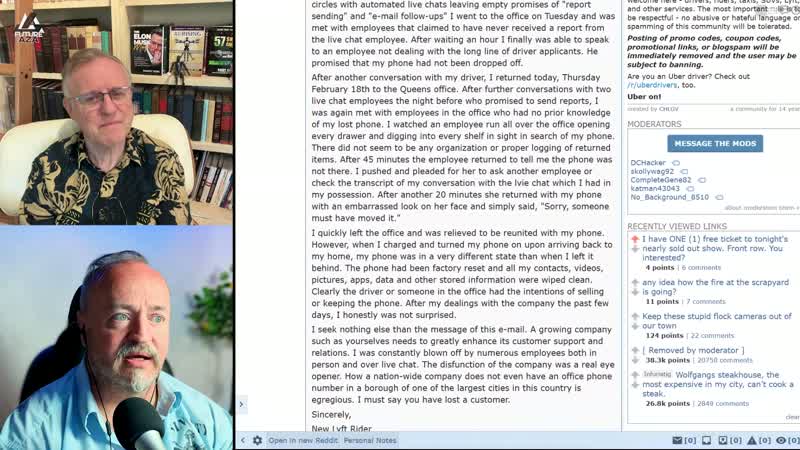
Uber only turned a full-year profit two years ago, in 2024, after years of burning cash. Its take rate is the part competitors love to quote: on a long ride from Ocala to Orlando — roughly a $250 fare — the driver reportedly received about $125, meaning Uber’s cut in a single trip covered a background check, a vehicle safety inspection, and more. Multiply that across billions of rides and the question becomes unavoidable: where does the money go?
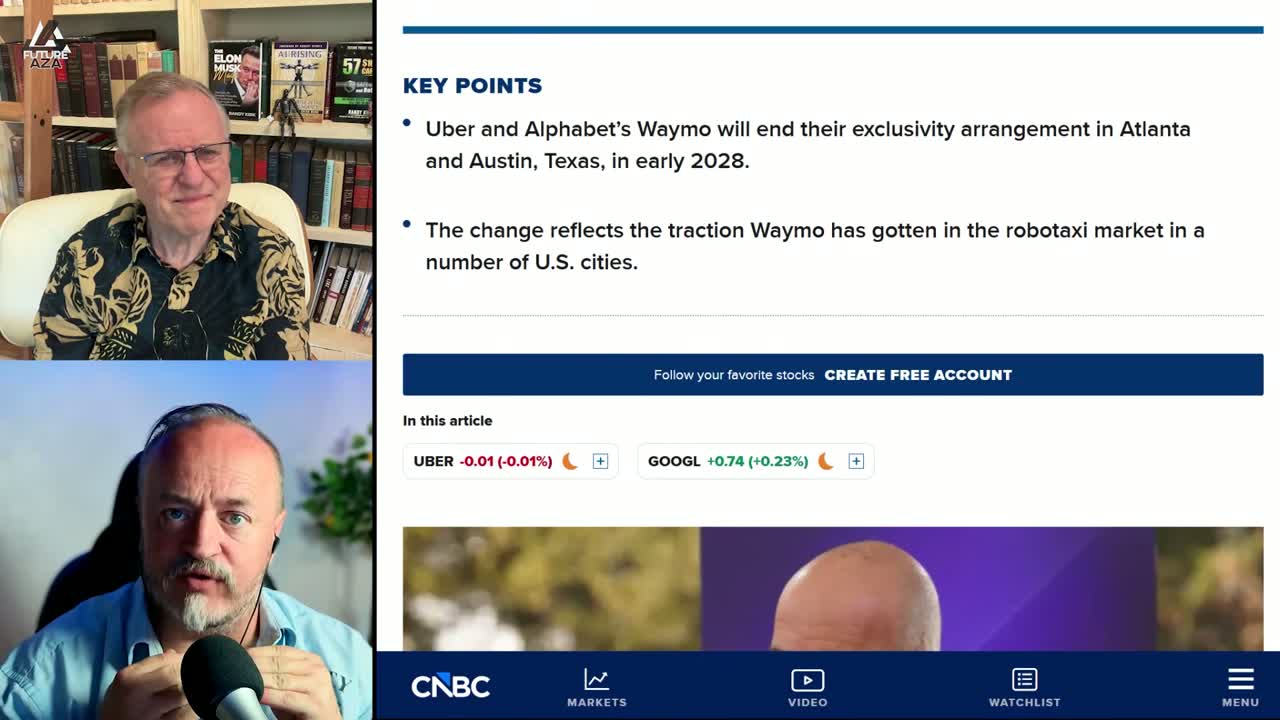
The market is already voting. When news broke that Waymo plans to end its Uber exclusivity, Uber shares fell as much as 4.9% to $65.56, and the stock is down nearly 20% year-to-date. The business model that looked unassailable in 2019 now looks like the layer everyone is trying to route around.
“The problem with Uber’s business model is that they don’t provide anything. They’re just an app that connects two parties.” — FutureAzA
Tesla vs Waymo vs Uber: the numbers that matter
Forget the vibes. Put the three players side by side on the metrics that determine who owns the rider relationship.
| Dimension | Tesla (Robotaxi / Cybercab) | Waymo (Alphabet) | Uber (platform) |
|---|
| Active fleet | ~50 cars in Austin vs Waymo’s 250+; 120 Cybercabs built by mid-June 2026 | ~3,700 vehicles across 10+ US cities | 0 owned AVs; aggregates partners |
| Scale signal | 10 billion cumulative FSD miles; +29M miles/day | ~500,000 paid rides/week; targeting 1M/week by end-2026 | 1M+ human drivers; AV via partners only |
| Autonomy approach | Vision-only, FSD v14, no lidar | Lidar + radar + cameras, Gen-6 hardware | None — buys/leases from others |
| Target cost / mile | $0.20/mile operating (Tesla target) | Premium pricing, no tip/driver | $1.50–$2.50/mile average ride |
| Owns the customer? | Yes — Tesla / X app | Yes — standalone Waymo app | Yes, but only as middleman |

The Waymo–Uber divorce is the tell
The cleanest evidence that the aggregator model is losing its grip: Waymo has notified Uber it intends to launch its own app directly in Austin and Atlanta in January 2028, ending the exclusivity that gave Uber a differentiated driverless product. The existing contract runs through May 2028, so both options coexist briefly — but the direction is set. Waymo already runs standalone in more than 10 US markets and is expanding to Tokyo and London.
Uber’s response has been to sign everything that moves: a deal with Rivian for 10,000 R2-based robotaxis by 2028, a Volkswagen ID. Buzz program in Los Angeles, and a pledge of more than $10 billion toward AV fleet purchases and equity. Yet Wall Street reads this as desperation, not strategy. The deeper tell is regulatory: Uber has been lobbying at the state and federal level for “hybrid networks” that would force AV operators to route a large share of rides through human-driven platforms — New Jersey, for instance, floated a rule requiring human drivers for at least 85% of orders. That is a company trying to slow the future it cannot build.
Tesla’s numbers vs Waymo’s numbers, cross-brand
The head-to-head is lopsided today but converging fast. Waymo’s ~3,700 vehicles and 500,000 paid rides per week dwarf Tesla’s early fleet. But Tesla’s advantage is the cost curve. The Cybercab uses a 48 kWh battery for about 293 miles of EPA range, targets a sub-$30,000 price, and aims for a $0.20/mile operating cost — against an average Uber ride of $1.50–$2.50/mile. Waymo’s own Gen-6 “Driver” cut hardware cost by roughly 50% versus Gen-5 and reduced sensor count by 42%, proving the expensive-lidar critique is easing, but Tesla’s vision-only bet starts from a far lower floor.
And the data flywheel is real. Tesla reports 10 billion cumulative FSD miles as of May 2026, adding about 29 million miles a day, and 1.28 million FSD subscribers in Q1 2026 — up 51% year-over-year. More miles means a better model means more capable autonomy, the loop Waymo cannot match on volume.
Cross-time: the 2026 acceleration
A year ago this was a pilot. In 2026 it became a rollout. The timeline shows the slope, not the scale:
| Date | Tesla robotaxi milestone |
|---|
| Oct 2024 | Cybercab revealed at the “We, Robot” event — no wheel, no pedals |
| Feb 2026 | First Cybercab rolls off the Giga Texas line, ~2 months early |
| Apr 2026 | Unsupervised service launches in Dallas & Houston; scaled Cybercab production begins |
| Jul 3, 2026 | Miami goes live — first city outside Texas and California |
| H2 2026 | Target of 8–10 US cities; true unsupervised FSD targeted for Q4 2026 |
The regulation wildcard
The single biggest constraint on the Cybercab is not technology — it’s the Federal Motor Vehicle Safety Standards, which still assume a human controls the car. That is changing. The SELF DRIVE Act of 2026 (H.R. 7390) was introduced on February 5, 2026, directing NHTSA to issue a final AV rule by September 30, 2027. A companion measure (H.R. 7389) would lift the annual exemption cap for wheel-less vehicles from 2,500 to 90,000. And on June 25, 2026, the DOT proposed removing the brake-pedal requirement for vehicles “designed to be driven exclusively by automated driving systems” — a change written almost specifically for the Cybercab.
Translation: the legal floor that capped Tesla’s purpose-built car is being raised. Every quarter of regulatory progress widens the gap between a company that builds the car and an app that merely summons one.
Signal check: how real is the threat?
Tesla’s structural threat to Uber
Waymo’s independence from aggregators
US AV regulatory tailwind
Uber’s AV self-sufficiency
Cybercab production at scale
FAQ
Will Uber survive the robotaxi shift?
Almost certainly — but as a smaller, lower-margin piece of the stack. Uber is pivoting to an “agnostic AV aggregator,” signing Rivian, Volkswagen, Waymo (where contracts remain), and others. The risk is that the companies building the cars decide they would rather own the customer, exactly as Waymo is now doing in Austin and Atlanta. Uber’s best defense is convenience and density; its worst vulnerability is that it adds the least.
Is the “$100 million lawsuit” argument against robotaxi valid?
No. As the source video notes, if every death from a mode of transport cost $100 million, airlines and Amtrak wouldn’t exist. Liability is handled through layered insurance, reinsurance (Lloyd’s of London and others), and precedent-set settlements that appeals courts routinely trim. A commercial operator is treated like any other courier service — deeper pockets mean better collection odds, not automatically larger verdicts.
When does Tesla robotaxi reach my city?
Tesla targeted 8–10 major US cities by the end of 2026, with Miami, Orlando, Tampa, Phoenix, and Las Vegas named as next steps beyond its Texas and California footprint. True unsupervised FSD was targeted for Q4 2026, and broader national coverage depends on the NHTSA rule landing by late 2027.


Related reading on EVCUBE