Toyota’s New Battery Could Make Its Hybrids Unbeatable — Here’s the Catch
August 10th, 2026
By EVCUBE .NET
No Comments
Toyota’s New Battery Could Make Its Hybrids Unbeatable — Here’s the Catch
Hybrid Tech · Analysis
Toyota’s New Battery Could Make Its Hybrids Unbeatable — Here’s the Catch
While the industry obsesses over the next pure-EV headline, Toyota just quietly upgraded the batteries inside its hybrids. The result could be the most pragmatic powertrain on the road—if you can live with the catch.
Toyota’s next-gen hybrid battery trades nickel-metal hydride for lithium-ion in high-volume models.
What Changed in the Battery
The headline move: Toyota is replacing nickel-metal hydride (NiMH) with lithium-ion cells in high-volume hybrids like the Corolla and Camry. The chemistry jump is enormous—lithium-ion runs about 200–250 Wh/kg versus NiMH’s 60–80 Wh/kg, roughly triple the energy density. That means more electric-only range and better power from the same space.
For the sixth-generation plug-in hybrid (debuting in the 2026 RAV4), Toyota quotes +8% output, +30% capacity, +24% electric range, and—notably—the addition of Level 3 DC fast charging, something most PHEVs still lack. That turns a short daily EV commute into a genuinely usable one.
Tripling energy density is what unlocks longer EV range without a bigger battery box.
The Numbers That Make It Compelling
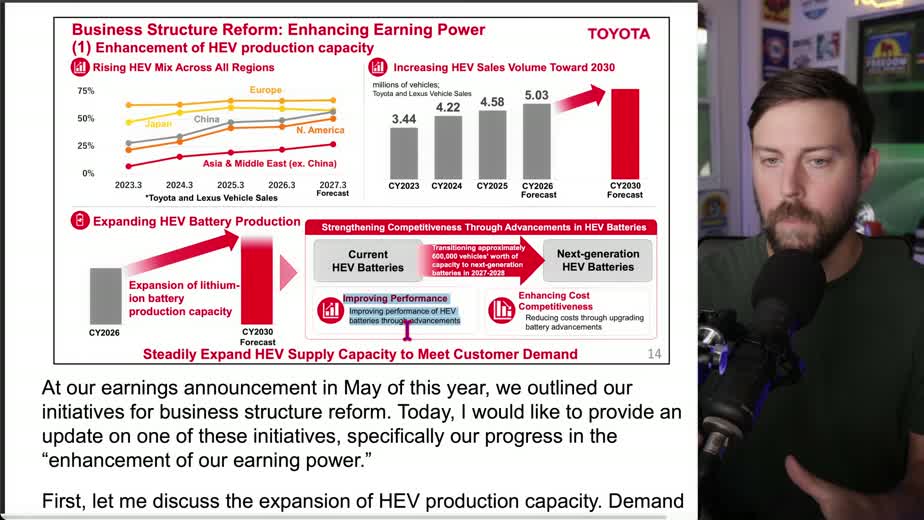
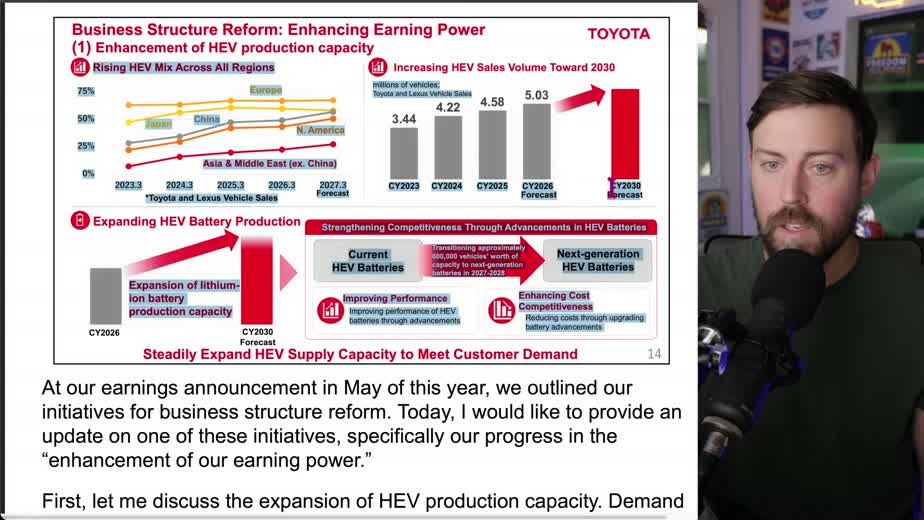
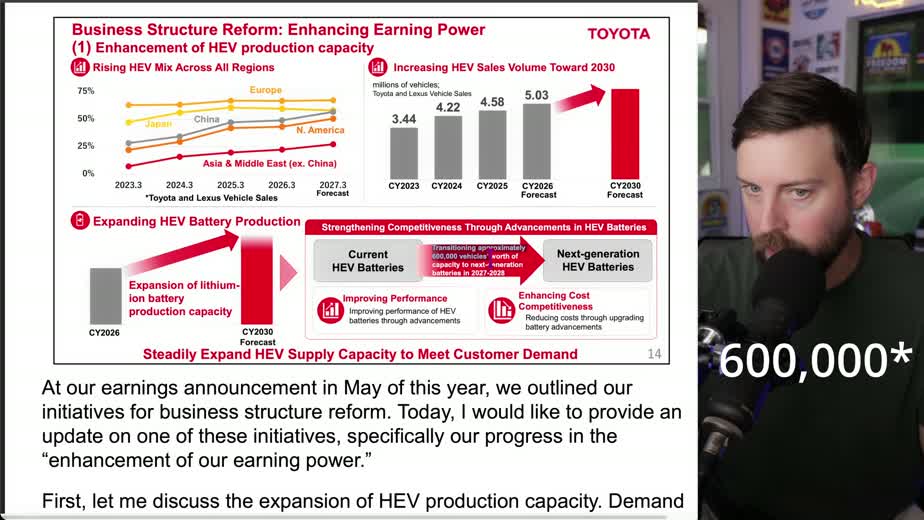
The 2026 Camry hybrid is rated around 4.2 L/100 km with a 1,000 km total range. In China, the joint-venture (HuaChen/BMW-Toyota) version starts near 130,000 RMB. Toyota expects hybrid volume to top 5 million units in 2026, and its next-generation hybrid battery—rolling out from August 2026—is sized for 600,000 vehicles of annual capacity.
Metric
Old (NiMH)
New (Li-ion)
Energy density
60–80 Wh/kg
200–250 Wh/kg
6th-gen PHEV output
baseline
+8%
6th-gen PHEV capacity
baseline
+30%
6th-gen PHEV EV range
baseline
+24%
DC fast charge (PHEV)
rare
Level 3 added
Data points: Toyota technical disclosures. In the first half of 2026, Toyota’s electrified sales reached 2.7 million (+9.1%), with hybrids at 2.3 million—about 86% of the electrified total. The hybrid, not the BEV, is carrying Toyota’s transition.
Hybrids are 86% of Toyota’s electrified volume—the real bridge, not the headline BEV.
Why this matters more than another BEV headline
Hybrids = 86% of Toyota electrified sales +24% EV range, L3 charge added still not a full BEV
For buyers without reliable charging, a vastly better hybrid is more useful than a discounted EV they can’t conveniently charge.
The Catch You Have to Weigh
The catch is in the name: it’s still a hybrid. You get better electric range and a DC fast-charge port, but you’re not escaping the gasoline engine, the emissions, or the fuel stops. For the driver who wants a true zero-tailpipe commute, a PHEV’s 24% bigger battery still won’t cover a long daily mileage. And Toyota’s hybrid focus, while pragmatic, is a bet that slows its pure-BEV cadence—exactly what critics say leaves it exposed if regulators tighten.
But for the vast middle of the market—drivers with no home charger, long highway commutes, or range anxiety—Toyota’s upgraded hybrid is arguably the most sensible powertrain you can buy in 2026. It just isn’t the revolution the BEV crowd is waiting for.
The hybrid is the bridge most buyers can actually use today—with the limits that implies.
Honest Questions About Toyota’s Hybrid Battery
Is a lithium-ion hybrid battery safe?
Toyota’s hybrid Li-ion packs are thermally managed and have a long, conservative service record across its hybrids. The density gain is real, and Toyota’s calibration favors longevity over peak output—standard for the brand.
Does the DC fast charge matter on a PHEV?
Yes, more than people expect. A 24% larger battery with L3 charging means you can top up on a road trip and extend electric driving without burning gas—something most PHEVs, which only AC charge, cannot do quickly.
Should I wait for Toyota’s next-gen BEV instead?
If you have home charging and want zero tailpipe emissions, Toyota’s bridge Li-ion BEV (2026) and the later solid-state Lexus are the pure-EV path. But the hybrid is the better tool if charging is unreliable where you live.
Why is Toyota betting so hard on hybrids?
Because hybrids are 86% of its electrified volume and profitable at scale, while covering the gap for buyers without charging access. It’s a bridge strategy—pragmatic, not ideological.
Discover the most attractive leasing and financing options for electric vehicles (EVs) this November 2024. Whether you’re looking to lease or finance, there are some excellent deals available that cater…