Austin has become the single most important address in Tesla’s autonomy plan. Giga Texas is no longer just where Model Ys roll out — it is now the place where Cybercabs are built, where the robotaxi fleet is staged, and where a 5.2-million-square-foot expansion is rewriting what the plant is for.
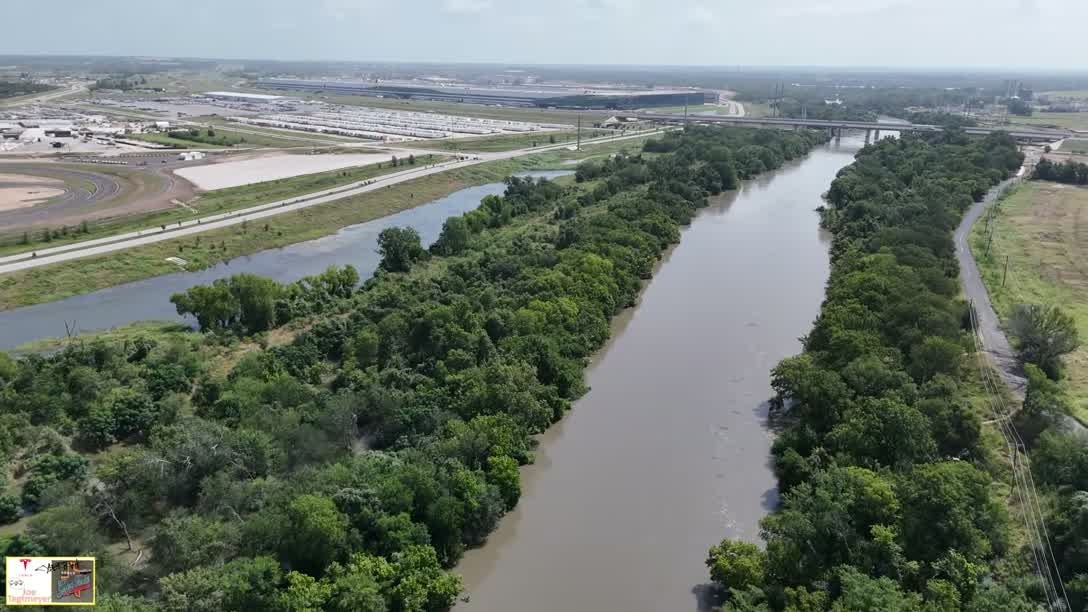
A flyover during a wet, busy week in Austin
On July 20, 2026, drone watcher Joe Tegtmeyer flew his usual loop over Giga Texas — but the timing was unusual. Central Texas had just been hit by heavy rains, and the Colorado River running past the factory was swollen with runoff released from Lake Travis, which Tegtmeyer notes reached its highest level in decades. The plant itself stayed high and dry thanks to the grade work and detention ponds built into the site, but the footage is a reminder that even a $119-billion-scale campus sits inside a flood-prone landscape.
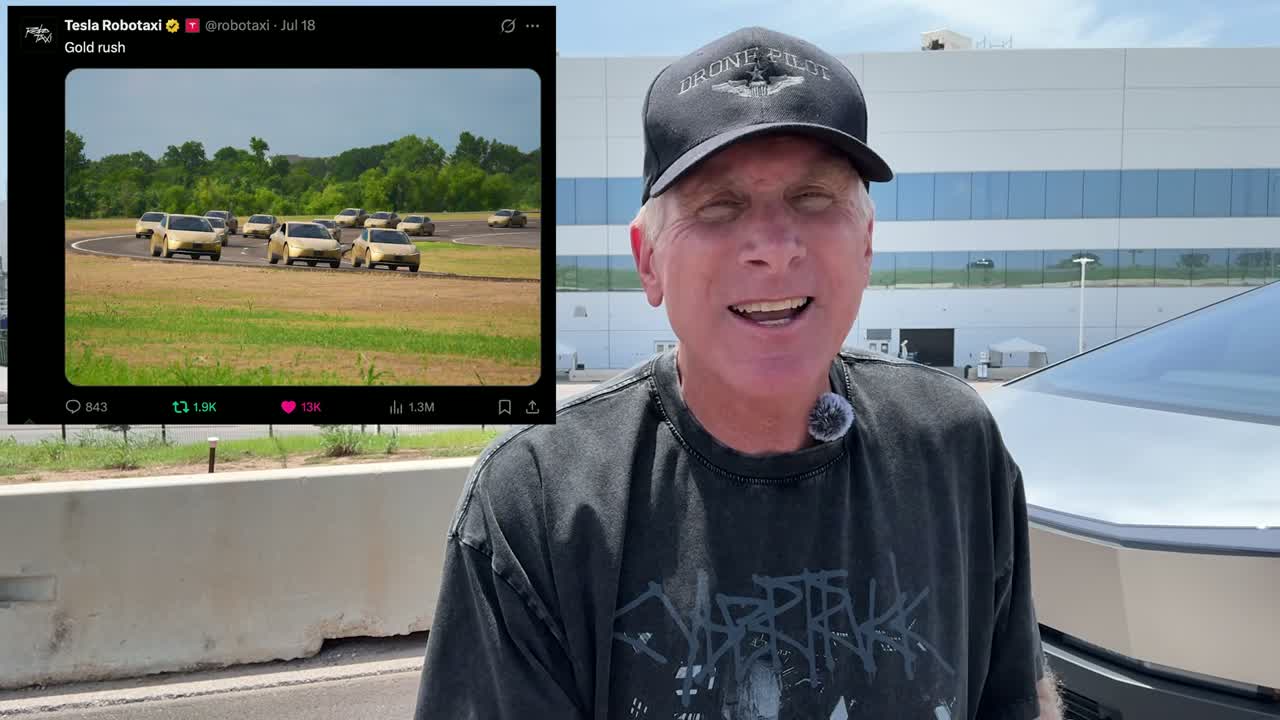
The bigger reason for the flyover was news flow. Tesla was about to host its second-quarter 2026 earnings call at the plant on Wednesday, July 22, and a Robotaxi social post the day before had shown Cybercabs on the Giga Texas test track for the first time “preemptively.” In the outbound lot, Tegtmeyer counted several hundred Cybercabs a day earlier and roughly half that on the day of filming, with many already trucked off-site. Some carried the Cybercab logo (no steering wheel), others a temporary steering-wheel kit used to gather real-world data. It is a friendly channel, so treat the headcounts as directional — but they line up with independent production tracking.

Cybercab production: real, but early
The Cybercab is no longer a concept. Tesla confirmed on its Q1 2026 call (April 23) that the first production unit, VIN #001, left the Giga Texas line on February 17, 2026 — about six weeks ahead of the April target — and that continuous production began in April. Using Tesla’s “unboxed” parallel-assembly method, the two-seat, steering-wheel-free cab carries a 48 kWh battery good for 293 miles of EPA range, costs under $30,000, and is rated at 165 Wh per mile, which Tesla calls the most efficient production EV ever built.
How fast is the ramp? Independent sightings compiled by the Cybercab Tracker show a classic early-S-curve: 1 unit on February 17, about 25 by early March, 36 by March 25, roughly 60 by late May, 85 by June 14, and about 120 by June 17. The Wall Street Journal reported in March that the line was targeting “hundreds of vehicles per week.” That is a meaningful start, but it is a rounding error against Tesla’s long-term goal of 2 million Cybercabs a year. Tegtmeyer’s several-hundred-unit lot count in July is consistent with that trajectory.

| Milestone | Date | Status / figure |
|---|
| First production Cybercab (VIN #001) | Feb 17, 2026 | Off the Giga Texas line |
| Continuous / volume production | April 2026 | Confirmed on Q1 call |
| Tracker sightings on the ground | Mar–Jun 2026 | ~25 → ~120 units |
| Line output target | 2026 | “Hundreds per week” (WSJ) |
| Long-term volume goal | Undated | Up to 2M units/year |
One regulatory note matters for US buyers: Tesla says it self-certified the Cybercab to existing Federal Motor Vehicle Safety Standards, and VP Lars Moravy has stated the company is “not subject to the 2,500-vehicle” testing cap. On June 25, 2026, the DOT proposed a rule that would drop the brake-pedal requirement for vehicles “designed to be driven exclusively by automated driving systems” — a change that directly clears the path for pedal-free Cybercabs.

The Austin robotaxi service: a wide map, a thin fleet
The robotaxi service launched in Austin in June 2025 using modified Model Ys with safety monitors. Fully driverless rides (no human inside) began January 27, 2026, and the geofence has since expanded to roughly 245 square miles covering the whole Austin metro, including the airport. The catch is the gap between map and metal. Under Texas Senate Bill 2807, which took effect in late May 2026 and forces operators to register exact fleet numbers, Tesla holds permits for 42 unsupervised Model Y robotaxis — but independent trackers put the actually active cars at just 14 to 20.
Austin active driverless Teslas
Waymo active cars in Austin
For context, Waymo runs about 300 robotaxis in Austin and more than 3,000 across the US. Tesla’s fleet is small, and executives have explicitly tied any major ramp to Full Self-Driving v15 — a roughly tenfold larger neural network (about 10 billion parameters) targeted for late 2026 or early 2027. Until then, the public footprint stays modest even as the service area widens.
Safety data is contested. The Austin Statesman has reported 15 crashes since the robotaxi launch. One tracker claims a rate of one incident per 57,000 miles — about four times the human average — but that single-source figure should be treated as indicative, not confirmed.
The bigger autonomy story for Tesla’s core business is the consumer side: Musk has said unsupervised FSD will begin reaching customer cars in Q4 2026. For background on how the US robotaxi field is shifting, see our look at Lucid, VW, and Tesla in the 2026 robotaxi shakeup.
The factory is becoming a campus
What Tegtmeyer’s drone shows best is construction. Tesla filed plans in March 2026 for 5.2 million square feet of new building at Giga Texas — a 50% jump on what is already the world’s largest factory by floor area. The pieces:
- Optimus factory: a structure nearly 4,000 feet long. Tegtmeyer counted seven cranes and a width already at 10 columns (~400–450 ft), with steel and roof decking going in. High-volume humanoid output at Giga Texas is targeted for summer 2027.
- Terafab North Campus: a ~2-million-square-foot chip fab, a joint venture tied to Tesla, SpaceX, and Intel, aimed at 2nm process tech. Tool installation begins Q3 2026; first silicon is expected in early 2027.
- Cortex 2: the AI training cluster, whose first 250 MW phase went live in April 2026. Tegtmeyer noted 47 new Megapacks delivered (bringing the on-site total to roughly 170–180) to stabilize the power draw for FSD and Optimus training.
Is the autonomous bet paying off?
The delivery numbers give Tesla cover. On July 2, 2026, the company reported Q2 results of over 450,000 vehicles produced and 480,126 delivered (up about 25% year over year and 34% quarter over quarter) plus 13.5 GWh of energy storage — its best second quarter ever. Model Y remains the volume anchor, with a peak line rate near 10,000 a week. For the car-buying angle, our piece on 2026 Model Y and Model 3 changes covers what is actually new this year.
But “paying off” depends on what you measure. On the autonomy side, the honest read is: the hardware is real and the production line exists, yet the revenue engine is not. Cybercabs are not in paid service yet; the public ride-hailing beta is planned for late Q3 or early Q4 2026 in Austin and Las Vegas, and the consumer fleet ramp waits on FSD v15. Musk himself warned in January that early Cybercab and Optimus output would be “agonizingly slow.” Most analysts expect material robotaxi revenue only in 2027.
The bet is consequential: Tesla discontinued the Model S and Model X in May 2026 to free factory space for robots and autonomy, and CapEx is running hot (opportunistic estimates near $20–29 billion for 2026). If FSD v15 lands on schedule and Cybercab volume scales, Giga Texas becomes the center of a driverless network with real unit economics — Tesla cites a target operating cost near $0.20 per mile. If the software slips or regulators push back, the company will have spent billions building capacity for a service that is still mostly a demonstration. Right now, Giga Texas looks every bit the command center of that bet. Whether the bet pays off is still the question the July 22 earnings call was meant to start answering.
When will Cybercabs actually carry passengers?
Tesla plans a public Cybercab ride-hailing beta in select cities — likely Austin and Las Vegas — in late Q3 or early Q4 2026, after internal validation and geofenced mapping. Broad paid service depends on FSD v15 and regulatory sign-off, so a meaningful commercial launch is widely expected in 2027 rather than 2026.
How many robotaxis does Tesla run in Austin today?
Tesla holds Texas permits for 42 unsupervised Model Y robotaxis, but independent trackers estimate only 14–20 are actively operating. The service area covers about 245 square miles of the Austin metro. Waymo, by comparison, runs roughly 300 robotaxis in Austin.
Was Giga Texas damaged by the July 2026 Texas floods?
Not materially. The footage shows the Colorado River swollen and debris-laden from record Lake Travis releases, but the plant’s grade work and detention ponds kept the west support and end-of-line facilities dry. The flooding was a backdrop, not a shutdown.
Sources: Tesla IR Q2 2026 production/deliveries release (July 2, 2026) and SEC 8-K; Tesla Q1 2026 shareholder call (April 23, 2026); Cybercab Tracker / Tesorb production timeline; Wall Street Journal (Mar 12, 2026) on line output; Electrek and TechTimes on Austin robotaxi fleet and Texas SB 2807; Tesla DOT proposed rule (June 25, 2026); Travis County expansion filing and Tesorb Terafab analysis (March–July 2026); Joe Tegtmeyer Giga Texas flyover (July 20, 2026). Crash-rate and “well over 500 robotaxi vehicles” figures are single-source and flagged as unconfirmed.