America’s 2026 EV shakeup isn’t Tesla losing ground — it’s everyone else scrambling. In the second quarter, luxury startup Lucid outsold the entire Volkswagen brand in the US, while Tesla quietly pushed its driverless robotaxi network into a phase most rivals haven’t reached at all.
The ranking that shouldn’t be possible
The headline from Cox Automotive’s Q2 2026 report is familiar: Tesla still commands half the market. Of 247,226 BEVs sold in the US, Tesla took 124,800 — a 50.5% share, down modestly from 52.3% in the first half but still more than the rest of the industry combined. What is new is who is fighting for the scraps.
Per Kelley Blue Book estimates, Lucid delivered 2,657 BEVs in Q2 2026; Volkswagen delivered 2,591. Lucid — founded in 2007 and still selling barely 2,600 cars a quarter — edged out one of the world’s largest legacy automakers by 66 units. It is symbolic more than commercial, but in a volatile market, symbols move stock prices and boardrooms.

| Brand | Q2 2026 US BEV sales | Market share | YoY change |
|---|
| Tesla | 124,800 | 50.5% | −13.1% |
| Chevrolet | 14,908 | 6.0% | −47.6% |
| Hyundai | 14,274 | 5.8% | −8.5% |
| Cadillac | 12,216 | 4.9% | +3.6% |
| Toyota | 11,826 | 4.8% | +225% |
| Rivian | 11,405 | 4.6% | +7.6% |
| Lucid | 2,657 | 1.1% | +0.7% |
| Volkswagen | 2,591 | 1.0% | +1.4% |
Read the table the right way and the story isn’t “Lucid beat VW” — it’s that the entire non-Tesla field is a thin crust. Chevrolet, the distant number two, sold less than one-eighth of Tesla. The real movement is underneath: Toyota surged 225% into the top five while Ford (−40.7%) and Mercedes (−58.8%) bled out. The middle of the US EV market is being reordered in real time.
Why VW collapsed in America while Lucid merely survived
Volkswagen’s US EV business is in free fall. VW Group reported 9,800 BEV deliveries in the US for H1 2026 — down 68.8% year over year, with Q2 down 49% to 5,800 units (Electrive). The cause is partly self-inflicted: VW ended ID.4 production at its Chattanooga plant in April 2026 to retool for gas SUVs like the Atlas. The ID. Buzz van rebounded 121% to 1,249 units, but that is a rounding error against the ID.4’s lost volume.
Globally the picture is grim: a CEO memo outlined plans to cut up to 100,000 jobs and close plants, and the stock sits near a 16-year low. VW Group is not dying everywhere — European BEV registrations rose 8.4% in H1 2026, led by the Skoda Elroq (59,900 units, its best-selling EV). But Skoda isn’t the VW brand and isn’t sold under that name in the US; American and Chinese buyers, VW concedes, “don’t seem to want the Volkswagen-branded EVs.”
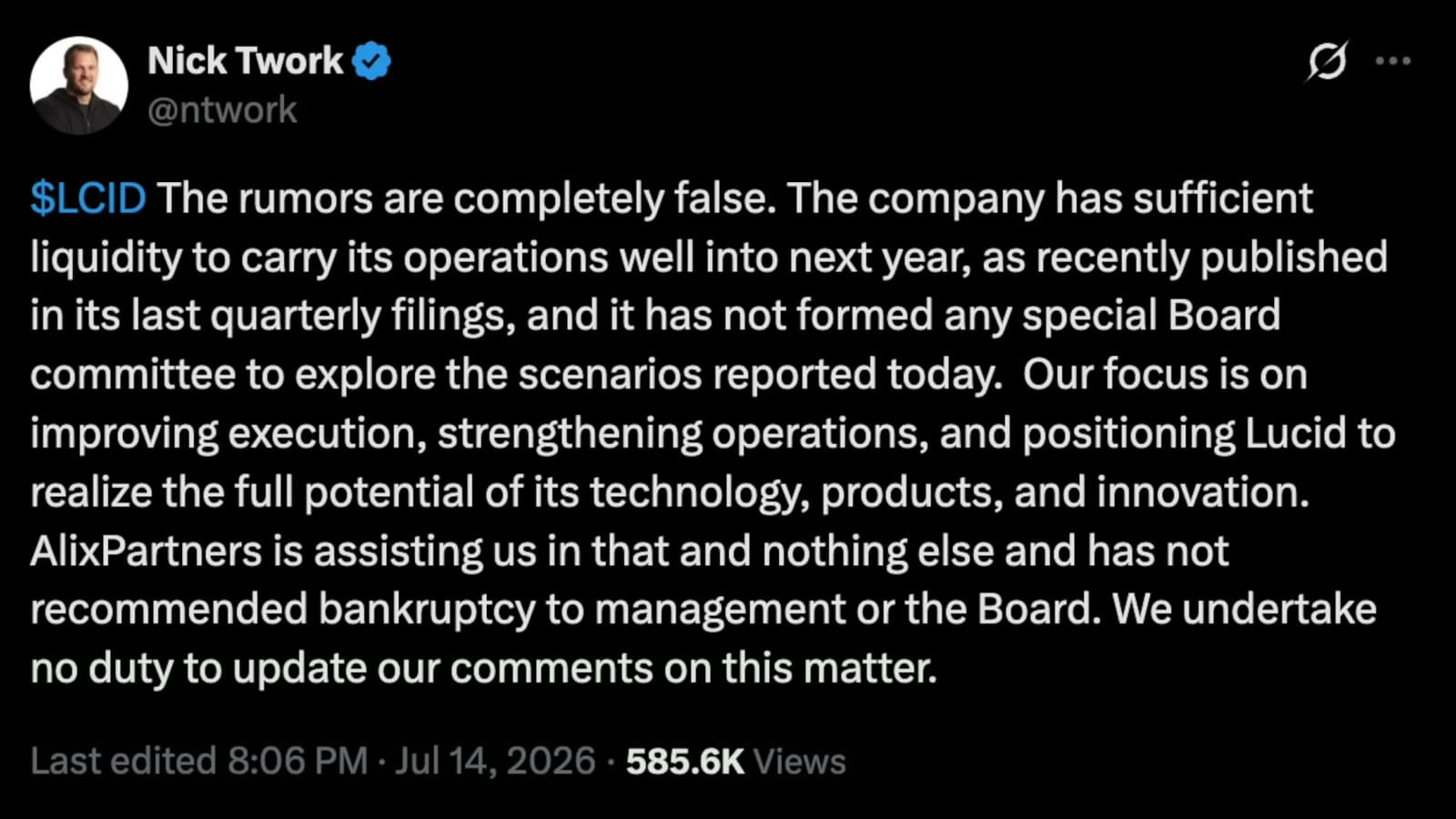
Lucid, by contrast, is not collapsing — it is merely fragile. Its H1 2026 US deliveries of 5,208 were up 2.1%, and it stays alive on luxury pricing, leasing, and the Gravity SUV’s awards. But the stock is down about 48% near an all-time low, and reports surfaced that Lucid was weighing going private or a Chapter 11 filing. Its head of communications called the “rumors not completely false” yet said the company has liquidity into next year. That hedged denial is itself a signal: Lucid survives on a knife’s edge while VW retreats by choice.
Tesla’s quiet second act: the robotaxi ramp
While the brand race stays frozen at the top, Tesla is building the next business underneath it. On June 3, 2026, VP of AI Ashok Elluswamy confirmed unsupervised robotaxi service expanded across the entire Austin metro — roughly 245 square miles, including the airport and I-35 corridor. Dallas and Houston launched in April 2026, giving Tesla driverless ride-hailing in three Texas cities.
Here the numbers get murky, and buyers should treat bold claims with caution. The source video asserts Tesla reached about 175 unsupervised robotaxis in Texas, but independent trackers tell a more modest story: Robotaxi Tracker, cited by Electrek, counted roughly 39 verified unsupervised vehicles across Austin, Dallas, and Houston as of June 2026, with Austin holding the majority. Tesla has never published an official fleet count, so the “175” figure should be read as an unverified channel claim.
Verified unsupervised robotaxi fleet (indep. trackers, Jun 2026)
What is confirmed: cumulative paid robotaxi miles reached 1.7 million by the end of Q1 2026, and Musk stated there have been zero accidents in unsupervised operations — a claim not independently verified. The real constraint is software, not cars: any large ramp is tied to the FSD v15 rewrite (a ~10x jump to roughly 10 billion parameters), now targeted for late 2026 or early 2027. Regulation is tightening too — Texas’ HB 2813 created a state AV permit system effective May 28, 2026, requiring $1 million in coverage — and Tesla made its NHTSA crash filings public in May 2026 after a year of redaction.
The $7,500 credit is dead — and that changed everything
No discussion of the 2026 US EV market is complete without the policy shock underneath: the federal $7,500 clean-vehicle credit expired for purchases and leases after September 30, 2025, killed by the One Big Beautiful Bill Act (Consumer Reports, Kiplinger). The effect was immediate — US EV sales fell 20.5% year over year in Q2 2026 — yet the quarter also rose 14.7% from Q1, a rebound analysts tie to gas prices near $5 a gallon after the US-Iran conflict that made home-charging economics attractive even without a subsidy.
What it means for US buyers
For a US shopper in 2026, the shakeup resolves into three takeaways. First, Tesla’s 50%+ share isn’t just a bragging right — it means the largest Supercharger network, the deepest used-car liquidity, and the fastest FSD iteration cycle, all protecting resale value. Second, a legacy brand retreating from US BEVs (VW) is a longer-term support and resale risk; a fragile niche brand (Lucid) may offer attractive luxury lease deals but carries real survival risk. Third, the robotaxi network isn’t yet a reason to buy or skip a Tesla, but it widens the autonomy moat.
With the credit gone, total cost of ownership now hinges on gas prices, home-charging access, and how long you keep the car. If you’re weighing timing, our buy-now-or-wait breakdown covers 2026 changes, and our Model 3 auto-park review shows where the software already delivers. The brand map is shifting — but for most US buyers, the safe, well-supported choice has rarely been clearer.
Did Lucid really outsell Volkswagen in the US?
Yes, but only by a hair. Cox Automotive’s Q2 2026 estimates put Lucid at 2,657 BEVs and the Volkswagen brand at 2,591 — a 66-unit gap. Both are tiny next to Tesla’s 124,800, so the result is symbolic: it marks VW’s collapse in the US EV market more than any Lucid breakthrough. VW Group’s total US BEV volume fell 68.8% in the first half of 2026.
How big is Tesla’s robotaxi fleet, really?
Unclear, because Tesla does not publish an official count. The source video claims about 175 unsupervised robotaxis in Texas, but independent Robotaxi Tracker data cited by Electrek put verified unsupervised vehicles at roughly 39 across Austin, Dallas, and Houston as of June 2026. Treat the larger number as an unverified claim; the verified range is far smaller, and meaningful scaling is gated on the FSD v15 software rewrite.
Does the federal $7,500 EV tax credit still exist?
No. The up-to-$7,500 new EV credit and the $4,000 used credit expired for vehicles purchased or leased after September 30, 2025, under the One Big Beautiful Bill Act. Buyers who signed a binding contract and made a payment by that date can still claim it, but the upfront discount at the dealership is gone for new orders.
Sources: Cox Automotive Q2 2026 EV Sales Report (Kelley Blue Book estimates); Electrek (Toyota top-5, robotaxi FSD v15 timeline); Electrive (VW Group H1 2026 deliveries, job-cut memo); Consumer Reports & Kiplinger (federal EV tax credit expiration, Sept 30 2025); The Verge (Q2 2026 EV market rebound, gas prices); Drive Tesla Canada & EVXL (Austin robotaxi geofence expansion, June 3 2026); Robotaxi Tracker via Electrek (unsupervised fleet counts); VW Group deliveries data (Electrive).