No products in the cart.
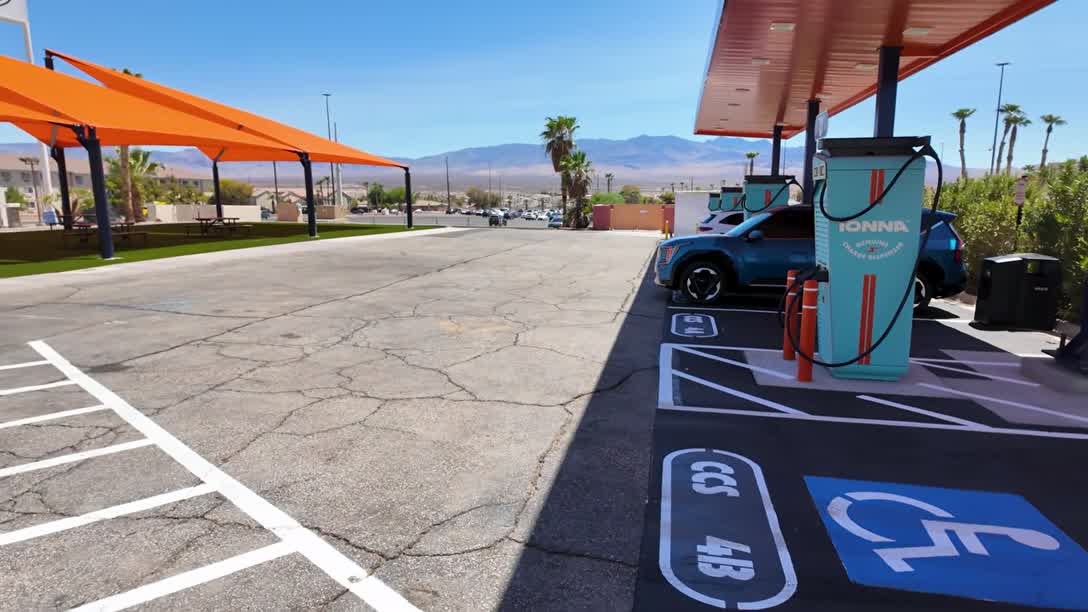
On a 115-degree day in Mesquite, Nevada — the last charging stop for an hour in any direction on I-15 — IONNA opened a station with a canopy, credit-card tap-to-pay, and 20-cent-per-kWh introductory pricing. It sounds basic. In the context of a U.S. fast-charging network where up to one in four chargers is out of service at any moment, it’s practically revolutionary.
Mesquite sits on I-15 about an hour northeast of Las Vegas, where Nevada meets Arizona and Utah. It’s a critical corridor for EVs: head north or south and the next chargers are more than 30 miles away. IONNA’s new Rechargery — its second in southern Nevada — opened 24 hours before the review, and it’s the strongest argument yet that the automaker-backed network understands what American EV drivers actually need: shade, speed, and simplicity.
What “done right” means at this station
Four 400 kW charging units, each serving two cars, make eight stalls total — six CCS and two NACS connectors, with the mix adjustable as more NACS-native cars hit the road. Payment is a credit-card tap at the charger: no app, no account, no membership gymnastics. The regular rate is 39 cents per kWh, with a first-week introductory price of 20 cents — against 47 to 60 cents at Mesquite’s other fast chargers. There are squeegees (welcome after a desert crossing), shaded picnic tables, and a canopy that turns a 115°F charge stop from misery into something survivable. The site lacks its own restrooms, but it sits next to a 24-hour gas station and the Casablanca Resort, so food and facilities are steps away.
SIGNAL: The industry’s real problem was never charger count — it’s that at any given moment, studies say one in six to one in four public chargers is down. IONNA’s answer is boring and powerful: 99.5% uptime at its first 97 sites, both plug standards on every stall, and stations built where drivers actually want to stop.
The network behind it
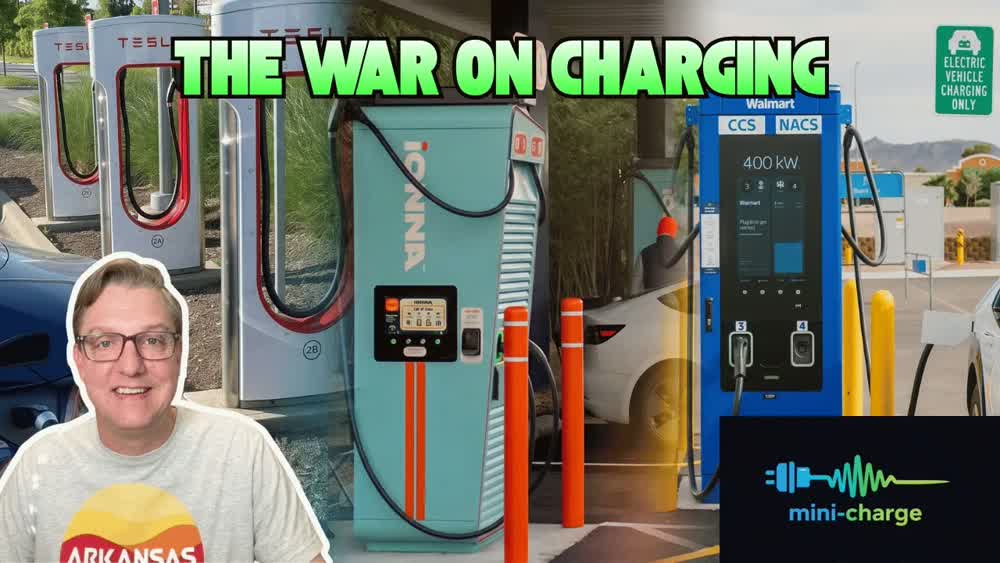
IONNA — short for Ion North America — launched in March 2024, backed by eight automakers: BMW, GM, Honda, Hyundai, Kia, Mercedes-Benz, Stellantis, and Toyota. In under two years it has passed 100 locations and roughly 1,000+ stalls (about 1,160 by mid-2026), with every stall carrying both NACS and CCS1 connectors natively. The plan: at least 30,000 high-power bays by 2030 — roughly 3,000 stations, about equal to Tesla’s entire U.S. Supercharger network today. In April 2026, IONNA added a Circle K partnership to convert about 85 existing sites and build 350+ Rechargeries @ Circle K by 2027.
| Network (2026) | Size | Peak speed | Plug | Uptime |
|---|---|---|---|---|
| Tesla Supercharger | ~36,900–37,700 stalls (~51% of US DC) | 250–350 kW | NACS | most reliable (J.D. Power, 5 yrs) |
| IONNA | ~1,160 stalls (target 30,000 by 2030) | up to 400 kW | NACS + CCS (every stall) | 99.5% at first 97 sites |
| Electrify America | ~4,500–5,600 ports | up to 350 kW | CCS (+NACS rollout) | industry average |
| EVgo | ~1,000–5,000 ports | 100–350 kW | CCS (+NACS rollout) | industry average |
For context, the U.S. had roughly 74,000 public DC fast-charging ports by mid-2026, growing more than 1,000 stalls a month. Tesla alone controls about half of them, and J.D. Power’s satisfaction data keeps Tesla on top — but its non-Tesla access pricing runs a ~40% premium unless you buy the $12.99/month membership. IONNA’s pitch is the dual-plug standard, premium amenities, and a reliability number (99.5%) that dwarfs the roughly 70% industry uptime average cited by its own CEO.
Why this matters for American EV drivers
The reviewer’s own session is the proof point: 53 kWh in 16 minutes for $10.60 at 213 kW peak — his car’s maximum, not the station’s. That’s the experience EV owners are supposed to have: fast, predictable, and cheap enough that charging beats gas on price. The industry’s “charge anxiety” has shifted from charger availability to charger reliability and payment friction; IONNA’s model attacks all three. If the network hits 30,000 stalls by 2030, the charging landscape in the American West — where stations like this are currently sparse — changes fundamentally.
This station isn’t a tech breakthrough; it’s a standards breakthrough. Canopy, tap-to-pay, dual plugs, and 20-cent power at a desert crossroads — the boring stuff done reliably is exactly what gets people to stop worrying about range and start planning road trips.
Who owns IONNA?
Eight automakers: BMW, General Motors, Honda, Hyundai, Kia, Mercedes-Benz, Stellantis, and Toyota. It launched in March 2024 and is headquartered in Durham, North Carolina.
Is IONNA actually more reliable?
CEO Seth Cutler reports 99.5% uptime at the first 97 live sites, versus industry averages where studies find one in six to one in four chargers out of service at any given time (NREL and other analyses).
Can any EV use IONNA?
Yes — every IONNA stall natively carries both NACS (J3400) and CCS1 connectors, so Tesla and non-Tesla vehicles both plug in without adapters. Payment is available at the charger by credit card tap.