
No products in the cart.
China’s July 2026 EV sales are in, and a brand most American buyers have never heard of — Leapmotor — just crossed 100,000 deliveries in a single month, a threshold no Chinese EV startup has ever cleared. With overall NEV penetration now at 64.4% and BYD flipping to an export-led growth model, the month tells Detroit something the U.S. tariff wall cannot block: the cost curve of an EV sold at scale has permanently bent, and the price war that softened domestic demand is now being exported.
The headline: Leapmotor’s 100,000-unit month
The number to fix in your head is 101,267. That is Leapmotor’s global deliveries for July 2026, confirmed by Stellantis’ joint-venture press release on August 1 — a 102% year-on-year surge from roughly 50,000 in July 2025, an 8.5% sequential gain from June’s 93,376, and the fifth straight month of growth. It also makes Leapmotor the first Chinese EV startup to deliver more than 100,000 vehicles in a single month, a milestone BYD-scale players took years to reach.
For context, here is what “100,000 from a startup” means against the other famous new forces:
- Leapmotor: 101,267 (+102% YoY)
- Xpeng group: 38,027 (+4% YoY)
- NIO group (NIO + Onvo + Firefly): 35,934 (+71% YoY)
- Zeekr: 35,837 (+111% YoY)
- Li Auto: 30,468 (−1.4% YoY, fourth straight monthly decline)
Add NIO group + Li Auto + Xpeng together and you get about 104,400 — Leapmotor effectively matches the combined output of the three best-funded Chinese startups, and out-delivers any one of them by roughly 2.7× to 3.3×. The source video rounds the trio’s totals slightly high, but the conclusion holds either way: the second tier of the China “new forces” race has officially closed, and Leapmotor is alone on the top step.

SIGNAL: Leapmotor’s 100K month is not a fluke — it is the output of a cost-engineering philosophy that prices competitors out of the response, and the Stellantis distribution deal makes it a European problem by the end of 2026.
How Leapmotor actually wins: reverse-engineering cost before product
The interesting story is the mechanism. While Western coverage focused on BYD vs. Tesla and the implosion of NIO, Leapmotor CEO Zhu Jiangming quietly built what one industry analyst calls a “top-cost logic applied to a top market” — engineer to a target price first, then build the product around that constraint, instead of the reverse.
Three numbers explain why this matters in July 2026:
- C-series SUV price band of roughly ¥120,000–¥160,000 — that sits between a loaded VW Tiguan and a base Tesla Model Y in China, but the range and ADAS spec run closer to the Tesla. The margin for any competing ICE-era SUV is functionally zero.
- About 65% of core components in-house — electric drive, battery system, smart cockpit, and electronic architecture are all developed internally, which compresses the BOM the way Tesla’s 4680 cell did for the U.S. market.
- Stellantis owns ~21% of Leapmotor International — that joint venture already has the B10 and C10 produced at Zaragoza, Spain (from H2 2026) and at a new KD plant in Purwakarta, Indonesia, alongside the existing Malaysian facility. In Spain alone, the B10 was the best-selling EV to private buyers in July, with 94% retail (not fleet) penetration.
The product cadence is also why the run-rate compounded. June brought refreshed C10/C11/C16 plus the first MPV (D99); July added long-range 800V variants of the B01 sedan and B10 SUV and opened pre-orders on the A05 compact — three new nameplates in 60 days. Year-to-date through July, Leapmotor has delivered 457,754 vehicles, up 68.4% YoY, and cumulative since the brand’s first delivery in June 2019 has now crossed 1.69 million.
The U.S. angle: Leapmotor does not sell in America and the 100% Section 301 tariff wall keeps it out. But a sub-$25,000 EV that Stellantis will move through 130 countries by the end of 2026 fundamentally reprices the global cost curve — and that is what Detroit is competing against on its way to 2030.
BYD is still king — but the engine flipped
BYD’s July numbers from the Hong Kong Stock Exchange filing (419,211 NEVs, up 21.8% YoY on the month) reconfirm what we already knew: nobody is threatening BYD’s volume throne. The more important shift is where the volume came from.
| Metric | July 2026 | July 2025 | YoY |
|---|---|---|---|
| Total NEV sales | 419,211 | 344,296 | +21.8% |
| Battery electric (BEV) | 233,105 | 177,887 | +31.0% |
| Plug-in hybrid (PHEV) | 177,967 | 163,143 | +9.1% |
| NEV exports | 180,538 | ~80,500* | +124.3% |
| YTD NEV sales (Jan–Jul) | 2,227,722 | 2,490,250 | −10.5% |
*July 2025 export figure is industry-derived; 2026 figure is from BYD’s voluntary HKEX announcement, August 2.
Two stories sit inside that table. First, BYD’s domestic sales declined about 9% YoY in July, evidence that the brutal first-half price war is now eating its own. Second, exports of 180,538 vehicles — roughly 43% of BYD’s monthly volume — grew 124.3% YoY, meaning the company that flooded Chinese showrooms is now flooding the world’s. Brazil alone took more than 180,000 Chinese-brand vehicles from January through July (+105.4%), with Chinese marques accounting for 52.4% of all Brazilian vehicle imports.
BYD’s other July lever was the second-generation 5C flash-charging network, which the company says can add roughly 400 km of range in about 10 minutes under ideal conditions — a direct rebuttal to the “range anxiety” objection that Toyota and Honda dealers still lean on in China, and an infrastructure moat that Leapmotor cannot match overnight. If you are a U.S. reader tracking whether China is about to overtake Detroit, this is the under-discussed signal: BYD is no longer competing on showroom volume alone; it is competing on the cost of charging.
SIGNAL: BYD’s growth engine has flipped from “domestic volume” to “export volume.” That makes it immune to China’s brutal retail price war — and far harder for Detroit to ignore, because the price discipline that hit U.S. automakers in 2008 is now happening on the global market.
Zeekr: the domestic luxury leader is real, not a Geely experiment
For two consecutive months, Zeekr has been the top-selling domestic luxury EV brand in China. In July, the Geely-owned brand delivered 35,837 vehicles — a record, +111% YoY, the fourth straight monthly record, and the sixth consecutive month of both YoY and MoM growth. Year-to-date deliveries reached 214,207, putting Zeekr roughly 61–71% of the way toward its 2026 target depending on which industry estimate you trust.

The interesting part of the Zeekr number is the price. The brand’s average transaction price crossed ¥360,000 in May, up 52.4% YoY, while the flagship Zeekr 9X — which competes at ¥500,000 and above — has now held the #1 spot in the large-SUV segment for seven straight months. The 9X and 8X super-hybrid (EREV) models led the July mix; the pure-electric 7X cleared 10,000 global deliveries, and the 001/001 GT shooting brake line also cleared 10,000 — meaning Zeekr crossed 20,000 pure EVs a month even while leaning into hybrids. Few Chinese premium brands can sell 10,000+ BEVs and 10,000+ EREVs in the same month.
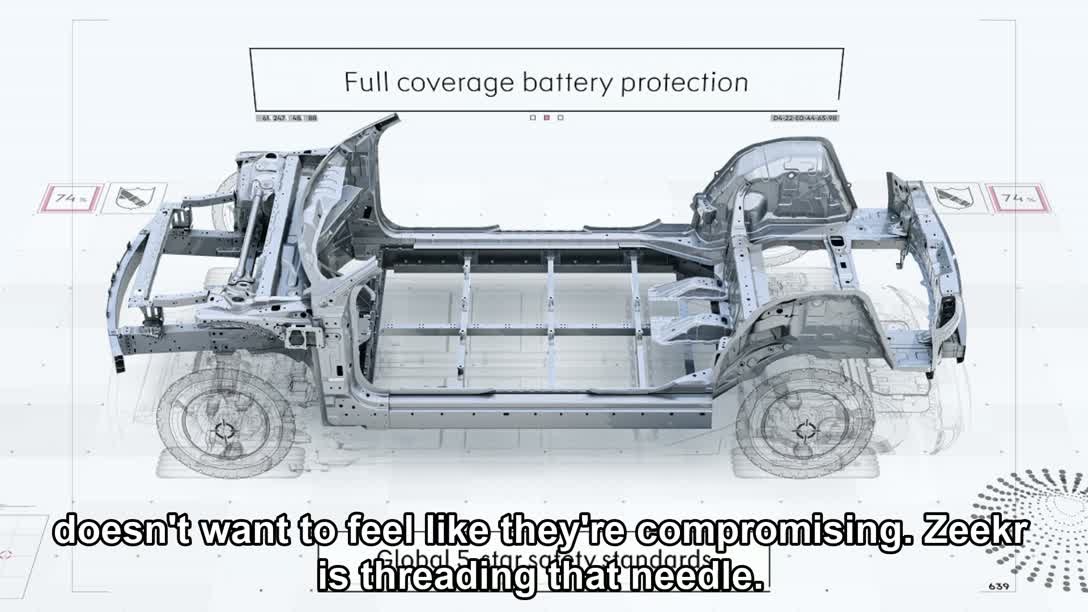
Underneath, the Volvo-derived SEA platform does real work: shared R&D amortization across Geely, Volvo, Lynk & Co and Zeekr, standard 800V (and now 900V) architecture, and the same crash/ADAS engineering DNA. The 9X Ultra — unveiled for Europe on July 29 — quotes 897 hp, 4.1 seconds to 100 km/h, and 737 km of combined range, aimed squarely at the BMW X7, Mercedes GLS and Audi Q9. European deliveries start in late December; in Sweden, Netherlands, Germany, and Denmark, Zeekr is already a Tier-1 premium-EV name.
Contrast with NIO: NIO group (including Onvo + Firefly) did 35,934 in July, +71% YoY, but Onvo and Firefly now make up 44% of that volume, and the battery-swap network expansion that anchors NIO’s premium moat is a per-unit fixed cost that becomes punitive at 36,000 cars a month. If NIO cannot push Onvo above 30,000 monthly by Q1 2027, the swap network becomes an anchor, not an asset.
The old guard is bleeding — and it rhymes with 2009
The video does not name the legacy Chinese brands, but the pattern is now undeniable: traditional ICE-era Chinese automakers — brands that built reputations on combustion vehicles through the 2000s and 2010s — are showing July numbers that quietly crater, with no credible native EV product line to defend share. CPCA’s preliminary estimate puts total Chinese passenger-vehicle retail at roughly 1.506 million in July, down 18% YoY, while NEV retail held at about 970,000 (down only 2% YoY) and NEV penetration hit a record 64.4%.

For perspective on how fast that penetration number moved: 5.4% in 2020, 25.6% in 2022, 47.6% in 2024, 53.9% in 2025, 62.8% in June 2026, 64.4% in July. The market did not transition gradually; it tipped. ICE sales in the first two weeks of July fell 56% YoY at the wholesale level, and in May 2026 no pure-ICE model appeared in China’s top-10 retail ranking for the first time ever. This is exactly the shape the U.S. “Big Three” dealer channel looked like in 2009 — the volume cliff comes faster than the balance sheet models predict.
The August CPCA update should rebound, partly because the July pull-forward of June half-year targets created an artificial trough. But the structural story is a one-way ratchet: every incremental EV gain is coming directly out of collapsing ICE share, not out of new car buyers entering the market.
Exports are the new domestic: the price war went global
For a U.S. reader, this is the most under-appreciated number of the month. China’s July auto exports hit 1.092 million units, up 57% YoY, per CPCA secretary-general Cui Dongshu’s August 7 update — a monthly record. Through July 2026, total Chinese auto exports reached 6.4 million units (+54% YoY), worth $110.8 billion (+55%). NEV exports alone for the first half hit 2.355 million units, up 120% YoY, with green-product export value up 71.2% in customs data through July. The average NEV export price has hit $29,800 and crosses $40,000 in premium European and U.S.-bound segments.
| Manufacturer | July total sales | July exports | Export YoY | Key markets |
|---|---|---|---|---|
| BYD | 419,211 | 180,538 | +124.3% | Brazil, SE Asia, Europe, Australia |
| Chery | 276,820 | 202,533 | +70.1% | Russia, Middle East, S. America |
| Geely group (incl. Zeekr) | 250,161 | 106,663 | +202% | Europe, Middle East, SE Asia |
| Leapmotor (global) | 101,267 | growing | +102% (total) | Europe (Stellantis), Mexico, Indonesia |
| Tesla China (wholesale) | 93,579 | significant | +37.9% | Asia-Pacific, Europe |
The Chery line deserves its own paragraph: 276,820 total July deliveries (+23.3% YoY), of which 202,533 were exports (+70.1%) — making Chery the first Chinese automaker to cross the 200,000 monthly export mark, a threshold it has now hit five months in a row. Chery’s NEV sales hit 129,067 (+97.5%), with the QQ3, Fengyun A9 and iCAR V9 all running record months. The model is the old Volkswagen playbook from 1970s Brazil: convert existing ICE-era distribution networks in South America, the Middle East and Southeast Asia to carry EVs and hybrids faster than any new entrant can build greenfield.
For U.S. automakers, the export boom is the part that matters most. The 100% U.S. tariff wall blocks finished Chinese EVs from crossing the border, but it does not block the price discipline that comes from a global EV market where the marginal supplier is now Chinese. Brazil’s 35% import tariff took effect July 1 and is already forcing a pivot to local-for-local production: BYD’s Bahia plant produced its 100,000th vehicle in July, GWM’s Iracemapolis facility is at 50,000-unit annual capacity, GAC breaks ground in Q4 2026, and Leapmotor is leveraging Stellantis’ Spanish and Italian plants. The EU’s 17–35% countervailing duties are doing the same thing — BYD’s Hungary plant is scheduled for 2027. The endgame is not “Chinese cars flood the world,” it is “Chinese OEMs build the world’s cars locally.” Detroit has a few years to figure out how to compete with that cost structure on its own continent.
What it means for a U.S. buyer right now
If you are shopping an EV in the United States in August 2026, none of this changes your local showroom today — Leapmotor, BYD, Zeekr, NIO, Xpeng and the rest are not on sale here. What it does is set the cost ceiling that GM, Ford, Hyundai, Honda, Toyota and Tesla are negotiating against:
- The cost floor for a competitive compact EV is now structurally below $20,000 in China, and BYD/Leapmotor are actively exporting that price point globally (average NEV export price $29,800; sub-$25K models on the way to Europe).
- The second-generation 5C charging standard BYD is rolling out implies 400 km of range in 10 minutes — a public-equivalent metric Detroit’s CCS/NACS networks have not matched.
- NEV penetration crossed 64.4% in a market where the broader auto industry is still printing a 1.5% profit margin (CAAM, through May) — the price war is structural, not transitional.
- ICE volumes collapsed 56% YoY at the wholesale level in early July. The U.S. will not see that this year, but the direction of travel is identical to what happened to American sedans in 2012–2018.
For GM and Ford, the question is not whether to keep building EVs — it is whether their 2027–2030 product plans can hit a $25,000-$30,000 effective transaction price with margin, while also standing up a comparable fast-charging moat. For Tesla, the question is whether FSD and robotaxi can fund a price war at the volume end without compressing the margin that funds them.
SIGNAL: The U.S. tariff wall is real, but it is a 3-to-5-year timer, not a permanent shield. When Leapmotor hits European showrooms under €30,000 in late 2026 and BYD starts producing in Hungary in 2027, the cost curve that Detroit has been protected from goes global.
Did Leapmotor really outsell NIO, Li Auto and Xpeng combined?
Effectively, yes — within ~3%. Verified July deliveries are Leapmotor 101,267 vs. NIO group 35,934 + Li Auto 30,468 + Xpeng 38,027 ≈ 104,429. The source video rounds NIO at roughly 24,000 (close to the NIO-brand-only figure of 20,008, before adding Onvo 10,155 and Firefly 5,771), which makes the trio sum appear lower and the “outsold the pile” claim look cleaner. Using the full NIO group number, Leapmotor matches the trio within 3% rather than beating it, but it still beats any one of them individually by 2.7× to 3.3×.
Why is China’s NEV penetration 64.4% while the U.S. is closer to 10%?
Three structural differences. First, China used license-plate lotteries in megacities like Beijing and Shanghai for a decade, making an EV the only legal way for many residents to own a car. Second, China’s average EV price is roughly half the U.S. average after subsidies and supply-chain scale. Third, China’s residential charging rollout outpaced the U.S. by years because most urban housing is high-density apartment stock, where shared chargers were deployed at scale. The U.S. trajectory looks similar in shape — just on a 5-to-8-year delay.
What does this mean for Tesla, GM, and Ford?
Tesla’s China wholesale hit 93,579 in July — its best July ever — but BYD alone sold more than four Teslas for every one in the same market, and the gap is widening on exports, not retail. GM and Ford do not sell Chinese-market EVs at scale, but they compete globally with Chinese-owned brands that now control 52.4% of Brazil’s import market, ~62% of BYD’s overseas volume, and — via Leapmotor/Stellantis — are about to control the European sub-€30K segment. Detroit’s competitive problem in 2030 is not the Chinese showroom; it is the Chinese factory floor.
Related reading on EVCUBE
Sources
- BYD Company Limited — Production and Sales Volume for July 2026 (HKEX voluntary announcement, August 2, 2026)
- Stellantis Media — Leapmotor Doubles Deliveries and Breaks the 100,000-Unit Milestone (August 1, 2026)
- iEVChina — China NEV Sales July 2026: 970K, 64.4% Penetration (CPCA preliminary data, early August 2026)
- Eletric-Vehicles.com — Zeekr Delivers Record 35,837 in July as Premium Mix Holds (+111% YoY)
- Cailianshe via QQ News — Chery Group July 2026 Sales: 276,820 Units, Exports 202,533 (+70.1%)
- iEVChina — China EV Exports Rocket to Records in July 2026: BYD 180K, Chery Tops 200K
- CnEVPost — CPCA Forecasts China’s July NEV Retail to Dip to ~980,000 Amid Seasonal Slowdown












