Tesla’s Cybercab Just Got a Major Upgrade — What Actually Changed
July 23rd, 2026
By EVCUBE .NET
No Comments
Tesla’s Cybercab Just Got a Major Upgrade — What Actually Changed
EV Market Analysis · Tesla Cybercab
Tesla’s Cybercab Just Got a Major Upgrade — What Actually Changed
On July 21, 2026, Tesla and SpaceX’s Starlink confirmed something nobody expected on a self-driving car: Starlink V5 is now “directly integrated” into the Cybercab. The puzzle is obvious — a car designed to drive itself with no internet connection suddenly gets satellite internet. Here’s what’s confirmed, what’s hype, and why it matters.
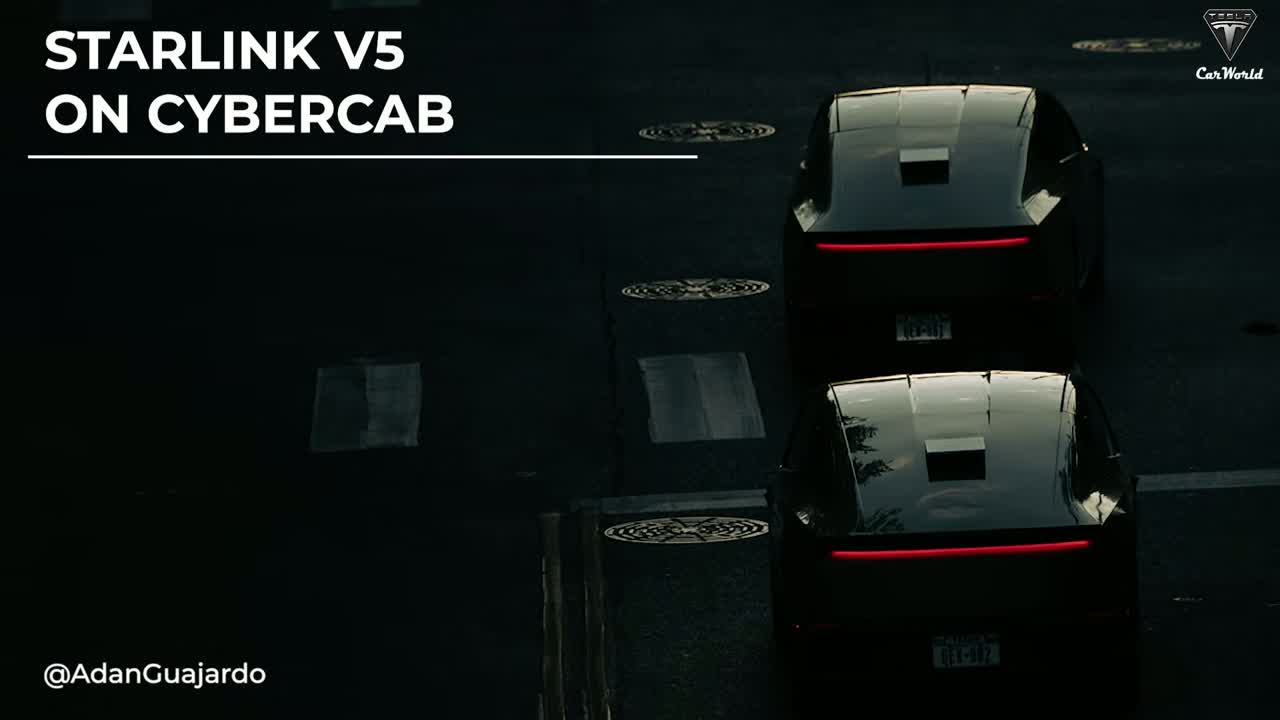
The announcement included a cutaway showing a Starlink module mounted on the roof alongside the autonomous-driving cameras and sensors.
What Was Actually Announced
Tesla and Starlink posted within minutes of each other on X, accompanied by an image showing a Starlink module on the Cybercab’s roof next to the camera and sensor stack used by its autonomous system. Starlink called it “high-speed internet from space for the future of autonomous vehicles.” Tesla’s post was shorter: “Starlink V5 directly integrated into Cybercab.”
That’s the entire announcement. No specs, no timeline, no explanation of why a car that drives itself offline needs space-based internet. The silence is what makes this interesting.
Starlink V5: The Hardware That Makes It Possible
The reason this integration is plausible now — and not with the bulkier previous generation — comes down to size and power. V5 is the latest residential dish, far more compact than V4.
Spec
Starlink V5
Starlink V4
Weight
~2.4 lb
Heavier (prior gen)
Power draw
35–50 W avg
75–100 W avg
Peak download
~375+ Mbps
~400+ Mbps
Design focus
Lighter, cheaper to build, flat-panel
Higher peak speed
V5 trades a little peak speed for a much smaller footprint and roughly half the power. On a vehicle where every watt and pound counts, that’s the difference between “theoretically possible” and “actually shippable.” A 35–50 W draw is a rounding error against a 75 kWh-plus pack, and at 2.4 lb the roof penalty is minor.
V5’s compact flat-panel design is what makes permanent vehicle integration practical.
Why a Self-Driving Car Needs Satellite Internet
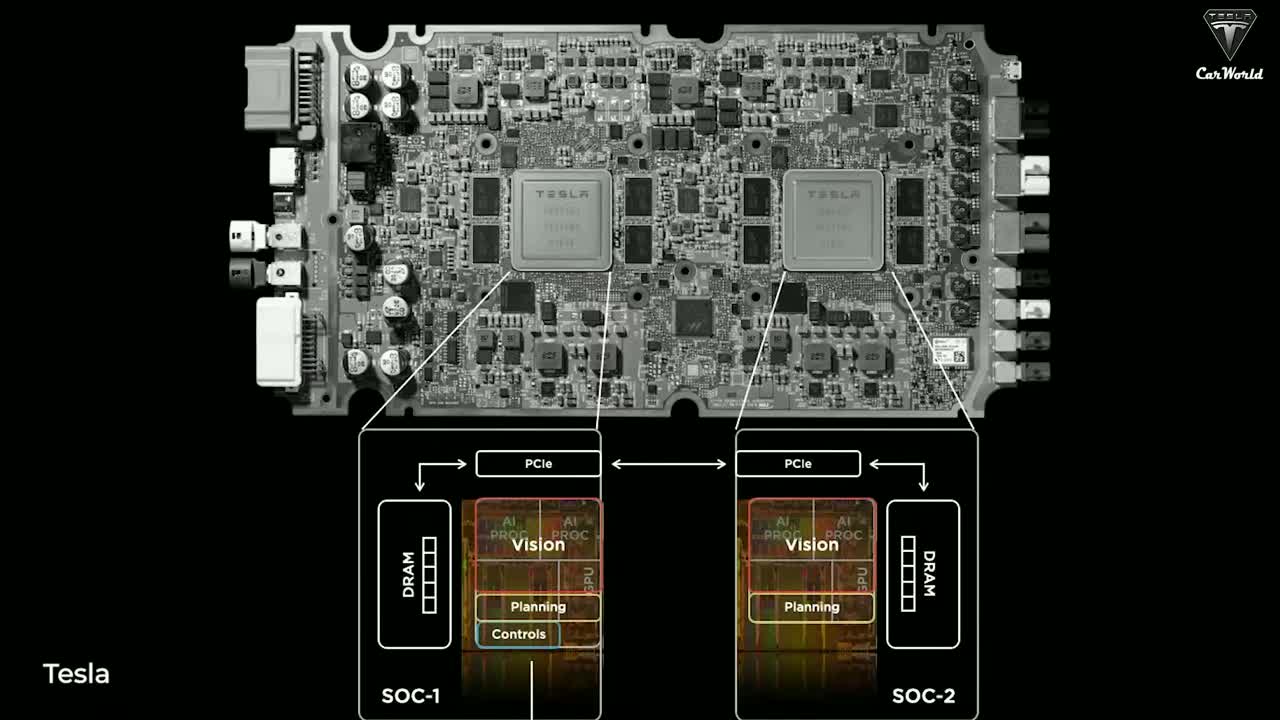
Here’s the part that confuses people. The Cybercab runs on Tesla’s AI4 (HW4) computer, which is built around an onboard philosophy: perceive, plan, and drive entirely on the vehicle, with no internet required. Even if the network drops, the car keeps driving. Ashok Elluswamy, Tesla’s VP of AI software, explicitly confirmed a satellite link is not required for the vehicle to operate safely.
So Starlink is an enabling technology, not a driving component. What it actually unlocks:
Over-the-air software updates even in dead zones, so a parked Cybercab can pull the latest FSD build without hunting for a signal.
Real-time fleet management and teleoperations during the early, monitored phase of deployment.
Passenger connectivity — Musk’s own pitch: “Watch 4K streaming video while cybercab takes you anywhere you want.”
Reliable operation in remote areas where 5G or LTE is thin, exactly the places a robotaxi network still has to serve.
Starlink’s role: core vs. auxiliary
Driving = onboard AI4, offline-capable Starlink = updates, fleet, entertainment Not a safety system
Elluswamy was clear: connectivity supports services, not vehicle control. The car drives fine without it.
The Strategic Angle Nobody’s Talking About
There’s a second reading that fits a pattern. Musk has spent years building synergies across his companies — Tesla, SpaceX, and xAI — and Tesla has already invested roughly $2 billion in xAI. If every Cybercab ships with a Starlink terminal, SpaceX could quietly acquire millions of new satellite-internet subscribers as the robotaxi fleet scales. In that scenario, Starlink becomes more than a technical feature; it’s recurring revenue for SpaceX, baked into the vehicle.
Whether the greatest beneficiary is the consumer or the broader Musk ecosystem is, as one analyst put it, “an open question only time will answer.” But the integration itself signals where Tesla is heading: an autonomous ecosystem with seamless, always-on connectivity regardless of location.
The Cybercab Itself: Built for Scale
The Starlink news lands on top of a vehicle that’s already in production at Giga Texas. The Cybercab has no steering wheel or pedals, seats two, and is aimed at a sub-$30,000 price with a ~$0.20-per-mile operating cost. More than 250 units have been spotted at the factory. Critically, Tesla structured it to meet federal safety standards without the NHTSA 2,500-unit annual exemption cap that constrained Waymo and Cruise — so it can scale on a normal S-curve ramp.
The AI4 computer is the foundation: paired chips with 16 GB or more of RAM each, enough headroom to run complex end-to-end models, fuse multiple high-resolution camera feeds, and handle edge cases with lower latency. Combined with FSD V14 and the expected V15, the Cybercab is the purpose-built robotaxi the Model Y pilots are bridging toward.
Production-intent Cybercabs have logged thousands of real-world miles; the Starlink module is the latest piece of the connected-vehicle puzzle.
What It Means for the AV Bet
For Tesla, this is less a “feature drop” and more a statement of architecture: the car drives itself, and everything around the ride — updates, fleet ops, passenger experience — is wired for always-on connectivity. That’s a meaningful edge in a robotaxi business where uptime and remote management decide margins. It also deepens the Tesla ownership and ecosystem story far beyond the vehicle itself.
The caveats are real, though. Tesla has disclosed no technical specs, no rollout date, and no confirmation of whether Starlink ships on the first production units or arrives later. As we noted in our Q2 2026 earnings breakdown, the company’s autonomy timeline has historically slipped — so treat “integrated” as a direction, not a delivery date.
A Few Honest Questions About Cybercab + Starlink
Does the Cybercab need Starlink to drive?
No. The AI4 computer drives the car entirely onboard and is designed to keep operating even with no network connection. Starlink is for updates, fleet management, support, and passenger internet — not for vehicle control.
Why not just use 5G?
5G and LTE are fine in dense metros, but a robotaxi needs reliable connectivity in remote and rural areas too. Satellite fillsthe gaps where cellular coverage is thin, and it lets a parked car pull OTA updates anywhere.
When will Starlink-equipped Cybercabs be available?
Tesla hasn’t said. The announcement gave no specs, timeline, or confirmation of whether first-production vehicles include it. Treat it as a roadmap item aboard the late-2026 robotaxi deployment plan.
Is this just a Musk ecosystem play?
Partly. The technical benefits (updates, fleet ops, passenger streaming) are real, but equipping every Cybercab with a Starlink terminal would also hand SpaceX a massive recurring-subscriber base — a clear strategic synergy across Musk’s companies.
Sources
Tesla & Starlink posts on X (Jul 20–21, 2026); Electrek reporting on the integration
Ashok Elluswamy (Tesla VP AI Software) clarification on X: satellite not required for safe operation
Discover the most attractive leasing and financing options for electric vehicles (EVs) this November 2024. Whether you’re looking to lease or finance, there are some excellent deals available that cater…