For a typical American household that can plug in at home, an EV still costs dramatically less to fuel and maintain than a gas car in 2026 — but the full total-cost math is closer, and sometimes worse, than the savings headlines suggest.
The headline number that actually matters
The truth in mid-2026 sits in the gap between the competing studies. The operating case for an EV is genuinely strong — electricity is far cheaper than gasoline per mile, and EVs need far less maintenance. But AAA’s 2026 Your Driving Costs study reached an uncomfortable conclusion for EV fans: across every vehicle category it tested, a new EV now costs more to own overall than a comparable gas car, because higher depreciation, insurance, and financing eat up the fuel and maintenance savings.
So the right question is not “are EVs cheaper?” in the abstract. It is “are they cheaper for my exact situation?” Three variables decide it: can you charge at home, how many miles do you drive a year, and are you buying new or used. Get those three right and the answer is often yes. Get them wrong and you can lose money.

Fuel: where the EV still wins big
Start with the per-mile math, because this is where the savings are real. The average U.S. household paid about 17.9 cents per kWh for residential electricity in early 2026 (U.S. Energy Information Administration). A typical modern EV uses roughly 30 kWh to travel 100 miles, or about 3.3 miles per kWh. At the national average rate that is about 5.4 cents per mile in electricity.
Now the gas comparison. The national average gasoline price was around $3.80 per gallon in mid-2026 (AAA), elevated roughly 21% from a year earlier on Middle East oil volatility. A comparable compact crossover rated at 28 mpg costs about 13.6 cents per mile in fuel. On a 12,000-mile driving year, that gap is roughly $1,000 to $1,300 in annual fuel savings for the EV.
The kicker is the off-peak rate. Most utilities now offer time-of-use or EV-specific tariffs that drop residential power to roughly 8 to 12 cents per kWh overnight. Charge a 12,000-mile year on a 9-cent rate and your electricity bill for the car falls to about $325 a year — roughly one-fifth of the gas equivalent.
The home-charging rule (and what it costs)
The fuel savings above only exist if you charge at home. If you rely on public DC fast chargers, the economics collapse — fast charging can run 30 to 50 cents per kWh, wiping out most of the advantage over gasoline.
A Level 2 (240-volt) charger installed in 2026 typically costs $1,200 to $3,000 all-in (charger hardware plus a licensed electrician), with a national median around $1,100 to $1,400 for a straightforward run. The budget-buster is your electrical panel: if your home needs a service upgrade to free up capacity, the bill can climb to $2,000 to $4,500. One honest note for buyers this summer — the federal 30C tax credit that covered 30% of installation cost (up to $1,000) expired on June 30, 2026, so there is no federal help for the install anymore.
Maintenance: the quiet, compounding win
Fuel gets the attention, but maintenance is where EVs quietly pull ahead over time. Consumer Reports’ multi-year owner data shows EV drivers pay about half as much for repair and maintenance as gas-car owners — roughly $4,600 saved over the life of the vehicle. AAA puts it at 5.17 cents per mile for a battery EV versus 7.75 cents per mile for an internal-combustion car. In dollar terms, expect to spend about $540 to $740 a year on an EV versus $910 to $1,330 on a gas car (12,000 miles/year).
The savings come from what an EV does not have: no oil changes, no spark plugs, no transmission service, no timing belt, no exhaust. The one catch is tires — EVs are heavier and wear rubber faster, so budget a little extra there. Net result: roughly $400 to $600 a year in maintenance savings, every year you own the car.
EV vs gas: a five-year cost line-by-line
Here is a representative new compact-SUV comparison over five years and 60,000 miles, home-charged on an off-peak rate. Numbers are illustrative but anchored to the sources above.
| Cost line (5 yrs / 60,000 mi) | New EV | Gas equivalent |
|---|
| Purchase price (no federal credit) | $44,000 | $38,000 |
| Fuel / electricity | $1,800 | $8,200 |
| Maintenance & repair | $3,000 | $5,500 |
| Insurance (EV slightly higher) | $9,000 | $8,000 |
| Depreciation (5-yr) | $22,000 | $17,000 |
| Home charger (one-time) | $1,800 | $0 |
| Five-year total | $81,600 | $76,700 |
Home-charged fuel savings vs gasoline
Lifetime maintenance savings (EV vs gas)
The table explains AAA’s verdict: the EV saves about $6,400 on fuel and $2,500 on maintenance, but loses about $5,000 more to depreciation and carries a $1,800 charger cost plus slightly higher insurance. Bought new, the gas car still comes out ahead on paper by a few thousand dollars.
Depreciation: the wildcard that flips the math
Depreciation is the reason a new EV is a tougher sell in 2026. The used-EV market tells a more encouraging story. Cox Automotive’s Kelley Blue Book data shows the price premium for a used EV over a comparable gas car has narrowed to about $1,000 — a fraction of the $10,000-plus gap seen in 2023. Used-EV listing prices ran around $34,650 to $37,000 in 2026, and wholesale values have actually risen every month this year as higher gas prices pulled in shoppers.
The federal incentives that used to soften this are gone. The $7,500 new-EV tax credit expired on September 30, 2025, and the up-to-$4,000 used-EV credit expired at the same time. Buying used in 2026 means skipping the steep first years of depreciation and not mourning a credit you can no longer claim — which is why a 2-to-4-year-old EV is usually the smarter value play than a fresh one.
So who is an EV actually worth it for in 2026?
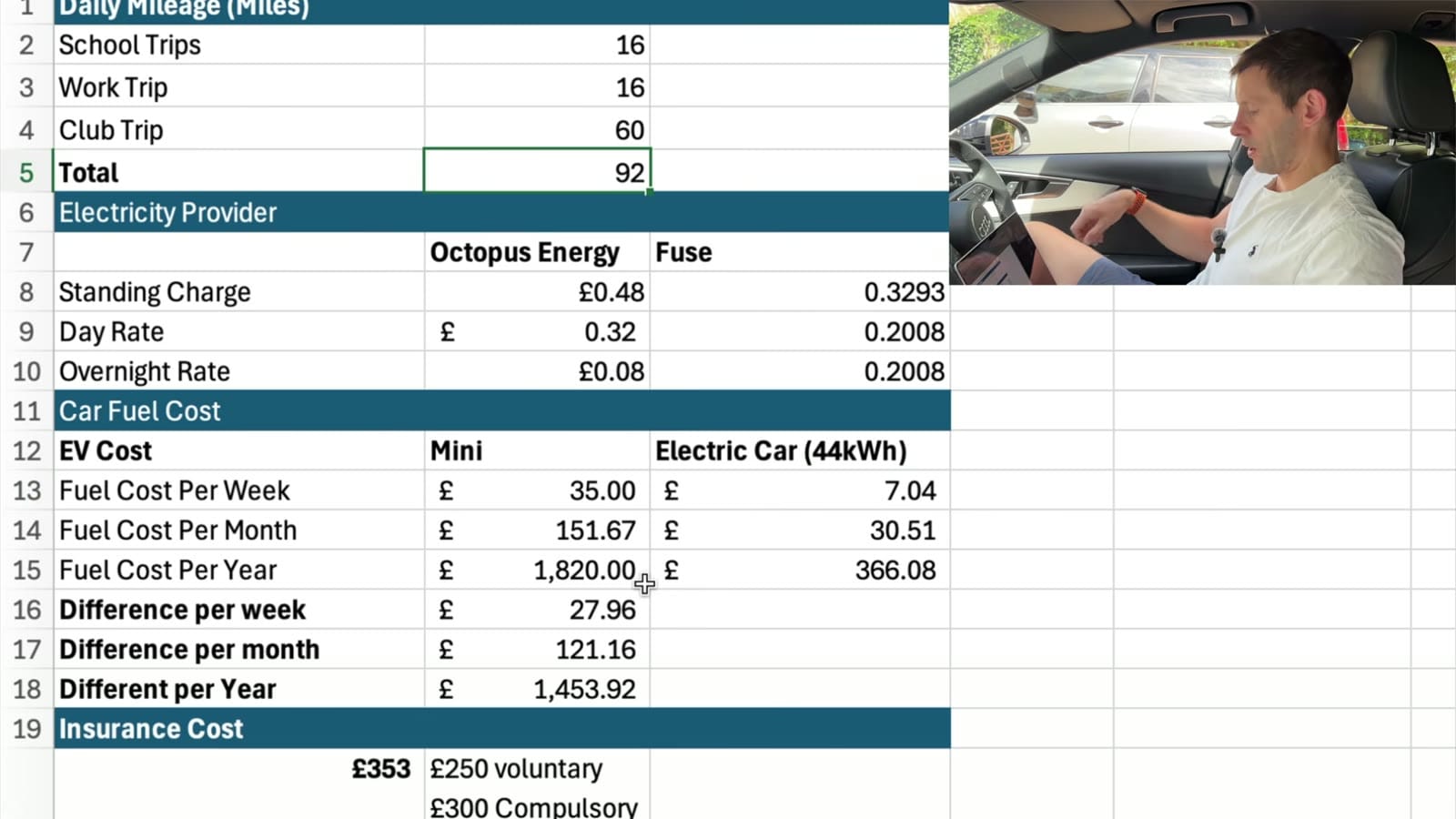
The winner’s profile is clear from the numbers. You come out ahead when you: (1) can install a home charger and charge overnight on a cheap rate, (2) drive 10,000 to 12,000 miles a year or more in that vehicle, and (3) buy used or lease rather than pay the new-car depreciation cliff. A second car used mainly for the school run, commuting, and errands — exactly the scenario in the video above — is close to the ideal EV use case, because the daily mileage is predictable and the car sits at home every night to charge.
For budget-minded buyers, models like the 2026 Hyundai Kona Electric show that a new EV can still land in affordable territory, while the slowest-selling EVs often carry the deepest discounts on dealer lots. The honest bottom line: an EV is worth it in 2026 for the right driver, but the savings are earned through home charging and high mileage — not assumed at the showroom door.
Is the $7,500 federal EV tax credit still available in 2026?
No. The federal clean-vehicle tax credit of up to $7,500 for new EVs expired on September 30, 2025, and the up-to-$4,000 credit for used EVs ended at the same time. As of mid-2026 there is no federal purchase incentive, so your EV business case has to stand on fuel, maintenance, and depreciation alone — which makes buying used and charging at home even more important.
Can I still save money with an EV if I can’t charge at home?
Usually not much. Public DC fast charging often costs 30 to 50 cents per kWh, which can push an EV’s per-mile cost close to or above a gas car’s. The big savings depend on cheap overnight home (or workplace) charging. If you rely entirely on public fast chargers, the fuel advantage shrinks dramatically and may disappear.
Are used EVs a better deal than new ones in 2026?
For most value-focused buyers, yes. The used-EV price premium over a comparable gas car has narrowed to roughly $1,000 (Cox Automotive / Kelley Blue Book, 2026), used prices have stabilized and even strengthened, and buying used skips the steepest years of depreciation. With the federal credits gone, a 2-to-4-year-old EV typically beats a brand-new one on total cost.
Sources: U.S. Energy Information Administration, Electric Power Monthly (residential electricity ~17.9¢/kWh, early 2026); AAA Your Driving Costs 2026 (EV vs ICE per-mile and total-cost findings; gasoline ~$3.80/gal mid-2026); Consumer Reports EV maintenance and reliability tracking (~$4,600 lifetime maintenance savings); Cox Automotive / Kelley Blue Book EV Market Monitor 2026 (used-EV premium ~$1,000; new-EV ATP ~$54,500; used wholesale prices up every month in 2026); U.S. DOE Alternative Fuels Data Center (EV efficiency ~30 kWh/100 mi); iSeeCars (post-credit used-EV price moves). Federal credit expiry dates per IRS / U.S. Treasury guidance (new and used clean-vehicle credits ended Sept. 30, 2025; 30C installer credit ended June 30, 2026).