Tesla published its 2026 Summer Update on July 21, and the headline is that the car can finally talk back: Grok can now place phone calls, open the glovebox, and run the climate system by voice. Here is what is actually shipping to US cars, what is held back by hardware or region, and what owners are still waiting on.
Grok stops being a chatbot and starts driving the car
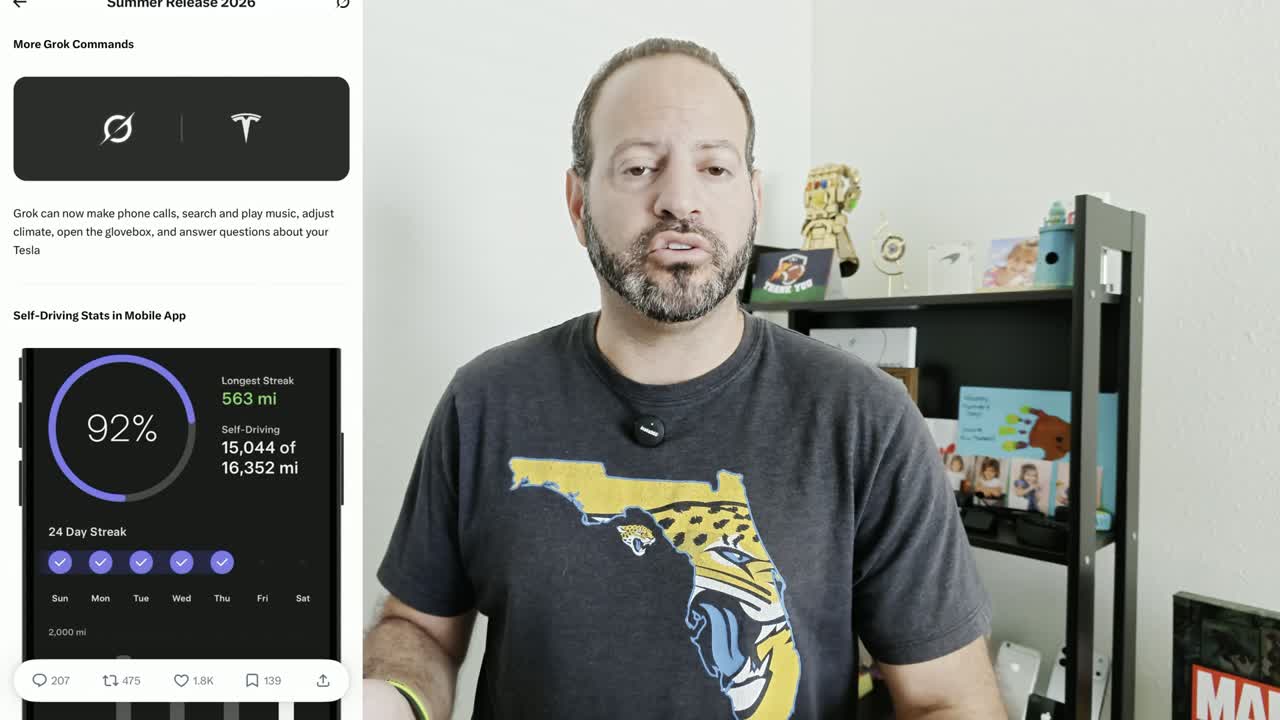
The single biggest change in this release is the expansion of Grok from a screen-based chatbot into a genuine voice controller. Per Tesla’s own release notes, Grok can now “make phone calls, search and play music, adjust climate, open the glovebox, and answer questions about your Tesla.” That closes a gap that has been open since Grok first appeared in Teslas in July 2025, when it was little more than a conversational assistant bolted onto the display. The “Hey Grok” wake word arrived in the Spring 2026 update, and this summer release pushes the assistant into actually operating the vehicle.
Electrek framed it bluntly: this is “the piece Grok was missing.” For US owners, it is the most immediately useful item on the list, because it works hands-free while driving. The catch is that it is region-gated. Grok is powered by xAI and is live in the US and a handful of markets, but it is not offered in China, where Tesla’s in-car assistant relies on different language models. So “More Grok Commands” is a US and select-market feature first, not a global one.

Your phone becomes the FSD scoreboard
Tesla is moving self-driving engagement data into the mobile app. Owners can now view and share FSD statistics, including a percentage of miles driven with FSD engaged, a running day-streak counter, a “longest streak” figure measured in miles, and monthly mileage. The example screenshots show Tesla leaning into gamification, giving owners an easy, shareable graphic of their own numbers.
This is tied to a Tesla app update (version 4.59), so US owners need to update their phone app before the stats appear. It is a small feature, but it matters because it reframes FSD as a habit to be tracked and compared rather than just a toggle. For buyers weighing the value of the subscription, our breakdown of what Tesla’s 2026 tech changes mean for EV buyers covers how the software ecosystem now drives purchase decisions as much as range does.
Navigation learns your actual commute
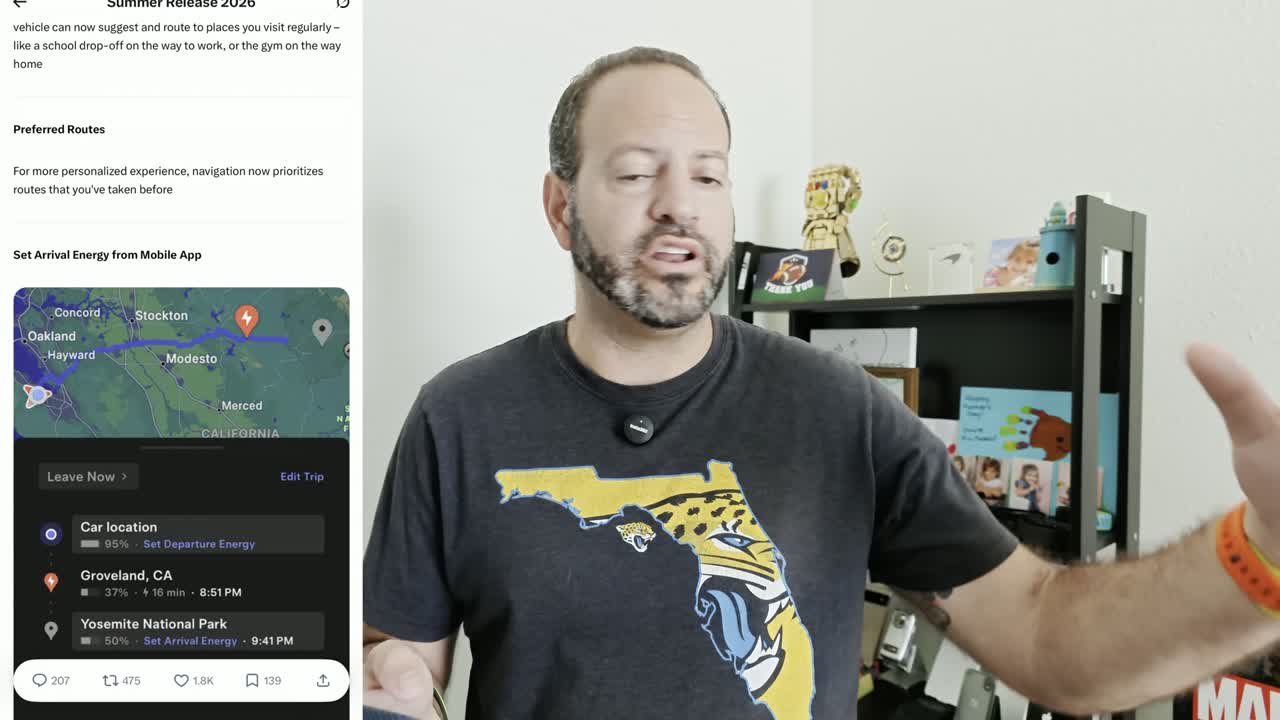
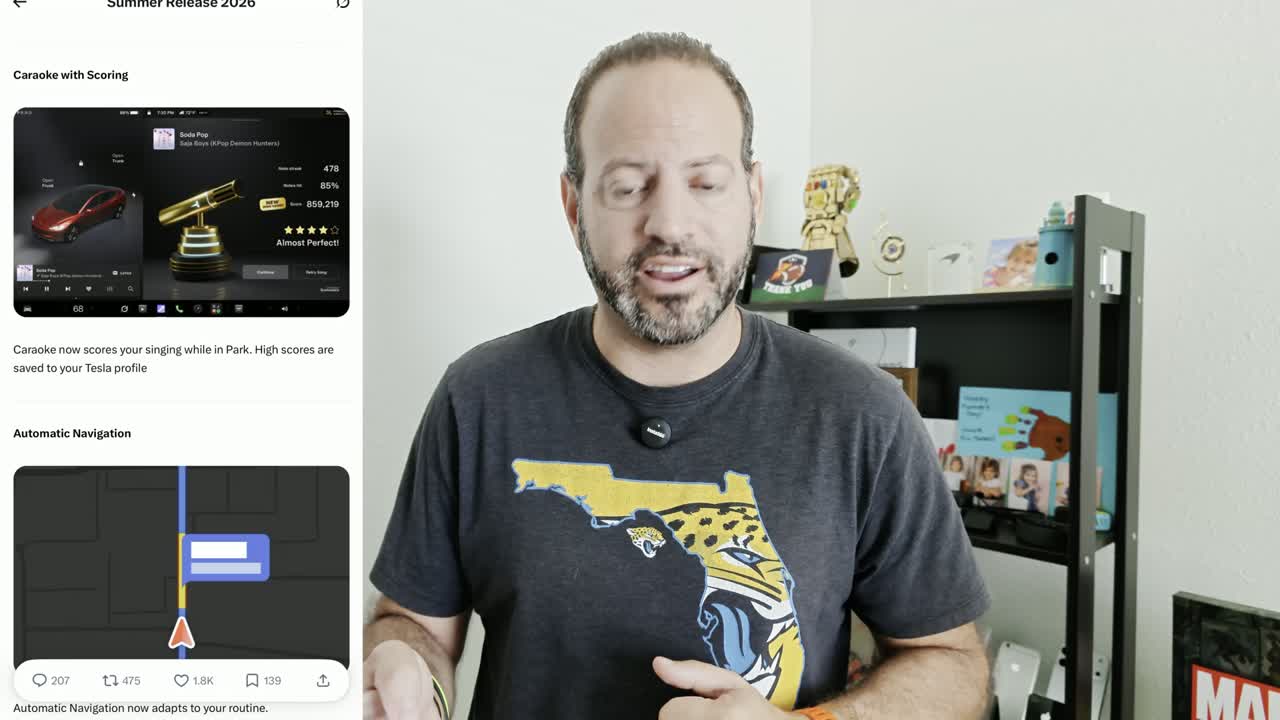
Two related routing upgrades ship in this release. Automatic Navigation now “adapts to your routine.” Beyond the long-standing Home, Work, and calendar-event predictions, the car can suggest and route to places you visit regularly, like a school drop-off on the way to work or the gym on the way home. Preferred Routes takes the same idea further: when more than one path exists, navigation now prioritizes roads you have personally taken before over the algorithm’s default fastest route.
This is the kind of change that sounds minor in a press release but quietly reshapes daily driving. It is available to US owners with navigation and an active Premium Connectivity plan, and it does not depend on vehicle hardware generation the way some other features do.
The smaller changes that owners will actually feel
The release is rounded out by a list of quality-of-life fixes that, collectively, may matter more than the headline features:
- Set Arrival Energy from the app — pick your desired battery percentage on arrival remotely, instead of only inside the car. Useful for planning Supercharger stops before you get in.
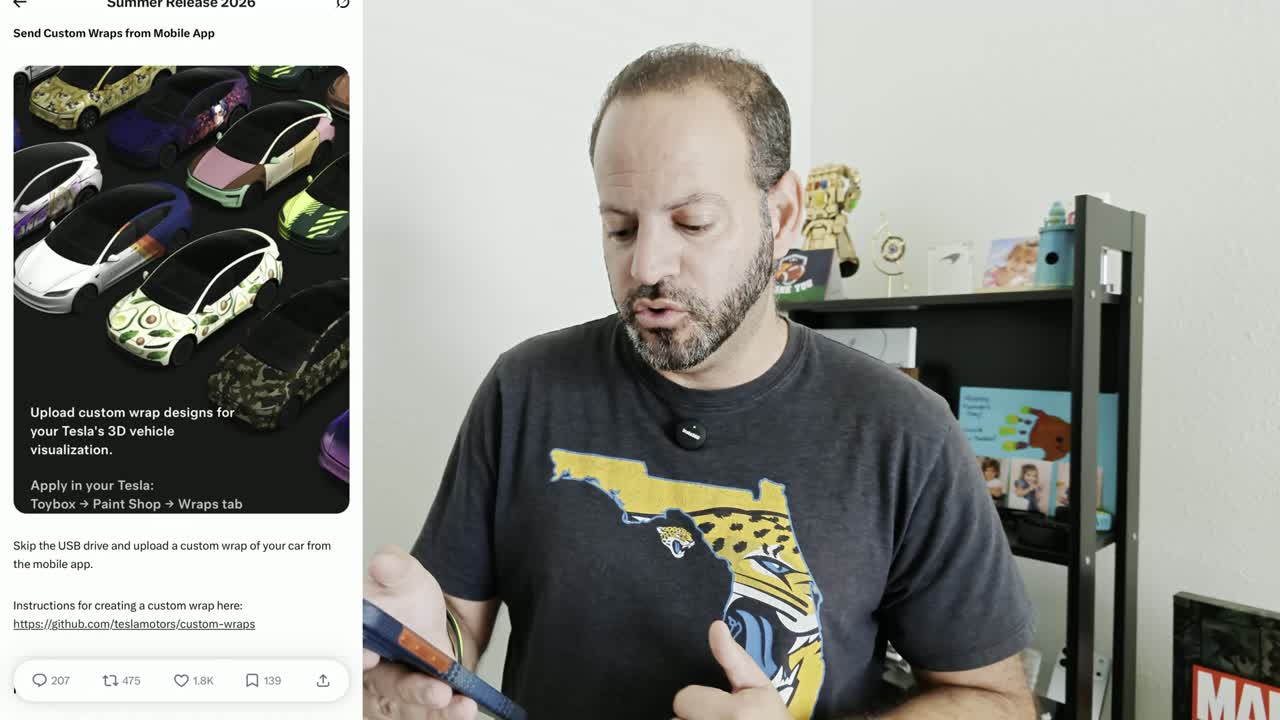
- Send custom wraps from the app — upload a custom 3D car render without a USB drive. Tesla maintains a public GitHub repository (github.com/teslamotors/custom-wraps) with templates; the wrap feature itself dates back to 2022.
- Caraoke with scoring — the built-in karaoke app now scores your singing while Parked and saves high scores to your profile. Caraoke has existed since the V10 update in 2019; this turns it into a game.
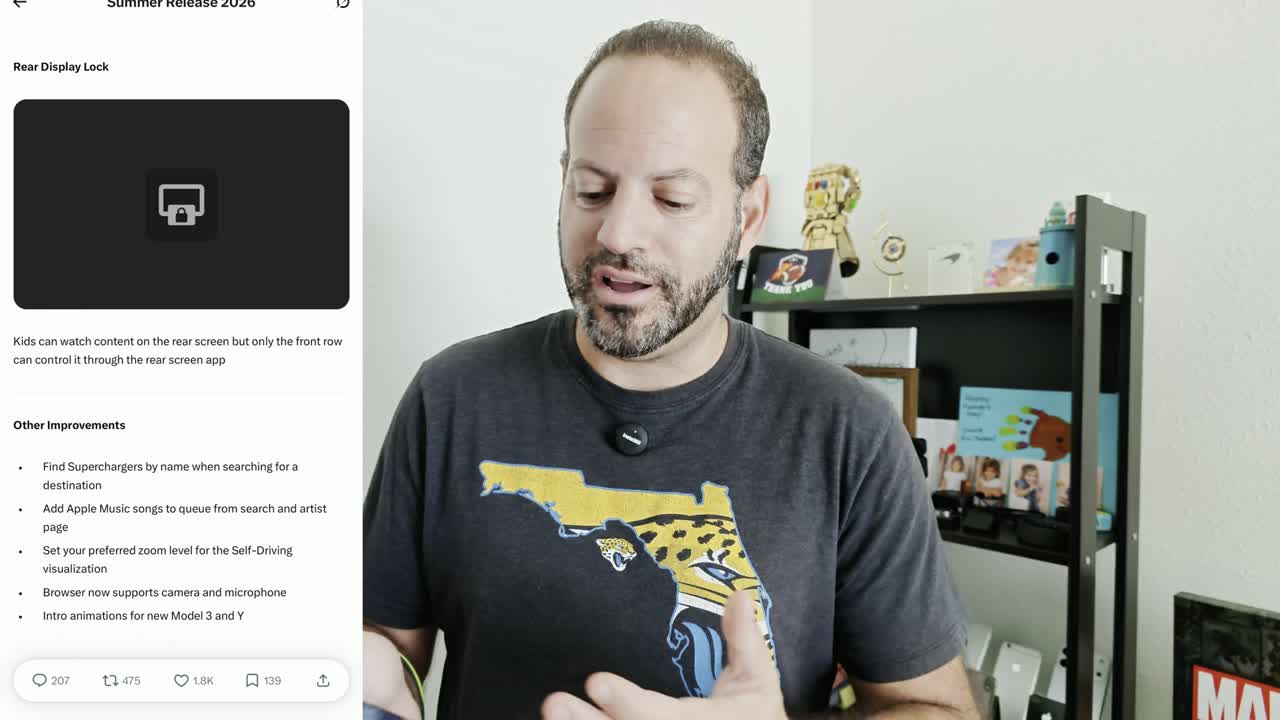
- Rear Display Lock — kids can watch the rear screen, but only the front row can control it through the rear display app. This is hardware-gated: it needs a rear screen, found on the new Model 3 (Highland), new Model Y (Juniper), Cybertruck, and Model S/X.
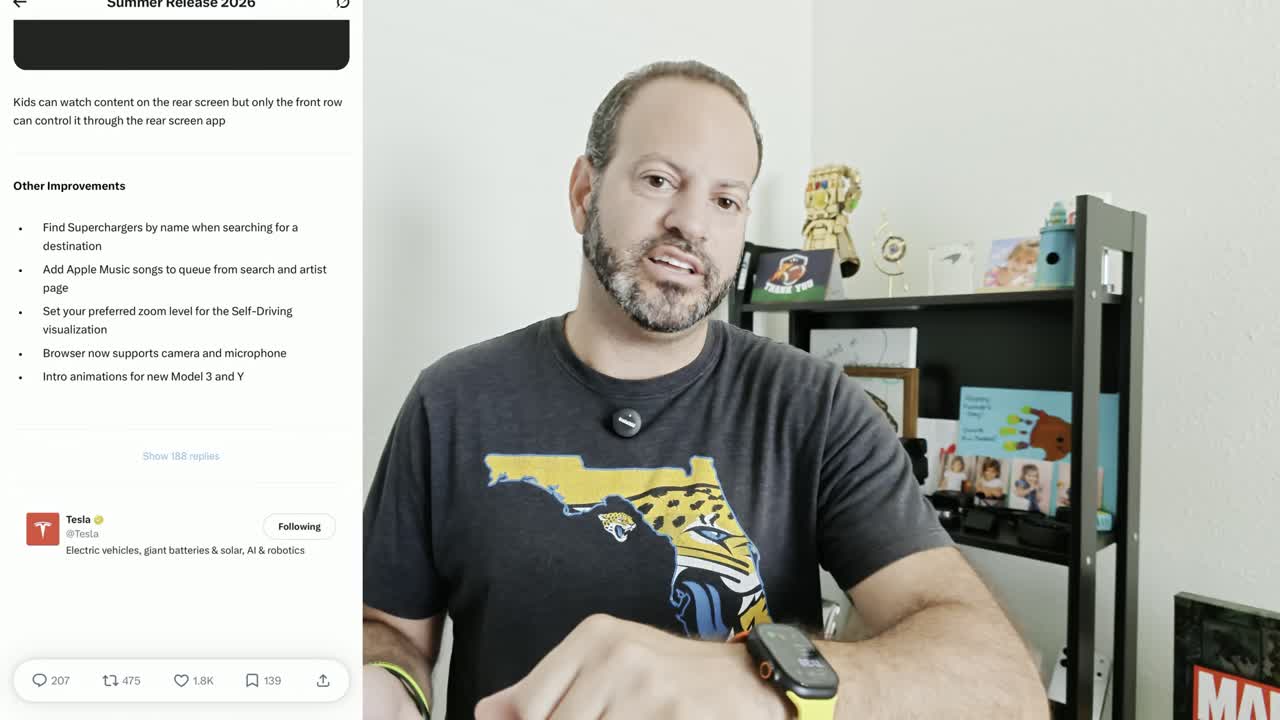
- Other tweaks — find Superchargers by venue name, add Apple Music songs to the queue from search and artist pages, set a preferred zoom level for the self-driving visualization, and a browser that now supports camera and microphone. New Model 3 and Model Y also get fresh startup animations.
What is US-only, what is hardware-locked, what is missing
The honest read, echoed by the source reviewer and by outlets like learnmyev, is that this is a normal point release aimed at daily usability rather than a leap in autonomy. To sort what US owners actually get, the gating breaks down like this:
| Feature | US rollout | What gates it |
|---|
| More Grok commands | Yes, in waves | Grok region (not China); connectivity |
| FSD stats in app | Yes | Tesla app v4.59 |
| Automatic / Preferred navigation | Yes | Nav + Premium Connectivity |
| Rear Display Lock | Yes | Rear screen (Highland, Juniper, Cybertruck, S/X) |
| Custom wraps from app | Yes | App update only |
| Browser camera & mic | Yes | Supported browser hardware |
What is not here is just as telling. There is no new FSD version number in this drop — no V14 bump, no expanded Robotaxi capability, no change to Autopilot behavior. FSD v14.3.3 shipped back in June 2026 as part of the Spring/2026.14.6.6 line and runs only on Hardware 4 (AI4) cars; older HW3 vehicles got a distilled “V14 Lite” build (2026.20.5.1) in late June. There is also no return of park assist, no AM radio addition, and — despite owner pleas — still no Apple CarPlay. Unsupervised FSD remains a Q4 2026 target at the earliest.
Daily-usability impact for most US owners
Grok availability outside the US
What it means for owners and buyers
For current US owners, this is a free, low-risk improvement that makes the cabin and the phone app more capable without changing how the car drives. The Grok controls and the navigation routine learning are the features most likely to be noticed on a Tuesday commute. The hardware-gated items — Rear Display Lock, browser camera/mic — are reminders that Tesla’s fleet is now fragmented by generation: a 2026 Juniper Model Y gets more of this update than a 2021 HW3 car.
For shoppers, the software gap between model years is becoming a real consideration. If you are deciding between a used older Tesla and a new one, our guide on whether to buy the 2026 Model Y or Model 3 now or wait lays out how much of the experience is determined by hardware you cannot upgrade later. And as Tesla keeps shipping software rather than hardware, the company’s ability to monetize and retain owners through updates will be central to the numbers investors watch — context we cover in our Q2 2026 earnings preview.
When will my US Tesla actually get the 2026 Summer Update?
Tesla rolls software out in waves rather than all at once, so the exact date depends on your vehicle, region, and firmware branch. US cars typically see new releases within days to a few weeks of the July 21 announcement. Check Controls > Software on the touchscreen while connected to Wi-Fi; if nothing is listed, it is still staged for your car.
Do I need a subscription for any of these features?
Grok and the navigation features need an active data connection; some depend on Premium Connectivity for full functionality. FSD stats in the app reflect the FSD Supervised subscription if you have one, but the app feature itself is part of the update. The custom-wrap and Caraoke features are free.
Is the $7,500 federal EV tax credit relevant to this update?
Not directly — this is a software release, not a purchase incentive. But note the federal clean-vehicle credit expired on September 30, 2025, so US buyers no longer receive it on a new Tesla. Software value is now a bigger part of the ownership case.
Sources: Tesla 2026 Summer Update release notes (published on X, July 21, 2026); Electrek, “Tesla’s 2026 Summer Update: auto navigation, Grok phone calls, Caraoke scoring, and more” (July 21, 2026); TeslaNorth, “Tesla Unveils 2026 Summer Software Update With Major AI Upgrades” (July 21, 2026); Teslarati and learnmyev.com release-note roundups (July 21, 2026); update-version tracking reporting the build as 2026.26. FSD v14.3.3 / HW3 “V14 Lite” (2026.20.5.1) context from Tesla Autopilot software update logs and Tesla AI/Autopilot communications, June 2026.