China Replaced Its Entire Power Grid in 10 Years — Why America’s EV Charging Future Depends on the Same Infrastructure Fix
June 15th, 2026
By EVCUBE .NET
No Comments
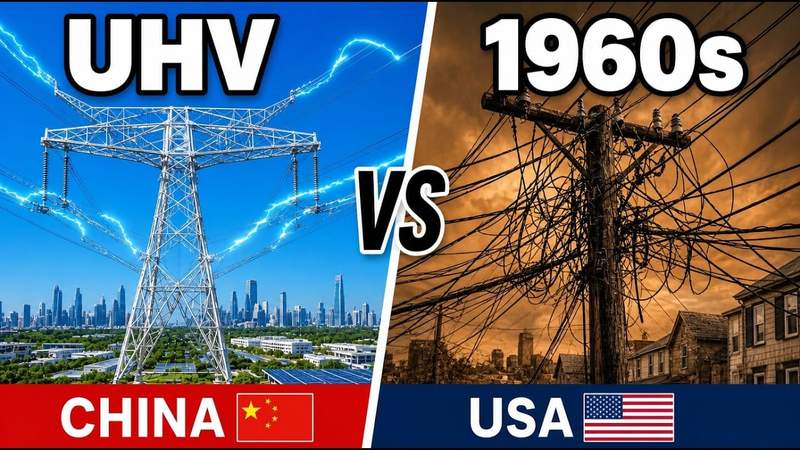
The United States invented ultra-high-voltage power transmission inside its own laboratories. Then it walked away. China took that same technology and in 11 years built 34 long-distance corridors that now move electricity 3,000 kilometers with less loss than New York City experiences moving power across its own five boroughs. For anyone building or investing in EV charging stations, this infrastructure gap is not an abstract engineering footnote—it is the single biggest constraint on how fast America can deploy charging where it is needed most.
Video: Project Scale — A deep engineering breakdown of China’s UHVDC grid transformation and what it means for the global energy transition.
The Grid Gap Is the EV Charging Gap
When you plug a Level 2 EV charger into a wall socket in Los Angeles or a 50A EV charger in a suburban garage, the electricity travels less than 200 kilometers to reach you. That distance has stayed roughly constant for 60 years—not because engineers stopped trying, but because the financial and regulatory machinery required to extend the grid never moved.
China faced the same problem at a scale that had no existing solution. In 2002, rolling blackouts hit 400 million people across eastern China. The coal reserves that could fix the crisis sat 2,000 kilometers away in Xinjiang. The megacities that needed the power—Shanghai, Shenzhen, Guangzhou—sat on the eastern coast. The only way to move that energy was to dig coal out of the ground, load it onto diesel trains, and ship it east. By 2005, the sheer volume of coal moving across China was strangling the national rail network. Transporting the fuel was consuming the fuel.
The answer was not incremental. It was a direct jump from 500 kV alternating current to 1.1 million volt direct current—a technology so extreme that the IEEE classified it as an entirely new category of power engineering requiring its own operational standards.
China’s modern grid infrastructure—purpose-built for moving gigawatts across continental distances at minimal loss.
Three Numbers That Define the Divide
Metric
China (UHVDC)
United States
Highest transmission voltage
1,100,000 V (UHVDC)
500,000 V (AC, 1960s standard)
Longest single line
3,284 km (Changji–Guquan)
~1,300 km (proposed SunZia, 525 kV)
New HV transmission built (2021)
16,000 miles
11 miles
Commercial UHVDC lines (≥800 kV)
34 corridors
0
Grid infrastructure spend (2009–2020)
$100 billion
Underfunded (ASCE grade: D+)
Renewable capacity added (2023 alone)
More than France’s entire installed base
Constrained by transmission limits
Time to permit + build 1,100 kV line
~6 years
17+ years (estimated for 525 kV)
Side-by-side comparison of China vs US power grid infrastructure—directly relevant to the buildout of public EV charging stations.
Why This Matters for Every EV Charger Installed Today
The connection between ultra-high-voltage transmission and your home 48A EV charger may not be obvious, but it is structurally decisive. Here is why:
EV charging loads are massive and concentrated. A single DC fast charger can draw 350 kW—roughly the same peak demand as 300 homes. When 10 or 20 such chargers cluster at a highway rest stop, the local substation cannot handle it without upstream grid upgrades. Those upgrades require high-voltage transmission capacity that the current US network does not have in the places where charging demand is growing fastest.
Renewable generation is stranded without transmission. America’s best wind resources sit in the Great Plains. Its best solar sits in the Mojave Desert and the Southwest. Its EV drivers sit in Los Angeles, Chicago, and New York. Without a high-voltage overlay network, renewable electrons cannot reach the chargers that need them, forcing charging stations to draw from fossil-heavy local grids.
The structural constraint is regulatory, not technical. A single 1,300 km transmission line in the US crosses 8–12 separate state and federal jurisdictions. Each requires independent environmental review, right-of-way negotiation, and public comment periods—running sequentially, not in parallel. China’s centralized authority completes the equivalent in 24–36 months. The EV pile that needs grid capacity in 2026 is waiting on decisions that were supposed to be made in 2016.
The US grid operates on architecture designed in the 1960s. Alternating current at existing voltage levels makes 1,500 km energy delivery prohibitively lossy, directly limiting where new EV charging stations can be economically built.
The Engineering Inside a UHVDC Converter Station
Standing inside the rectifier hall of the Changji converter station in Xinjiang—the origin of the world’s highest-voltage commercial power line—is a sensory experience that redefines what “power infrastructure” means. The hall is the physical size of a 12-story building laid horizontally on its side. The air smells faintly of ionized atmosphere. What you hear is a single 120 Hz harmonic hum from switching equipment operating in unison.
Suspended from the ceiling on insulating rods, thyristor valve modules are stacked to the height of two city buses. They cannot touch the ground. At 1,100,000 volts, contact with the earth would instantly vaporize the concrete beneath them. The air inside is scrubbed to a dust tolerance of 0.001%—because a single conductive particle near an active thyristor can trigger an arc flash violent enough to destroy the entire module. The internal cooling matrix pumps 3,000 gallons of deionized water per minute just to prevent the solid-state electronics from melting under their own thermal load.
This is not future infrastructure. It is operational today, delivering 12 GW of continuous power across 3,284 km—enough to simultaneously power every residential home, commercial skyscraper, and street lamp in both New York City and Chicago.
The transmission infrastructure gap and the energy transition gap are the same gap. Without a UHVDC overlay, the US cannot efficiently integrate remote renewables to power its growing fleet of EV charging stations.
What This Means for US EV Charging Deployment
The National Electric Vehicle Infrastructure (NEVI) program has allocated $5 billion for EV charger buildout along US highways. But the chargers themselves are only half the equation. Every NEVI-compliant station requires a grid interconnection study, often taking 12–18 months, followed by transformer lead times, substation upgrades, and utility coordination. None of these steps address the fundamental lack of high-voltage transmission capacity that limits how much new load can be added at highway exit points.
The structural reality is that the same regulatory and jurisdictional fragmentation that prevents the US from building high-voltage transmission lines also slows the deployment of Level 2 EV charger infrastructure in multi-unit dwellings, the permitting of 50A EV charger installations at commercial properties, and the siting of public EV charging stations at scale.
As one transmission engineer quoted in the video notes: “The gap is not technological. It is structural. One system was designed to move quickly on infrastructure decisions. The other was designed with multiple checkpoints that slow those decisions down.”
EV charging demands high current over extended periods. A single DC fast charger can draw 350 kW—equivalent to 300 homes. Without sufficient high-voltage transmission capacity, stations face interconnection delays, high upgrade costs, and limited throughput.
What is UHVDC and how is it different from normal power lines?
Ultra-high-voltage direct current transmits electricity at 800,000 to 1,100,000 volts using DC instead of AC. DC eliminates long-distance electromagnetic losses—China’s lines lose only 5% over 3,000 km vs up to 40% for AC at standard voltages.
How much faster can China build grid infrastructure than the US?
China built 16,000 miles of high-voltage transmission in 2021 alone; the US built 11 miles. A 3,284 km UHVDC line went from approval to operation in under 6 years. A comparable US line at half the voltage takes 17+ years due to regulatory fragmentation.
Does my home Level 2 EV charger depend on the high-voltage grid?
Indirectly, yes. Your Level 2 or 48A EV charger connects to the local distribution grid, which depends on high-voltage transmission. As EV adoption grows, local substations need upstream upgrades. Regions with weak transmission links will see higher charging rates.
How does the US grid affect Level 2 EV charger installation costs?
Home Level 2 EV charger installation costs $500–$2,000 normally, but areas with outdated grid infrastructure may face $2,000–$5,000+ in utility-side upgrades like transformer replacements, making site selection critical for cost-effective charging deployment.
Can the US catch up in grid modernization?
Several initiatives are underway including GRIP and FERC Order 1920, but none have produced a single UHVDC-class line. The Inflation Reduction Act includes transmission tax credits, but regulatory timelines remain the binding constraint. Federal transmission siting authority is widely seen as the key.
What is the single biggest barrier to US grid modernization?
Regulatory jurisdiction fragmentation. A 1,300 km transmission line crosses 8–12 jurisdictions, each with independent environmental review and public comment periods running sequentially. China completes equivalent scope in 24–36 months through centralized authority.
What is the Changji–Guquan UHVDC line?
The world’s highest-voltage commercial power line: 1,100,000 volts DC over 3,284 km from Xinjiang to Anhui, China. It delivers 12 GW of continuous power—enough for New York City and Chicago combined—built in under 6 years from approval to operation.
Discover the most attractive leasing and financing options for electric vehicles (EVs) this November 2024. Whether you’re looking to lease or finance, there are some excellent deals available that cater…